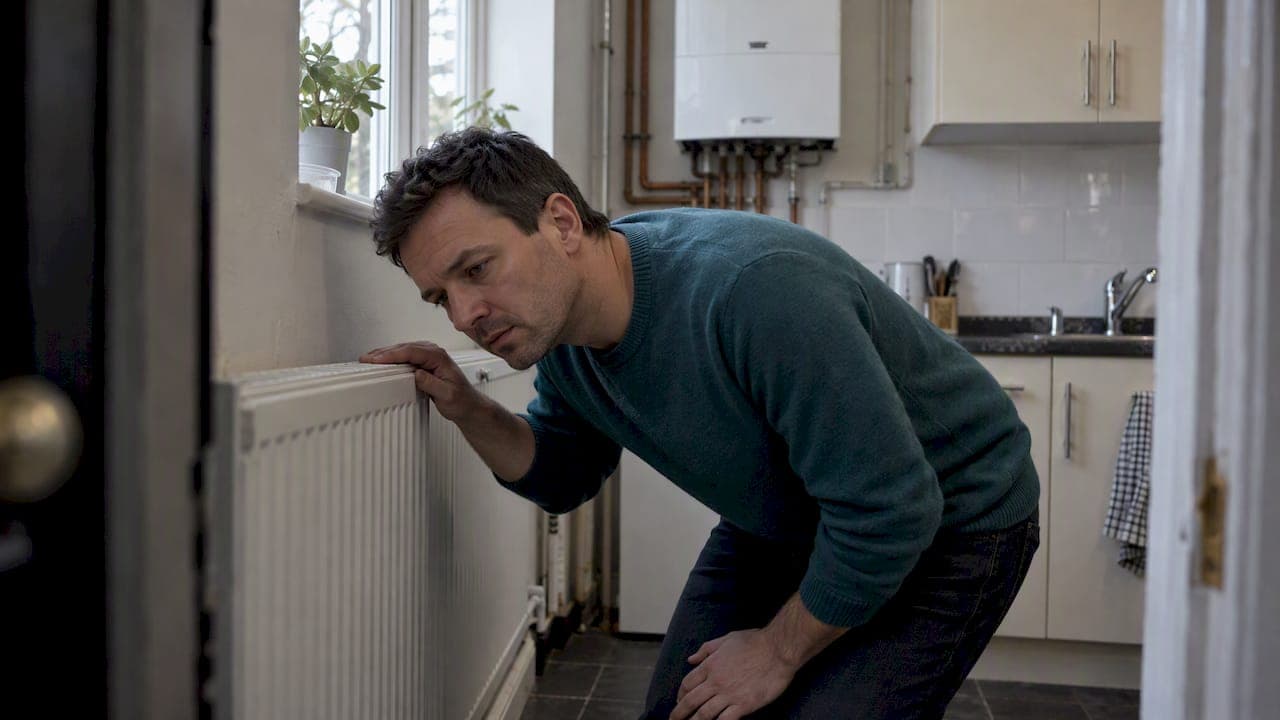
A gurgling boiler is usually telling you one of three things: air is trapped in the heating system, the condensate pipe is blocked or frozen, or the pressure has dropped. Air and pressure are often safe for you to deal with. A frozen condensate pipe can be too, if you do it carefully. Anything that involves the gas side, the flue or the inside of the boiler casing belongs to a Gas Safe registered engineer.
This guide explains what each sound means, what you can check in ten minutes, and how to tell a harmless gurgle from one that needs an engineer today. It also covers kettling, the rumbling, kettle-like noise people often confuse with gurgling.
TL;DR
- Gurgling most often means air trapped in the radiators or pipework. Bleeding the radiators and topping up the pressure fixes it in many homes.
- If the boiler gurgles and then shuts down in freezing weather, suspect a frozen condensate pipe. Thaw it with warm water, never boiling.
- Kettling (a rumbling, popping sound like a kettle about to boil) is a different problem, usually linked to scale, sludge or restricted flow, and needs an engineer.
- Never open the boiler casing or touch the flue yourself. If you smell gas or suspect carbon monoxide, turn the appliance off and call a Gas Safe engineer.
- We can send an engineer for boiler diagnostics at £110 per hour, with no call-out fee and no fix, no fee.
Table of Contents
- What a gurgling boiler is actually telling you
- Quick diagnosis: match the noise to the likely cause
- Cause 1: air trapped in the heating system
- Cause 2: a frozen or blocked condensate pipe
- Cause 3: low pressure or a circulation fault
- Boiler kettling: the other noise people search for
- When a gurgle is a safety issue
- What we would do first: a ten-minute checklist
- Our view: why we treat gurgling as information, not an emergency
- What it costs to get a gurgling boiler looked at
- When to get an engineer
- FAQ
- Sources
What a gurgling boiler is actually telling you
Gurgling is the sound of water and air (or water and a partial blockage) moving where they shouldn't. Think of the noise a bath makes as the last of the water drains. In a heating system, that usually comes from one of four places:
- Radiators and pipework, where air pockets mix with circulating water.
- The condensate pipe, which carries acidic waste water from a condensing boiler to a drain.
- The sealed system itself, where low pressure lets air in or stops water circulating properly.
- The pump or heat exchanger, where something is restricting flow.
The first three are the common ones. The fourth is where an engineer earns their fee.
The clues that separate them are simple: when the noise happens, where you hear it, and what else the boiler does at the same time. Work through those three questions before you touch anything.
Quick diagnosis: match the noise to the likely cause
| What you notice | Most likely cause | Safe to try yourself? |
|---|---|---|
| Gurgling from radiators, top of radiator cool, bottom warm | Trapped air | Yes: bleed the radiator |
| Gurgling after bleeding, boiler won't fire | Pressure now too low | Yes: re-pressurise as your manual describes |
| Gurgling from the boiler, then shutdown in a cold snap | Frozen condensate pipe | Yes, with care, if the pipe is reachable at ground level |
| Gurgling plus radiators cold in places despite bleeding | Sludge, a failing pump or a circulation fault | No: engineer |
| Rumbling or popping that gets louder as water heats | Kettling: scale, sludge or restricted flow | No: engineer |
| Gurgling with a smell of gas, soot marks or a yellow flame | Combustion or flue problem | No: turn off, call Gas Safe |
Cause 1: air trapped in the heating system
This is the most common reason. Which? explains that gurgling from radiators or the system often points to trapped air, and that a radiator that is cool at the top but warm at the bottom usually confirms it.
Air builds up for ordinary reasons: a small amount comes out of the water as it heats, new radiators or recent work let more in, and a system that has lost pressure draws it in. Left alone, it makes the house colder and the bills higher. The Energy Saving Trust notes that trapped air makes radiators less effective, which tempts people to turn the heating up.
How to bleed a radiator
Which? gives the sequence in full. In short:
- Turn the heating off and wait 20 to 30 minutes for the radiators to cool.
- Hold a cloth under the bleed valve at the top corner of the radiator.
- Turn the bleed key a quarter turn anticlockwise. You will hear a hiss as air escapes.
- Close the valve as soon as water starts to appear.
- Repeat on each radiator, starting with the one nearest the boiler on the ground floor and working upwards.
A radiator key typically costs around £3 from a DIY shop, according to the same Which? guide. If you want a longer walkthrough, our own pieces on a ten minute radiator bleed and radiator bleeding best practice go through the common mistakes.
Do not skip the pressure check afterwards
This is where many people turn a small noise into a no-heat call. Bleeding releases air, and the water that was holding the system at pressure goes with it. On a combi or other sealed system, check the gauge afterwards. Which? says it should sit between 1.0 and 2.0 bar, typically in the green zone, and that failing to top it up can stop the boiler firing. Your boiler's manual shows how to use the filling loop. If you can't find it or the pressure keeps falling, there is probably a leak or a failed expansion vessel, and that is an engineer's job.

Cause 2: a frozen or blocked condensate pipe
A condensing boiler produces acidic waste water, and the condensate pipe carries it away. Which? reports that if a boiler gurgles and shuts down in freezing weather, a frozen condensate pipe is a strong suspect, because the blocked pipe stops the boiler operating.
The pattern is distinctive. The boiler worked yesterday. Overnight temperatures dropped below freezing. This morning there is a gurgling or bubbling sound from the boiler, then it locks out. The pipe is usually the plastic one running outside the house to a drain or soakaway, and the freeze tends to occur where it is exposed, long or poorly sloped.

Thawing it safely
The Which? advice, dated December 2023, is to find the pipe and thaw it with warm water, not boiling. The same guidance says that if you are unsure which pipe to disconnect or how to do it safely, you should consult a qualified heating engineer. We agree with that without reservation. In practice:
- Only work on a pipe you can reach from the ground. Never climb a ladder to a pipe at height with a kettle in your hand.
- Use a warm water pour or a warm cloth, not boiling water, which can crack the plastic.
- Reset the boiler once, following the manual. If it locks out again, stop and call.
- Don't touch anything inside the boiler.
We have written this up in more detail: why you shouldn't thaw above head height, a six-step approach to a blocked condensate pipe, and a general guide to thawing frozen pipes and when to call an approved plumber.
If the pipe thaws but the gurgle returns each cold night, the pipe needs re-routing or insulating. That is a quick job for an engineer and cheaper than repeated winter breakdowns.
Cause 3: low pressure or a circulation fault
The Energy Saving Trust points out that your boiler's pressure dial or digital display is the first thing to look at, and that the ideal reading is roughly 1 to 1.5 bar on most systems. Check what your own manual says, as models differ. Low pressure on its own can cause gurgling because the water isn't pushed round the system properly and air collects.
If you re-pressurise and the reading falls again within days, something is losing water. Look for drips under the boiler, damp patches near radiator valves and stained pipework. A slow leak can be hard to trace, and leak detection is a job we do routinely.
If pressure is fine, radiators are warm at the top, and the gurgle persists, the cause may be a failing pump, a stuck diverter valve or a partial blockage. Forum threads on this topic often reach the same conclusion: something is stopping the water circulating, and that needs testing, not guessing.
Boiler kettling: the other noise people search for
Many readers arrive here after hearing something that is not quite gurgling: a rumble, tick or pop, like a kettle heating up. That is kettling. It is not trapped air, so bleeding radiators won't cure it.
Kettling happens when water in the boiler's heat exchanger gets locally too hot and forms small pockets of steam. The usual reasons are:
- Limescale on the heat exchanger, more likely in hard water areas.
- Sludge or debris from corroded radiators and pipework restricting flow.
- Poor circulation, from a faulty pump, a closed valve or a thermostat set wrongly.
We would not give a fixed list of home remedies here, because the fix depends on which of those it is. Typically an engineer will test flow and temperature, then recommend a system flush, a magnetic filter or a component repair. The honest advice is: if the noise is a rumble that gets louder as the boiler heats, don't run it for weeks hoping it goes away. Scale and overheating can shorten the life of the heat exchanger, which is the most expensive part of the boiler.
When a gurgle is a safety issue
Most gurgling is a nuisance, not a danger. But some situations are different, and the rule is the same for each: stop using the appliance and call a Gas Safe registered engineer.
The HSE's guidance for homeowners says it is illegal to use a gas appliance if you suspect it is unsafe. Turn it off and don't touch it until a Gas Safe registered engineer has checked it. Warning signs include:
- A smell of gas, or the national gas emergency line is needed.
- Soot or brown staining on or around the boiler.
- A yellow or orange flame instead of a crisp blue one.
- Headaches, nausea or dizziness when the heating is on.
- A carbon monoxide alarm sounding.
Carbon monoxide has no smell or taste, which is why the HSE stresses annual servicing of gas appliances and their flues by a registered engineer. Do not check or repair a flue yourself. The HSE also warns about flues running through concealed voids without inspection hatches: where an engineer can't verify the flue, they should advise you the installation is at risk and, with your permission, turn it off. If your boiler is older or the property has been altered, it is worth asking at the next visit whether such hatches exist.
If you suspect carbon monoxide, open windows, leave the property and call the gas emergency number, 0800 111 999, before anyone goes back in.
What we would do first: a ten-minute checklist
- Listen and note. Does it gurgle on heating, hot water or both? At start-up or all the time?
- Check the display. Any fault code? Write it down.
- Check the pressure gauge. Is it between 1 and 2 bar? If not, top it up per the manual.
- Feel the radiators. Cool at the top, warm at the bottom means air. Cold at the bottom and warm at the top suggests sludge.
- Go outside if it is freezing. Look for a frozen condensate pipe at ground level.
- Bleed the affected radiators and recheck the pressure.
- Reset once, if the manual allows it. Not repeatedly.
- Still noisy? Stop and book an engineer.
Our view: why we treat gurgling as information, not an emergency
We see the same pattern across the homes we work in. Someone hears a gurgle, assumes the boiler is dying, and either panics or ignores it for a year. Neither helps. A gurgle is a symptom, and nine times in ten it is cheaper to find the cause than to worry about it.
Our approach is to find out what the noise is before recommending any work. That means pressure, flow, condensate route and radiator behaviour first, and only then the boiler itself. If the fix is a bleed key and a top-up, we will say so. If it is a pump or a heat exchanger, we will explain what we found and quote before starting. You deal directly with the engineer who attends, and payment comes after the job is done and the problem is solved.
One piece of advice we would give every homeowner: don't wait for a noise to book a boiler service. A service is the cheapest point at which a blocked trap, low pressure or a failing pump gets noticed. If you want to understand what happens during one, our guides on servicing a gas boiler safely and why servicing matters lay it out.
— Michael
What it costs to get a gurgling boiler looked at
Do the free checks first. If you need an engineer, here is how our pricing works.
- Boiler and heating diagnostics and repair are charged at £110 per hour.
- There is no call-out fee, and we operate a no fix, no fee guarantee, with payment only after successful work.
- Repairs carry a 12-month warranty.
- A new boiler supplied and fitted starts from £1,300 one-off, after a free on-site quote.
For context on the wider market, the Energy Saving Trust says a one-off gas boiler service typically costs £80 to £120 and takes 40 to 90 minutes. Repairs are quoted separately, and the same page cites an average repair cost of around £156 from 2025 survey data. It also suggests getting at least three quotes for boiler work. That is reasonable advice, and our own breakdown of how to avoid emergency markups on central heating repairs explains what to ask any engineer.
If the engineer tells you the boiler is beyond sensible repair, you don't have to decide on the spot. Ask for the diagnosis in writing and compare it with a quote for replacement.
When to get an engineer
Call us if:
- the gurgle returns after bleeding and re-pressurising;
- pressure keeps dropping;
- the condensate pipe is frozen but you can't safely reach it, or it freezes repeatedly;
- the boiler is kettling;
- the boiler won't fire (our guide to why a boiler won't ignite covers the main reasons);
- you have any safety concern at all.
We cover homes and businesses across Reading, Newbury, Oxford, Abingdon, Bracknell, Windsor, Basingstoke, Bristol, Swindon and the surrounding towns. If the boiler has stopped working or you are worried about safety, book an emergency heating engineer with a 60 minute response time, available 24/7 including holidays. For non-urgent investigation, book a plumbing or heating visit. If the diagnosis points to replacement, request a new boiler quote. Over 300 Trustatrader reviews are there for you to read before you decide.
FAQ
Is it normal for a boiler to make a gurgling or bubbling noise?
An occasional soft bubble when the heating starts is usually just air moving through the system. Persistent or loud gurgling is not normal. It generally means trapped air, low pressure or a condensate problem that is worth checking.
Can I fix a gurgling boiler myself?
Sometimes. Bleeding radiators, checking pressure and gently thawing a frozen condensate pipe at ground level are reasonable homeowner tasks. Opening the boiler, adjusting gas settings or touching the flue is not, and should only be done by a Gas Safe registered engineer.
What causes boiler kettling and how do I fix it?
Kettling is usually caused by limescale, sludge or poor water flow around the heat exchanger, which makes water overheat and form steam pockets. It can't be cured by bleeding radiators. An engineer needs to test the system and may recommend a flush, a filter or a repair to the pump or thermostat.
Why does my boiler gurgle only in cold weather?
The most likely reason is a frozen condensate pipe, which blocks waste water and stops the boiler firing. Thaw it with warm, not boiling, water if you can reach it safely. If it keeps freezing, the pipe run needs changing or insulating.
Is a gurgling boiler dangerous?
Usually not, but it can be when combined with a gas smell, soot, a yellow flame or symptoms such as headaches and dizziness. In that case turn the boiler off, ventilate the property and call a Gas Safe registered engineer, or the gas emergency line on 0800 111 999 if you smell gas.
Sources
- Which?: How to bleed a radiator, step by step
- Which?: How to keep your boiler working in cold weather
- Energy Saving Trust: Eight quick DIY jobs to save energy
- Energy Saving Trust: Boiler services explained
- HSE: Gas safety for home owners
- HSE: Gas boilers, flues in voids