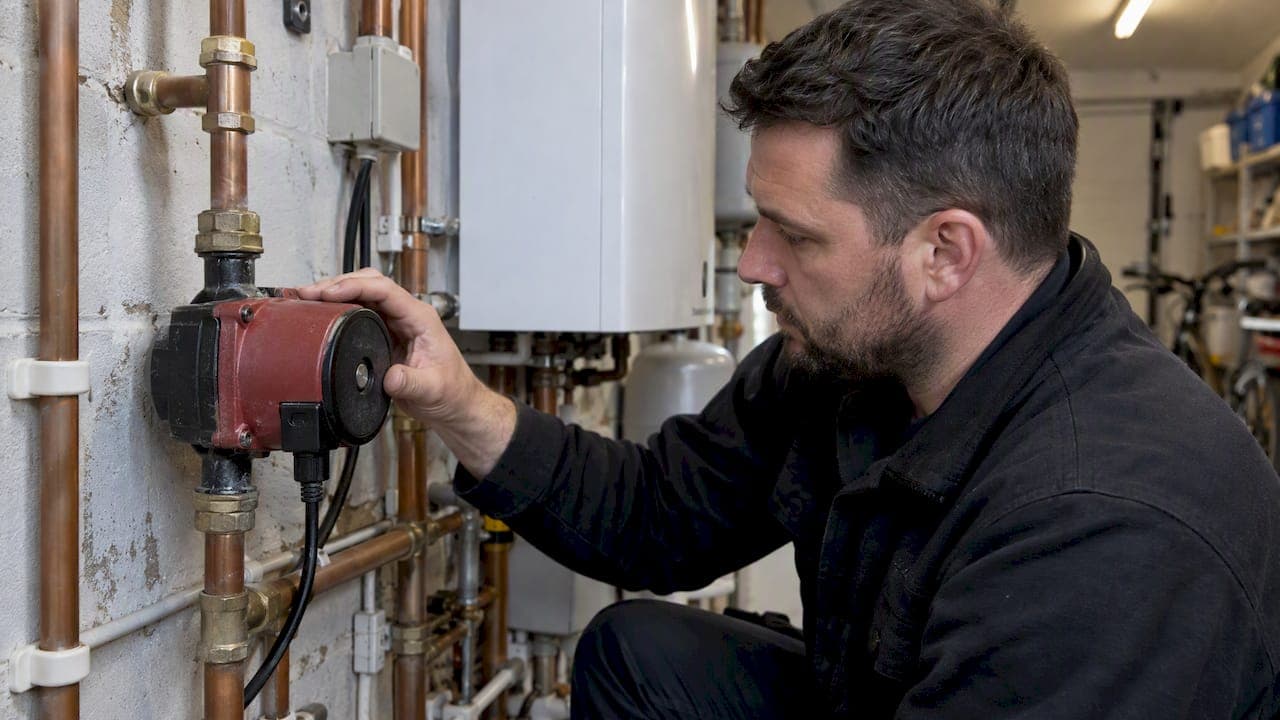
A noisy central heating pump is usually telling you one of four things: there is air in the system, the pump speed is set too high, sludge is dragging on the impeller, or the bearings are wearing out. Gurgling and a faint hum are often simple to cure. Grinding, banging or a pump casing too hot to touch means the pump needs a qualified heating engineer, not another weekend of guessing.
This guide helps you work out which noise you have, what you can safely try, and when to stop. It is written for UK homeowners with a standard wet central heating system: a boiler, a circulating pump and radiators.
TL;DR
- Gurgling, bubbling or a rushing sound usually means trapped air. Bleeding the radiators is the first and safest thing to try.
- A steady hum or whine can mean the pump speed is set higher than the system needs, or that the bearings are tiring.
- Grinding, scraping or banging is not a DIY job. Switch the heating off and book an engineer before the pump seizes or damages the system.
- Turning the pump up to cure cold radiators is a common mistake. Balancing the radiators is the proper fix.
- Sounds from a heat pump outdoor unit are a different matter, covered near the end.
Table of Contents
- First, check it is actually the pump
- What each noise usually means
- Gurgling and bubbling: trapped air
- Humming and whining: speed setting and wear
- Banging, knocking and grinding: stop and call
- Is it a shower pump instead?
- What a repair visit involves
- Our view: fix the system, not just the sound
- Need an engineer to look at the pump?
- What if it is a heat pump that is noisy?
- Preventing a noisy pump
- FAQ
- Sources
First, check it is actually the pump
People often blame the pump for noises that come from somewhere else in the system. Before you spend money, narrow it down.
Stand next to the boiler or the airing cupboard where the pump sits and listen with the heating on. Then switch the heating off at the programmer and listen again. If the noise stops within a few seconds, the pump or the flow it drives is involved. If it carries on, look elsewhere.
The usual false alarms:
- Pipes banging or ticking as they heat. Metal expands, and pipes that are clipped too tightly or run through joists will tick or knock. We cover this in what causes noisy pipes.
- A hum from the boiler casing. The fan and burner inside the boiler make their own noise. Which? says a working gas boiler should make no more than a low, constant hum that most people barely notice, and that banging, clunking and whirring deserve attention.
- Streaming or whistling at a radiator valve. That is usually water forced through a partly closed valve, which points to an unbalanced system rather than a faulty pump.
- A buzz from the electrics. If the sound comes from a fuse board or consumer unit rather than the pump, it is an electrician's problem. One electrician's explanation of a buzzing switchboard shows what to listen for, though it is written for Australian homes, so UK wiring rules differ.
What each noise usually means
The table below is a rule of thumb. Sounds overlap, and an engineer confirms the cause by testing, not by ear alone.
| Sound | Most likely cause | What to do |
|---|---|---|
| Gurgling, bubbling, rushing water | Air in the system or low pressure | Bleed radiators, check boiler pressure |
| Steady hum or buzz | Pump speed too high, or ageing motor | Check the speed setting, then call an engineer if it persists |
| Whine or high-pitched note | Air passing through the pump, or the pump working against a restriction | Bleed, then check for closed valves |
| Rattling or vibration | Loose mounting, or pipework carrying vibration | Check fixings, ask an engineer to isolate the pump |
| Knocking or banging | Debris or sludge hitting the impeller, trapped air | Stop using the heating and book a visit |
| Grinding or scraping | Worn bearings or a damaged impeller | Switch off, book urgently |
Which? lists the same family of causes for traditional systems: trapped air, a failing bearing, sludge build-up that may need a powerflush, or an incorrect pump speed, and says diagnosis often needs a qualified heating engineer.
Gurgling and bubbling: trapped air
Air is the most common culprit and the cheapest to deal with. Air gets in after a repair, through a tiny leak, or from gases released by corrosion inside the system. A pump is designed to move water, not air, so it chatters, gurgles and runs hot when it is pushing bubbles around.
Signs that point to air rather than a failing pump:
- Radiators are warm at the bottom and cold at the top.
- You hear water trickling in pipes or radiators, not just at the pump.
- The noise is worst when the heating first comes on.
How to bleed radiators safely
- Turn the heating off and let the radiators cool.
- Have a cloth and a radiator key ready. Start at the radiator closest to the boiler on the ground floor, then work to the furthest, then upstairs.
- Hold the cloth under the bleed valve and turn the key a quarter turn anticlockwise. You should hear a hiss.
- Close the valve as soon as water appears.
- Check the boiler pressure gauge. Most combi boilers want to sit within the range shown in the manual, so top up with the filling loop if it has dropped.
We have a full walk-through in our ten-minute radiator bleed guide. If you bleed repeatedly and air keeps coming back, something is letting air in or corrosion is producing gas, and that needs an engineer to trace.
Humming and whining: speed setting and wear
Most modern pumps have a switch or dial with two or three speeds, and many newer ones modulate automatically. A pump set to maximum on a small system will hum, push water noisily through valves and use more electricity than it needs to.
There is a trap here. When radiators stay cold, many people turn the pump up. The HHIC consumer guide to balancing says this is a common mistake: it can make radiator valves noisy and raise energy use without solving the underlying distribution problem. The correct approach is to balance the system using the lockshield valves on the radiators.
If the pump has a speed switch and the noise is a hum, you can try dropping it one setting and see whether the house still heats evenly. Give it a full heating cycle before judging. If the far radiators now struggle, go back to the original setting and ask for the system to be balanced instead.
If the hum is there at every speed and has been growing over months, the motor or bearings are probably ageing. Pumps do wear out, and replacing one is a routine job for an engineer.
Variable-speed pumps are worth knowing about. According to the HHIC, manufacturers have found a variable speed modulation pump to be a good way of maintaining system pressure, which also helps calm the streaming sound at radiator valves in unbalanced systems. If your pump is old and fixed-speed, that is a reason to consider an upgrade when it is replaced.

Banging, knocking and grinding: stop and call
These are the noises we do not want you to experiment with.
Knocking or rattling inside the pump can be debris or sludge hitting the impeller. Sludge is the black, magnetite-rich deposit that forms when old radiators and pipework corrode. It thickens the water, restricts flow and wears the pump. Often the pump is the victim, not the cause, so replacing it alone just brings the noise back. The system may need cleaning or flushing, and a magnetic filter fitted to catch what comes next. If your radiators are cold at the bottom and hot at the top, our common radiator problems checklist explains the difference between sludge and air.
Grinding or scraping suggests worn bearings or a damaged impeller. A pump running like this can seize, overheat or leak at the seals. Which? advises that banging, clunking or whirring sounds should be investigated by a qualified engineer rather than left to get worse.
What to do:
- Turn the heating off at the programmer or thermostat.
- Do not touch the pump body if it feels very hot, and do not open any fittings on it. They hold hot, pressurised water.
- Note what you hear, when it starts and whether the boiler displays a fault code.
- If water is dripping from the pump, turn off the boiler and call an engineer straight away.
- If the pump is part of a no-heating situation in cold weather, treat it as urgent. Our guide to central heating that does not work covers what to check while you wait.
A related issue: if your boiler keeps shutting down with the noise, the pump may not be moving water fast enough, causing the boiler to overheat and cut out. See why a boiler keeps turning off.
Is it a shower pump instead?
If you have a power shower or a boosted shower, the noisy pump may not be the heating pump at all. Shower pumps sit in the airing cupboard or loft and run only when a tap or shower is open. If the noise appears when you run water rather than when the heating comes on, read our shower pump problems guide.
What a repair visit involves
A proper diagnosis follows a sequence, so you are not paying to replace a pump that was never the problem:
- Listen to the pump running at each speed and compare against the system's flow.
- Check for air, and vent the pump if it has a bleed screw.
- Check the system pressure and look for leaks that are letting air in.
- Test flow and return temperatures to see whether radiators need balancing.
- Assess the water quality for sludge, and decide whether cleaning or a filter is needed.
- Replace the pump only when the evidence says it is worn or damaged.
On cost, our own published labour rate for heating and boiler work is £110 per hour. For the wider picture of what repairs tend to cost and how emergency markups creep in, see our guide on avoiding emergency markups on central heating repairs. Pump and part prices vary by model, so we do not quote a flat figure without seeing the system.
Our view: fix the system, not just the sound
We see the same pattern again and again. Someone hears a noisy pump, turns the speed up or down, maybe replaces the pump, and a few months later the noise is back. The pump was reporting a problem in the system: air getting in, sludge building up or radiators out of balance.
Our advice is to treat the noise as a symptom. Start with the cheap, safe checks: bleed the radiators, check the pressure, and try the speed setting only if your pump has a switch. If the noise is a hum and is stable, you have time to book a sensible visit. If it is grinding, banging or accompanied by heat, a drip or a cold house, do not wait for a convenient weekend.

We also tell customers to be wary of anything that sounds like a quick cure for cold radiators. Balancing takes patience, and removing and refitting a radiator for decorating can upset the whole system's balance, a point the HHIC guide makes about altering a single radiator circuit. Tell your engineer if you have recently had radiators off.
And if a pump has failed on a boiler that is already old and temperamental, it is fair to ask whether the money is better spent on the boiler. We will tell you honestly which makes sense, and a quote for a new boiler is free.
— Michael
Need an engineer to look at the pump?
We cover homes and businesses across Reading, Newbury, Oxford, Bracknell, Windsor, Basingstoke, Swindon, Bristol and many other towns. Our heating and boiler work is charged at £110 per hour, there is no call-out fee, and we operate a no fix, no fee guarantee with payment after successful work. Work carries a 12-month warranty, and you deal directly with the engineer.
For a noisy pump that cannot wait, book our emergency heating engineer with a 60-minute response time. For a less urgent visit, use our plumbing and heating booking page. If the pump is a symptom of a tired boiler, new boilers supplied and fitted start from £1,300, and you can request a free new boiler quote.
What if it is a heat pump that is noisy?
Searches for a noisy heating pump often mean a heat pump, which is a different machine from the circulating pump in a gas system. The outdoor unit of an air source heat pump is meant to make some noise.
The Energy Saving Trust says a heat pump typically runs between 40 and 60 decibels, comparable to a fridge or a gas boiler. When one is louder than expected, it points to an installation or maintenance issue rather than failure: the unit not level, debris blocking airflow or missing anti-vibration feet.
Siting matters inside too. In one Energy Saving Trust case study, an indoor unit in a resonant cupboard was noisier than expected, and insulating the enclosure helped.
If neighbours are affected, note that planning guidance for permitted development of air source heat pumps refers to a limit of 42 dB measured one metre from a neighbour's habitable room window. Check your own council's guidance, because local rules and conservation areas can differ.
Preventing a noisy pump
- Bleed radiators at the start of each heating season, and whenever one feels cold at the top.
- Keep boiler pressure in the manufacturer's range. Repeated drops mean a leak to find.
- Fit a magnetic system filter if you do not have one, and have it cleaned at servicing.
- Have the boiler serviced annually, and ask the engineer to listen to the pump while there.
- Get the system balanced after any radiator is added, removed or replaced.
- Do not turn the pump up to compensate for cold rooms.
If your hot water is also lukewarm, the same circulation fault might be involved, and our tepid hot water troubleshooting guide can help. In Berkshire, our Reading homeowner's guide to central heating systems covers local housing types and what they usually need.
FAQ
Is it normal for a central heating pump to hum?
A faint, steady hum while the heating runs is common and usually harmless. A hum that grows louder, changes pitch or comes with vibration suggests the speed is too high, air is in the pump or the bearings are wearing. If it gets worse over a few weeks, have an engineer listen to it.
How do I stop my central heating pump gurgling?
Gurgling is almost always air. Bleed the radiators with the heating off, then top up the boiler pressure if it has fallen. If the gurgle returns within days, air is getting in from somewhere, such as a small leak, and the system needs checking.
What does a failing central heating pump sound like?
Grinding, scraping, knocking or a loud whine that did not exist before. You might also see cold radiators, a hot pump casing, drips at the pump or the boiler cutting out. Turn the heating off and book an engineer rather than running it.
Can I turn the pump speed down to make it quieter?
If your pump has a speed switch, you can try one setting lower and watch whether every radiator still heats. If the furthest rooms go cold, return it to the original speed and ask for the system to be balanced. Do not raise the speed to fix cold radiators.
Why is my heat pump louder in winter?
The unit works harder in cold weather and may run defrost cycles, which produce different sounds. If it seems far louder than the normal 40 to 60 dB range, ask your installer to check that it is level, clear of debris and fitted with anti-vibration feet.
Sources
- Repair or replace? Five signs you might need a new boiler, Which?
- Consumer Guide: Balancing the central heating system, HHIC
- Condensing boilers: do they do what it says on the tin? HHIC
- Heat pump fact check, Energy Saving Trust
- Vanessa and Patryk's air source heat pump, Energy Saving Trust
- Air Source Heat Pumps: Guidance for Applicants, Sheffield City Council