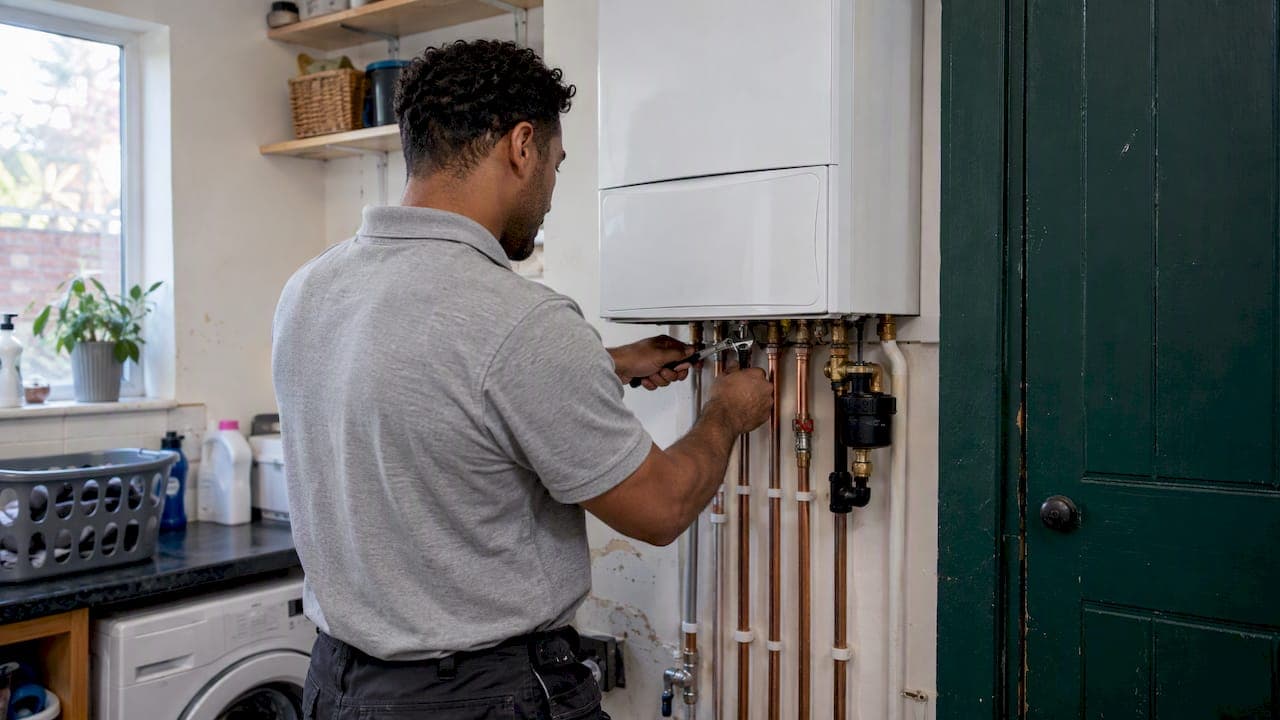
A straightforward like-for-like boiler replacement usually takes one working day, and Checkatrade's planning guide puts it at 1 to 1.5 days. If the boiler is moving to a new spot, or you are swapping a regular boiler for a combi, expect 2 to 5 days. Below we explain what fills the time, what makes a job longer, and how to prepare so your home is without heating for as short a time as possible.
TL;DR
- A like-for-like swap (combi for combi) typically takes about a day, roughly seven to eight hours of work.
- Moving the boiler, changing its type or changing the fuel adds days, because pipework, flues and tanks have to change too.
- The visit is only part of the story: a survey beforehand and paperwork afterwards also matter.
- Clear access, a parking space and an early start can save hours on the day.
- We offer free on-site quotes for new boilers, so you get a time estimate for your own house, not an average.
Table of Contents
- How long does a boiler installation take?
- What happens during a like-for-like replacement
- What makes a boiler job take longer
- Before and after the day itself
- How to keep the job short
- Our perspective on boiler installation time
- Will you be without heating or hot water?
- After the install: how you know it is working
- Book your boiler installation
- FAQ
- Sources
How long does a boiler installation take?
The honest answer is that it depends on what is being replaced with what. Viessmann's installation guide gives a useful ladder of timescales:
| Type of job | Typical time |
|---|---|
| Like-for-like swap, same location | About 1 day |
| Like-for-like swap, new location | About 2 days |
| Changing the type of boiler (for example regular to combi) | About 2 days |
| Changing the energy type | 2 to 3 days |
| Moving to an alternative system, such as a heat pump | 3 to 5 days, possibly longer |
The Checkatrade figures point the same way: 1 to 1.5 days for a like-for-like job, and 2 to 5 days or more for conversions and relocations. Other guides ranking for this question quote 4 to 6 hours for a very simple combi swap. That is possible on a tidy job, but plan for a full day so that testing and handover are not rushed.
These are industry guides, not promises about any particular house. The only reliable figure is one given after someone has looked at your boiler, flue route, pipework and cupboard.

What happens during a like-for-like replacement
It helps to see the day as stages, because each one has its own time cost.
- Arrival and protection (30 to 45 minutes). The engineer lays dust sheets, checks the old boiler and isolates the gas, water and electricity.
- Draining the system (up to an hour). The heating circuit is drained so the old boiler can be disconnected safely. Larger systems with many radiators take longer.
- Removing the old boiler (about an hour). It is disconnected and taken off the wall, along with the old flue where needed.
- Fitting the new boiler (two to three hours). The bracket, boiler, flue, condensate pipe and connections go in. Where the new boiler's connections do not line up with the old ones, pipework has to be altered.
- Filling, flushing and cleaning (one to two hours). The system is refilled, and a filter is typically fitted to protect the new boiler from sludge.
- Commissioning and testing (about an hour). Gas tightness, combustion and controls are checked, and the boiler is brought up to temperature.
- Handover (20 to 30 minutes). You are shown the controls, and warranty and paperwork details are explained.
Those are our working estimates for a typical swap, and they add up to a long working day. Add a hidden problem such as a corroded valve and it can slip into the next morning.
What makes a boiler job take longer
Changing the type of boiler
Swapping a regular boiler with a hot water cylinder and loft tanks for a combi means more than fitting a new box. Tanks are removed, pipework is altered, and the hot water supply is rearranged. That is why Viessmann puts a type change at around two days. If you are weighing up the change, our guide to what a combi boiler is explains how it differs from the system you have now.
If you have a stored hot water system, it is also worth understanding open vented and unvented systems, since which one you have affects how much has to change.
Moving the boiler
Relocating a boiler, for example from a kitchen to a utility room or loft, means new gas, water, heating and condensate runs, and often a new flue route. That is where two days becomes three or more. Flue position is regulated, so it is sensible to read our piece on boiler flue rules and the questions to ask your installer before agreeing a new location.
Changing size or output
A new boiler should match the heat your home needs, not simply the label on the old one. Oversizing wastes fuel and can make the boiler cycle on and off. Our article on whether your home needs 24 to 34 kW shows how to check. Settling the size at the quote stage keeps surprises off the installation day.
The state of the existing system
Old radiators that will not drain, seized valves, heavy sludge or tired pipework can all add hours. If the system needs a thorough cleaning, that is extra time on top of the swap itself. Air trapped in radiators after a refill is normal, and a ten-minute radiator bleed usually sorts it.
Switching fuel or going for a different system
Moving from gas to electric, oil or biomass, or to a heat pump with underfloor heating, is a different project altogether. Viessmann's guide puts those at 2 to 5 days or longer, and the gas-only rules in this article no longer apply in the same way. That sort of job needs a specific survey and quote.
Before and after the day itself
The time in your house is only part of the schedule.
Before: A survey or quote visit comes first. This is where the engineer checks the boiler location, the flue route, gas pipe size, the condition of the system and your hot water demand. We provide a free on-site quote for a new boiler, and the survey is the moment to ask for a realistic installation time for your house.
After: In England and Wales, a new boiler installation must be notified to the local authority so a Building Regulations Compliance Certificate can be issued. According to the Gas Safe Register, you should receive it in the post within 10 to 15 working days after your engineer has notified the installation. You need it when you sell or remortgage, so do not let it slip. Ask your installer when they will notify and check that the certificate arrives.
The installation is also the start of the boiler's life. Booking a yearly check keeps it safe, and our guide to servicing explained covers what is involved.
How to keep the job short
A little preparation can take real time off the day.
- Clear the area. Empty the cupboard or space around the boiler and the route to it. Move furniture, shoes and stored items away from the wall.
- Think about parking. Somewhere close for the van helps when heavy old boilers and new equipment move in and out.
- Agree the plan in writing. Boiler position, flue exit, controls, filter and any extras should be settled in the quote, not on the day.
- Have pets and children kept out of the way. The house will have open pipework and a fluctuating supply of hot water.
- Be at home or reachable. Decisions about small changes come up, and quick answers keep work moving.
- Choose your timing. Replace in good weather where you can. The Which? advice is to avoid waiting for a breakdown: it reports that 75% of homeowners with systems older than eight years were unprepared for a sudden failure, which tends to bring more disruption, higher costs and longer waits.
Do not try to do any part of the gas work yourself to save time. The Gas Safe Register is clear that you should never fix, fit or move appliances like a boiler on your own: it risks gas leaks, fires, explosions and carbon monoxide poisoning, and the work would not comply with the regulations.
Our perspective on boiler installation time
When customers ask us how long the work will take, we try to answer for their house rather than quote an average. A tidy combi-for-combi swap in a house we have surveyed is a one-day job. A house where the boiler is moving, tanks are coming out, or the pipework is in poor shape is not, and we would rather say so up front than promise a day and run into a second.
The biggest delays we see are not slow engineers, they are surprises: a flue route nobody checked, a cupboard too small for the new boiler, or a system full of sludge. That is why we offer a free on-site quote for new boilers and use it to look at those things. Our new boilers are supplied and fitted from £1,300, and the quote tells you what your own job comes to.

We would also say this about timing. If your boiler is past 10 to 12 years old and the repairs are becoming frequent, plan the replacement for a time that suits you. Age UK notes that as boilers age, sourcing parts becomes harder and replacement often makes more sense than repeated fixes. A planned install in a week you choose is almost always calmer than an emergency one in January.
Our approach is simple: no call-out fee, payment only after successful work, a 12-month warranty, and you can speak directly to the engineer. We have over 300 Trustatrader reviews, and we want the next one to say the work finished when we said it would.
— Michael
Will you be without heating or hot water?
For a one-day like-for-like job, the plan is usually to finish and commission before the end of the day, so you have heating and hot water that evening. Longer jobs mean one or more nights without a working boiler. If that applies, ask the installer in advance about the arrangement, and think about:
- a plug-in heater or two for key rooms, although Citizens Advice points out that running portable heaters on their own is much more expensive than central heating, so treat them as a short-term measure;
- an immersion heater for hot water, if you have a cylinder;
- arranging the work around a family member who is older or has a health condition, who will feel the cold sooner.
If your boiler fails suddenly and you cannot wait, we run an emergency plumbing and heating service with a 60-minute response time. Our engineers can diagnose the fault and tell you honestly whether a repair or a replacement is sensible. Boiler and heating repairs are charged at £110 per hour.
After the install: how you know it is working
Once the boiler is in, there is a simple benchmark. The Energy Saving Trust's guide to when to put the heating on says to set your timer about 30 minutes before you need the home warm. If a well-maintained system takes much longer than that to feel warm, it may need balancing or cleaning, which is worth raising with your installer while the warranty is fresh.
A few other things to check in the first weeks:
- Pressure stays steady on the gauge. If it keeps dropping, see our guide to a boiler leaking water.
- The boiler does not keep switching itself off, which our checklist for a boiler that keeps turning off walks through.
- You have the paperwork: warranty details, the manual, the commissioning record and the Building Regulations certificate when it arrives.
For a wider look at the whole process, our new boiler installation guide for homeowners covers choosing, quoting and handover.
Book your boiler installation
If you are replacing a boiler, we can give you a fixed answer on both cost and time. Request a free new boiler quote and we will look at your existing system, your hot water needs and the best position for the new boiler. New boilers supplied and fitted start from £1,300. We cover Reading, Newbury, Oxford, Basingstoke, Bristol, Swindon, Milton Keynes and many other towns across the region.
FAQ
How long does it take to put a boiler in a house?
A like-for-like swap normally takes about a day. Moving the boiler, switching from a regular boiler to a combi, or changing fuel can take two to five days. A survey beforehand will give you a firm figure for your house.
How long does boiler replacement take if I am moving it?
Allow around two days or more. New gas, water, heating and condensate pipes and a new flue route all have to be installed, and the old pipework is made safe. The more walls and floors involved, the longer it takes.
What is the 30 minute heating rule?
It is a rule of thumb that a well-maintained central heating system should make your home feel warm about 30 minutes after switching on. The Energy Saving Trust suggests setting your timer 30 minutes before you need the warmth. If it takes much longer, the system may need balancing or cleaning.
Do radiators get checked during a boiler service?
Not always. A standard service concentrates on the boiler itself: safety, combustion and internal components. Ask in advance whether radiator checks and system balancing are included, and if not, whether they can be added.
Can I fit a boiler myself to save time?
No. Gas work must be done by a Gas Safe registered engineer, and the installation has to be notified under Building Regulations. DIY gas work is dangerous and can cause problems when you sell the property.
Sources
- Checkatrade: new boiler installation, the complete UK planning guide
- Viessmann UK: boiler installation questions answered
- Gas Safe Register: Building Regulations certificates
- Gas Safe Register: home improvements
- Which?: planning for your boiler's replacement
- Age UK: looking after your boiler
- Citizens Advice: heat your home efficiently
- Energy Saving Trust: when to put your heating on
- Open vented and unvented hot water systems