When the hot tap upstairs dribbles and the cold tap next to it runs strongly, the fault is almost always inside your own home, not at the water company. The usual suspects are an airlock, a part-closed valve, scale in the tap or shower, or a hot water system that cannot push water up to the first floor. Most of these can be narrowed down in half an hour. If they cannot, our engineers can find the fault and fix it, with no call-out fee.
TL;DR
- Cold fine, hot weak: the problem is usually in your hot water system or the pipework after it, not the street supply.
- Check first: the stop tap is fully open, any isolation valves are open, and the shower head and tap aerators are free of limescale.
- Gravity-fed (tank) systems are prone to airlocks and low head upstairs. Mains-fed systems are prone to restricted supply or failing components.
- A pump or booster above 12 litres a minute needs your water company's consent. An unvented cylinder is notifiable work and needs a registered installer.
- Sudden whole-house pressure loss, damp or running-water sounds means turn off the stop tap and call a plumber at once.
Table of Contents
- Pressure or flow: what is actually wrong?
- Why the hot side is weak while the cold is fine
- Checks you can make safely at home
- When the problem is outside your home
- Fixes that actually raise hot water pressure upstairs
- When to call a plumber
- Our view
- Book a local engineer
- FAQ
- Sources
Pressure or flow: what is actually wrong?
People say "pressure" when they mean two different things. Pressure is the force pushing water along the pipe. Flow is how much water actually comes out of the tap. A tap can have decent pressure and poor flow if something narrows the route, such as scale or a half-shut valve.
Two simple tests help you tell them apart. A pressure gauge screwed onto an outside tap or washing machine connection reads below 1 bar when pressure is low, and 1 to 2 bar is normal. The same source describes a jug test: time how long the cold kitchen tap takes to fill a 1-litre jug. Six seconds or less is healthy, ten seconds or more suggests a flow problem.
Then compare. If the cold tap passes and the hot tap upstairs fails, you have narrowed the search to the hot side of your plumbing. The same source notes that good cold but weak hot water points to the boiler, a blocked cartridge, scaled pipework or a failing shower valve or tap component.
Why the hot side is weak while the cold is fine
The cold tap in a mains-fed home draws straight from the supply. The hot tap draws from the cold supply after it has passed through a boiler, cylinder or combi heat exchanger, and through more valves and pipe. Each of those is a place for restriction.
Your system type decides the likely cause
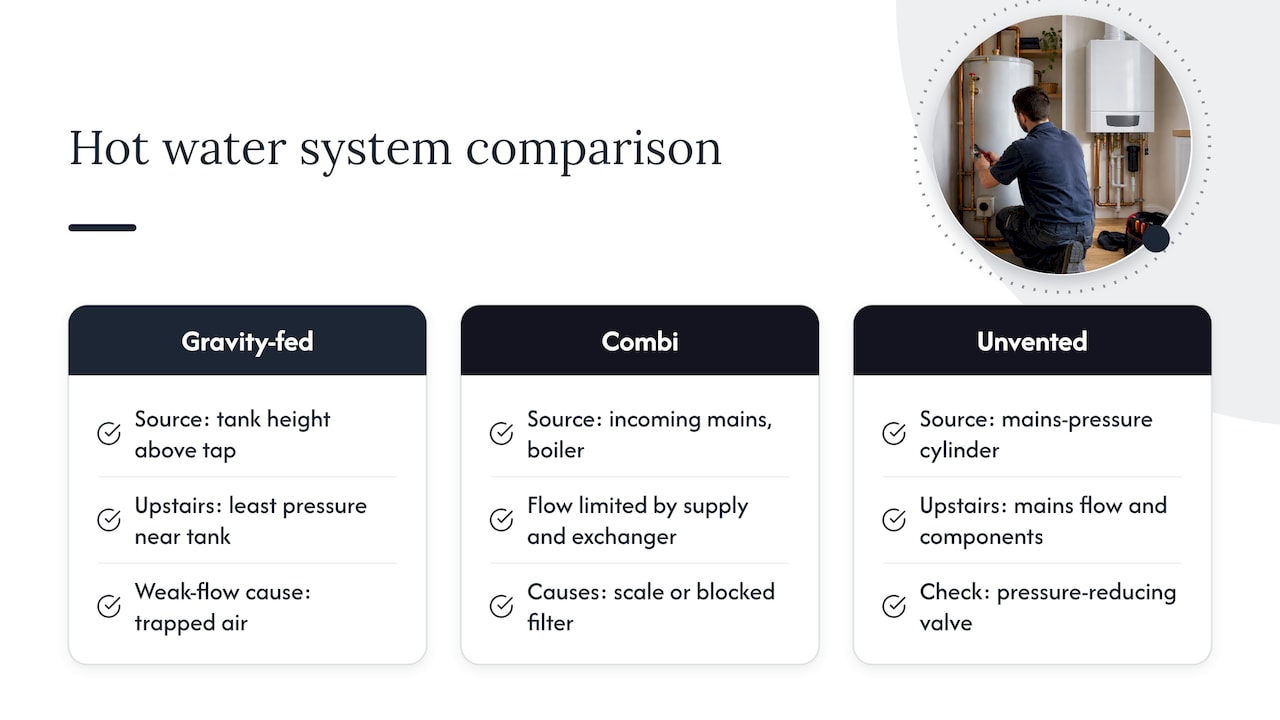
Gravity-fed (tank-fed) systems. A cold tank in the loft feeds a hot water cylinder, usually in the airing cupboard. Pressure comes only from the height of the tank above the tap. Upstairs outlets sit close to the tank, so they get the least pressure. A bathroom just below the loft hatch is the classic complaint. Airlocks, where a pocket of trapped air blocks the pipe, also affect these systems, particularly after plumbing work or draining down. Our guide to clearing an airlock in the hot water goes through the cylinder and crossover fixes.
Combi boilers. There is no tank or cylinder. The boiler heats mains water on demand, so hot flow is limited by what the incoming supply and the boiler's heat exchanger can pass. A scaled-up heat exchanger or a blocked filter can leave the hot side noticeably weaker than the cold.
Unvented cylinders. These store hot water at mains pressure, so upstairs performance depends on the incoming mains flow and the cylinder's components, including its pressure-reducing valve.
Outlet problems that look like system problems
If only one tap or one shower is weak, suspect the outlet itself. Limescale clogs shower heads and tap aerators, especially in hard-water areas, and cartridges in mixer taps and shower valves wear out. Descale the head or aerator first. It costs nothing and rules out the most common cause. If it is the shower that disappoints, our guide on fixing low shower pressure has the checks in order.
Checks you can make safely at home
Work through these in order. None involves opening up pipework or touching a boiler.
- Test several taps. Run hot and cold at the upstairs basin, the bath and the kitchen. If every hot tap is weak, think system. If one is weak, think outlet.
- Check the stop tap. The internal stop tap, usually under the kitchen sink or near where the supply enters, must be fully open. Water company codes of practice list this as the first check, along with looking for frozen or damaged pipes and local incidents on the company's website. Ofwat also advises ruling out a partly closed internal stop tap or a leak before contacting the water company.
- Look for part-closed isolation valves. These small slotted valves sit on the pipes under basins, near the cylinder and in the airing cupboard. One left half-turned after earlier work can choke a branch.
- Descale the outlets. Unscrew the shower head and tap aerators and soak them in vinegar overnight in hard-water areas, then refit.
- Note the timing. If pressure only drops at the morning and early-evening peaks, the cause is likely demand on the street supply, which is a matter for your water company.
- Check for a hidden leak. Take a reading from your water meter, make sure nothing is using water, wait an hour and read it again. A rise means water is escaping somewhere on the supply pipe. That company describes the test in its code of practice and offers a free leak detection service, and other suppliers have their own arrangements.
If your combi boiler's pressure gauge sits below 1 bar and the boiler keeps cutting out, that points to a leak in the heating circuit, which is a job for an engineer rather than a DIY fix.
When the problem is outside your home
Street-side pressure depends on the height of the service reservoir or water tower above your home, demand from other customers and the height of your property. Homes at the top of a hill can receive lower pressure. Ofwat lists high demand, undersized mains, leakage, equipment failures and blocked service pipes among the causes on the network side.
There is a floor. Under the Guaranteed Standards Scheme the minimum is seven metres of static head at the boundary of your property. That is a supply standard for the water company, not a promise of strong hot water at an upstairs tap. Some companies pay compensation if pressure falls below that level repeatedly: one company's code of practice sets £50 for repeated drops, with up to five payments a financial year. Rules vary by company, so ask yours.
Because cold water is fine in your home, a street-side fault is unlikely to be the reason hot water alone is weak. If your own checks find nothing, ask your water company to measure pressure and flow at your supply. Ofwat says the company can identify whether the fault lies on its side or yours.
Fixes that actually raise hot water pressure upstairs
| Situation | Likely fix | Who should do it |
|---|---|---|
| Airlock in a gravity system | Purge the air, check the cause | Plumber, or follow a guided fix |
| Part-closed valve | Open fully | You, if the valve is accessible |
| Scaled shower head or aerator | Descale or replace | You |
| Worn tap or shower cartridge | Replace the component | Plumber |
| Scaled combi heat exchanger or blocked filter | Service or clean | Gas Safe registered engineer |
| Low head from a loft tank | Fit a shower pump on the tank-fed supply | Qualified plumber and electrician |
| Weak mains flow | Investigate the supply; consider a booster | Plumber, with water company notice if over 12 l/min |
Pumps and boosters: the rules
A pump can transform a weak upstairs shower on a tank-fed system, but the fitting must suit the system. The Water Supply (Water Fittings) Regulations 1999 require that fittings are suitable and work is done in a workmanlike manner. Under Regulation 5, installing a pump or booster that draws more than 12 litres a minute, directly or indirectly, from a supply pipe needs prior notice to the water company and its consent. If the company gives no decision within ten working days, consent is deemed granted. The rules apply in England and Wales, and Scottish rules differ.
Ofwat also advises asking your water company before fitting modern heating appliances or showers that have minimum pressure requirements.
Changing the hot water system
Switching from a tank-fed cylinder to an unvented cylinder gives mains-pressure hot water upstairs, but it is notifiable building work in England. An installer registered with a competent person scheme can self-certify it, otherwise building control must be told before work starts. This is the kind of job to hand to a registered engineer. Replacing an ageing boiler is another route to a stronger and more consistent hot supply, and we give free on-site quotes for new boilers.
When to call a plumber
Call straight away if any of these apply:
- Pressure drops suddenly across the whole house, especially with the sound of running water or damp patches. Turn off the stop tap first.
- Brown or discoloured water comes from the taps, which can point to corroded pipework.
- The boiler gauge falls below 1 bar and the boiler keeps shutting down.
- You have tried the checks above and the hot tap is still weak.
For a burst or a hidden leak, our emergency plumber service offers a 60 minute response. Leaks can also be silent: our piece on hidden plumbing risks at home explains what to look for, and if the water is merely lukewarm rather than weak, see fixing tepid hot water. For wider background, we also cover the causes of low water pressure at home.
Our view
Most people who ring us about weak hot water upstairs have already tried the stop tap and the shower head. What is left is usually a job that needs a person to look at the whole hot side: the cylinder or boiler, the valves, the pipe runs. Guessing is what costs people money.
That is why we work on a no fix, no fee basis, with no call-out fee, and why you pay only after the work is done successfully. You speak directly to the engineer, and our work carries a 12-month warranty. Heating and boiler work is charged at £110 per hour.
If the cause turns out to be an old boiler or cylinder that cannot keep up, we say so and quote for a replacement. New boilers supplied and fitted start from £1,300.
Michael
Book a local engineer
We cover Reading, Newbury, Oxford, Abingdon, Bicester, Bracknell, Windsor, Basingstoke, Winchester, Swindon, Bristol, Cheltenham, Milton Keynes and many other towns. You can book a plumber online for pressure faults, leaks, taps and showers, with 24/7 availability including holidays. Our 300-plus Trustatrader reviews are there to read.

If the fault is in the boiler or heating, you can request a new boiler quote, which is free on site.
FAQ
Why is my hot water pressure low upstairs but the cold is fine?
The hot supply passes through your boiler or cylinder and extra valves and pipework, so it has more places to be restricted. Airlocks, scaled components and part-closed valves are common causes. In a gravity-fed system, low head from the loft tank also hits upstairs taps hardest.
How do I increase water pressure upstairs?
Start by opening the stop tap and isolation valves fully and descaling the shower head and aerators. If that does not help, a pump on a tank-fed system or a booster on a mains system may be the answer. Any pump drawing more than 12 litres a minute from the supply needs your water company's consent, so have a qualified plumber handle it.
Can I fix an airlock myself?
Some airlocks clear with simple steps, and our airlock guide explains them. If the water does not return to normal, or the airlock keeps coming back, something else is letting air in, and an engineer should check the system.
Is there a legal minimum water pressure?
Yes, at the water company's supply. The standard is seven metres of static head at the boundary of your property, set out in the Guaranteed Standards Scheme. It does not guarantee a particular flow from an upstairs hot tap.
Sources
- Water pressure, Ofwat
- The Water Supply (Water Fittings) Regulations 1999, legislation.gov.uk
- ESP Water customer code of practice, December 2025
- Portsmouth Water domestic customers code of practice
- How to increase the water pressure in your home, Grand Designs Magazine