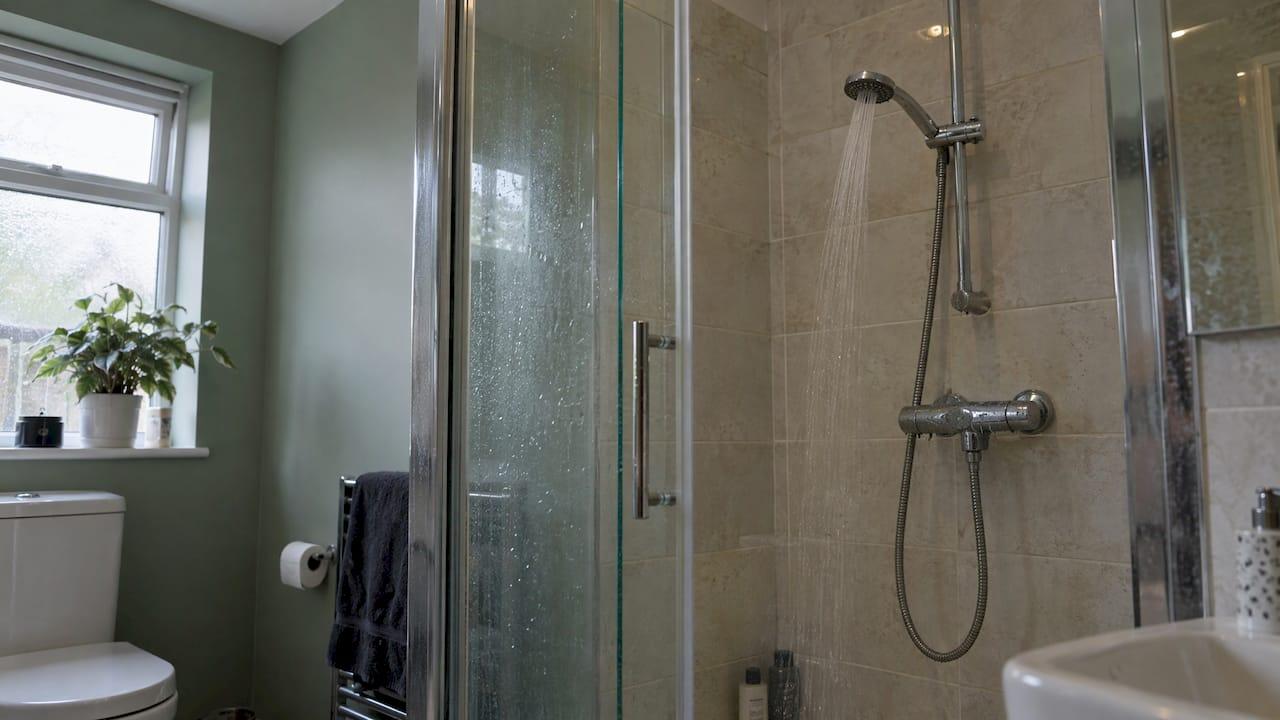
A mixer shower with low pressure is usually caused by something simple and local: a scaled showerhead, a clogged filter in the valve, a half-closed isolator or an airlock. If none of those is the answer, the cause is almost always your hot water system or the water supply. This guide shows you how to tell which it is, what you can safely check yourself, and when to stop and call an engineer.
TL;DR
- Start with the cheapest checks: descale or replace the showerhead, straighten the hose and make sure both isolators are fully open.
- If only one shower is weak, look at that shower's head, hose, valve filters and cartridge. If every tap is weak, look at your stop tap, your system or your water supplier.
- A showerhead changes how the spray feels but cannot add pressure to a weak supply. Pumps only suit certain systems and are dangerous on others.
- Thermostatic mixing valve problems often come down to dirty strainers, unbalanced hot and cold pressures or a worn cartridge.
- We offer a no call-out fee, no fix no fee service with a 60 minute emergency response if you would rather have an engineer look at it.
Table of Contents
- First, work out where the problem sits
- Check the showerhead and hose
- Check the isolators and the valve filters
- Why one shower is weak and the other is fine
- Is it your hot water system?
- Is it the water supply?
- Thermostatic mixing valve problems
- A sensible order for the checks
- When to stop and call a plumber
- Our perspective
- Get an engineer to sort it
- FAQ
- Sources
First, work out where the problem sits
There are four places a pressure problem can start: the showerhead and hose, the mixer valve, your home's hot and cold water system, and the mains supply outside. Each one leaves a different clue.
| What you notice | Most likely area |
|---|---|
| Spray is uneven, jets point sideways, flow improved a little when you tilt the head | Limescale in the showerhead |
| Flow is weak but taps elsewhere are fine | Hose, valve filters, isolators or cartridge |
| Hot side is weak, cold is strong (or the other way round) | Imbalance between hot and cold supplies, or an airlock |
| Every tap in the house is weak | Stop tap, leak, or the water supply |
| Flow drops when someone runs a tap or the washing machine | System capacity, especially combi boilers and shared supplies |
Ofwat lists high demand, the height of a property, inadequate pumping, undersized mains, leakage, equipment failure and blocked service pipes among the causes of low water pressure. It advises you to check your own plumbing for a partly closed internal stop tap or a leak before contacting the water company.
Check the showerhead and hose
This is where most weak showers are fixed, and it costs nothing.
- Unscrew the showerhead and look at the nozzles. White crusty scale is limescale, which narrows each hole.
- Soak the head in descaling solution or white vinegar, following the product label, then rinse and rub the nozzles clear.
- Check the hose from end to end for kinks, twists or damage. A hose that has been coiled tightly in a bath or tray can restrict flow.
- Look for a small filter or washer where the hose meets the head or the valve. If it is blocked, rinse it.
Mira's guidance lists a blocked or scaled showerhead, a blocked filter and a kinked or damaged hose among the common explanations for a weak shower.
Will a new showerhead help?
Sometimes, but not in the way people expect. Replacing a limescale-clogged head can restore flow, and a head with fewer, finer holes can make the water feel stronger, according to the same Mira guidance. What it cannot do is raise the pressure arriving at the shower. One showerhead explainer makes the same point: a different spray pattern can change how forceful the jets feel, while a genuinely inadequate supply needs the plumbing, supply or pump looked at.
So if a descaled head makes no difference, the head was not the problem. Move on to the valve and the supply rather than buying more heads.
Check the isolators and the valve filters
Most mixer valves have a service valve (isolator) on both the hot and cold feeds. If either is only partly open, flow drops. Fully open both with a flat screwdriver, then run the shower again.
Inside the valve, small mesh filters protect the mechanism from debris. Mesh inlet filters can clog with debris, particularly after recent pipework, and that restricts the flow. If your shower went weak soon after a plumbing job, this is a prime suspect.
To inspect them safely:
- Isolate both the hot and cold supplies before you take anything apart. If there are no service valves, isolate the supplies at the appropriate source, as bar valve guidance advises.
- Check that both inlet service valves are fully open before you strip anything down.
- Remove and rinse the mesh filters inside the inlet check valves, and refit them.
- Reopen the isolators slowly and run the shower for a minute to clear any air.
If you have no isolators, cannot find them, or the valve is concealed in the wall, stop there. That is a job for a plumber, not a screwdriver and a leap of faith. Our shower and plumbing repairs cover exactly this kind of diagnosis.
Why one shower is weak and the other is fine
This is one of the questions readers ask most, and it is good news: it means your supply is probably healthy. If the kitchen tap and the downstairs shower run well, the mains and your boiler or cylinder are delivering. The difference lies in what is unique to the weak shower.
Common reasons include:
- Height and pipe run. A shower on the top floor, or one at the end of a long run of pipework, has less pressure available than one near the cylinder or boiler. In gravity-fed systems the pressure comes from the height of the stored water, and Mira notes that excessive shower height relative to the water source can be a cause.
- A different valve or fitting. Two showers can have different valves, different filters and different hoses. One may simply be clogged.
- A worn cartridge. If the temperature drifts, the controls feel gritty or flow stays weak after cleaning and re-greasing, the cartridge has probably reached the end of its working life. Our guide on what to measure before replacing a shower cartridge walks through it.
- Pipework that was altered. A new bathroom or a repositioned pipe can leave an airlock or a restriction on one branch only.
If the comparison between the two showers is not obvious, an engineer can measure flow and pressure at each outlet and tell you quickly.
Is it your hot water system?
Mixer showers need hot and cold water at reasonably similar pressures. How your home heats water decides a lot about what you can expect.
Gravity-fed (tank-fed) systems
With a cold water tank in the loft and a hot water cylinder, pressure depends on height. As a rule of thumb, each metre of vertical distance from the tank base to the highest outlet provides roughly 0.1 bar. A shower only a metre or so below the tank will be gentle however clean the head is. Mira's perspective is that a gravity-fed shower can feel weak even when the shower itself is sound, and in some installations a pump may be needed.
One safety point matters here. Shower pumps must only be fitted to gravity-fed vented systems. Connecting a pump to a combi boiler or an unvented system is dangerous and invalidates warranties. If you are unsure which system you have, ask a qualified plumber before buying anything.

Combi boilers
A combi heats water on demand from the mains, so the shower competes with every other tap. If the pressure falls sharply when a hot and cold tap run while the shower is on, the boiler's internal flow limiter may need adjusting or cleaning by an engineer. That is boiler work, so it is not a DIY job.
Unvented cylinders
These run at mains pressure and normally give strong showers, so a weak result points to a blockage, a partly closed valve or a supply issue rather than height.
Hansgrohe's UK water systems guidance makes the underlying point well: identify your water system first, since it determines suitable products and likely pressure, and use a plumber to measure pressure before finalising designs or orders.
Is it the water supply?
If every tap is weak, not just the shower, look outside the bathroom.
- Check the internal stop tap. It should be fully open. Ofwat names a partly closed one as a common culprit.
- Look for leaks. Damp patches, a spinning meter with everything off, or a hissing pipe all matter.
- Ask your neighbours. If the street is affected, contact your water company. WaterSafe advises that if the whole property is affected you should check with the water supplier, and that an unclear fault should be investigated by a WaterSafe-registered plumber.
A simple flow test
Turn off other taps and appliances, then time how long the cold kitchen tap takes to fill a one-litre jug. Severn Trent suggests that around seven seconds equals 9 litres per minute, while a longer time suggests a restriction such as an airlock or a blockage. The thresholds are a guide, and your own supplier's page is the one to check for your area.
Our article on the causes of low water pressure at home goes deeper on supply-side problems, and low kitchen tap pressure is a useful companion if the kitchen is weak too.
Thermostatic mixing valve problems
Thermostatic valves hold a steady temperature by balancing hot and cold. That makes them sensitive to supply conditions, which is why people searching for thermostatic valve faults often end up with a pressure complaint. Typical issues:
- Supply outside the valve's range. Industry guidance says performance can suffer when supply conditions fall outside the valve's operating range, when isolators are not open, or when strainers are not clean. Diagnosis involves checking supply pressures and temperatures, the outlet temperature and the cold-water isolation test, and servicing should follow the manufacturer's instructions.
- Hot and cold out of balance. When cold pressure is higher than hot, it can overpower the hot supply and push cold water through the mixer. A pressure-reducing valve on the higher-pressure side can balance an unbalanced system.
- A stiff control. A stiff temperature control can often be cleaned with descaling solution. If the shower will not get hot enough, check the maximum-temperature limiter.
- Leaking when off. This usually means the internal cartridge has failed and needs replacing rather than repairing. If yours drips, see our guide to stopping a dripping shower mixer.
- Temperature swings. Our fluctuating shower temperature checks help you separate a valve fault from a supply fault.
An important lesson from engineers who work on these valves: a new valve is often not the answer. Heat Geek's view is that valves are frequently replaced when the real issue is a lack of servicing or pressure balancing, which can be solved without new parts. A proper diagnosis before spending is the cheapest route.
A note on low-pressure valves: some are designed to run from a low minimum pressure, and the manufacturer's specification will state the figure. If you are choosing a replacement for a gravity-fed system, match the valve to your system's real pressure, which an engineer can measure.
A sensible order for the checks
- Descale or replace the showerhead and check the hose.
- Confirm both isolators are fully open.
- Check whether other taps are weak, and look at the stop tap.
- If the weakness started after pipework, isolate and clean the valve's mesh filters.
- Identify your system type before considering a pump.
- If flow stays poor, or the temperature drifts, suspect the cartridge or an imbalance and get it diagnosed.
Our 10-minute low shower pressure checks cover the first steps in a compact checklist.
When to stop and call a plumber
Stop if the cause is not clear after the checks above. WaterSafe recommends using a qualified professional unless you are entirely confident the work is safe and correctly fitted. Specific moments to stop:
- You cannot isolate the supply to the valve.
- The valve is concealed behind tiles and you would need to open the wall.
- You suspect a combi boiler flow limiter or a pump on the wrong system.
- Water is leaking, or there is a damp patch you cannot trace.
- It is unclear whether the fault is in your home or in the supply. In that case, WaterSafe says to contact the water company first for advice.
Our perspective
Most weak mixer showers we are called to turn out to be one of three things: a blocked head or filter, an imbalance between hot and cold, or a system that was never right for the shower fitted to it. The expensive answer, a new valve or a pump, is rarely the first one.
That is why we diagnose before we sell. Our engineers look at the shower, then the system behind it, and tell you what is actually wrong. We do not charge a call-out fee, and our no fix no fee guarantee means you pay only after the work is done successfully.
If your whole heating system is the limit, for example an ageing boiler struggling to feed a modern shower, we will say so and quote for a replacement for free. Either way, you deal directly with the engineer.
Michael
Get an engineer to sort it
If you would rather not isolate valves and strip cartridges yourself, we can help. We provide plumbing and heating repairs, shower work and boiler diagnostics across Reading, Newbury, Oxford, Bristol, Swindon, Milton Keynes and many other towns. Heating and boiler work is charged at £110 per hour, with no call-out fee. Every job comes with a 12-month warranty and our no fix no fee guarantee.

If the shower has stopped working or the water supply has failed completely, our emergency engineer with a 60 minute response is available 24/7, including holidays. For shower and tap repairs you can book a plumber online. If the boiler is the bottleneck, ask for a new boiler quote; new boilers supplied and fitted start from £1,300.
FAQ
Why is my mixer shower pressure low but the taps are fine?
The fault is probably local to the shower: a scaled head, a kinked hose, partly closed isolators, clogged mesh filters in the valve or a worn cartridge. It can also reflect the shower's position, since a high outlet on a gravity-fed system has less pressure available. Work through the head, hose and isolators first.
Can I fit a pump to improve a low pressure mixer shower?
Only on a gravity-fed vented system. Fitting one to a combi boiler or unvented system is dangerous and invalidates warranties. Have a qualified plumber confirm your system type and measure pressure before you buy a pump.
Do thermostatic mixing valves need servicing?
Yes, they benefit from periodic checks. Strainers can clog, isolators can be left part closed and cartridges wear out. Servicing should follow the manufacturer's instructions, and a gritty control or drifting temperature after cleaning usually means the cartridge needs replacing.
Will changing the showerhead fix low pressure?
It can if the old head is clogged with limescale, and finer nozzles can make the spray feel stronger. It cannot increase the pressure coming into the shower, so if a clean new head changes nothing, look at the valve, the system or the supply.
Should I call my water company or a plumber?
If every tap in the house is weak or neighbours have the same problem, start with your water company. If only the shower is weak, or the cause is unclear within your own plumbing, call a qualified plumber.
Sources
- Water pressure, Ofwat
- How to increase water pressure in your shower, Mira
- Can a shower head increase water pressure?
- Troubleshooting common mixer shower problems
- Bar valve shower problems
- Shower pump calculator
- Shower has low pressure, how to fix it
- UK water systems, Hansgrohe
- Why is my water pressure low?, WaterSafe
- Supply and pressure, Severn Trent
- Type 2 guidance for installation, commissioning and in-service testing, Kiwa
- Mixing valve faults and issues
- Thermostatic shower valve service
- How to clean a shower cartridge
- Hiring a plumber, WaterSafe