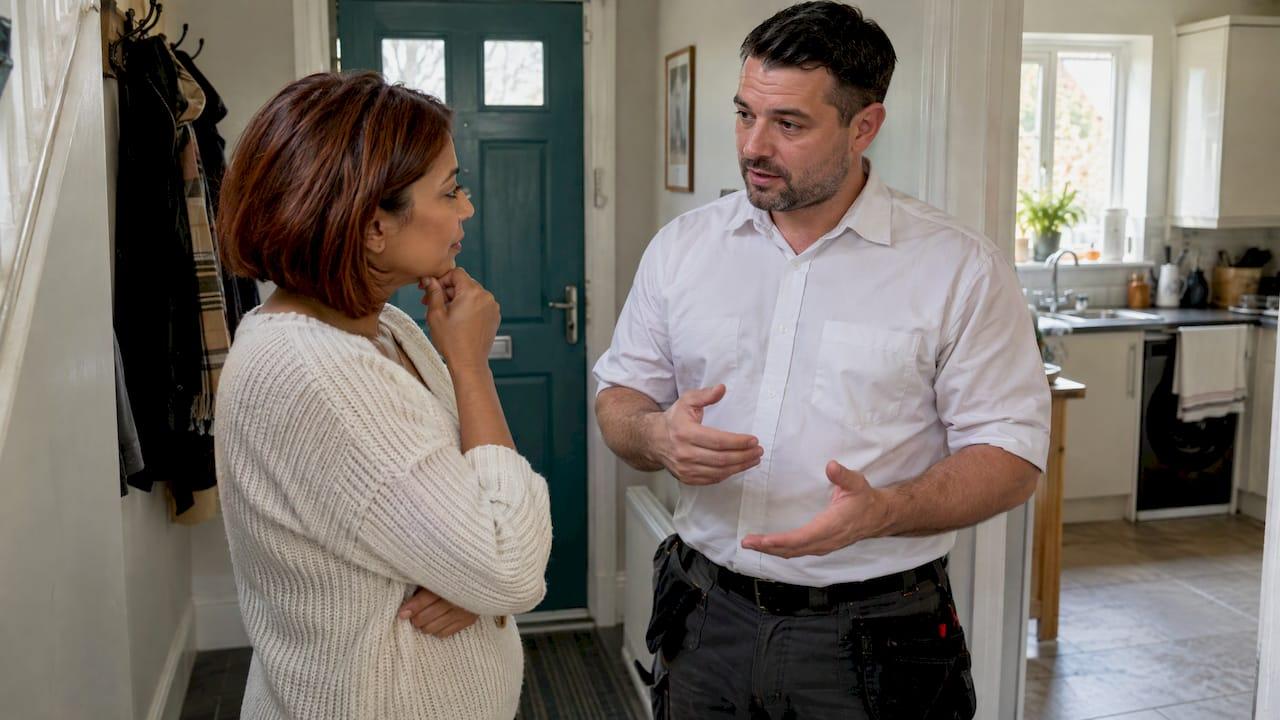
A plumber's call-out charge is the fee for getting an engineer to your door, before any repair work is priced. Some firms charge it as a flat sum, some fold it into the first hour of labour, and some charge none at all. At Your Local Plumber there is no call-out fee: you pay for the work, and only after it has been completed successfully. The rest of this guide shows you how to read any quote, what the rules say and what to ask before you say yes.
TL;DR
- A call-out charge covers travel and the first visit. It is not the price of the repair, and the final bill can be higher than the figure you are quoted first.
- Published UK figures vary widely, from nothing to £190 plus VAT for the first 90 minutes in one survey, so the structure of the charge matters more than the headline number.
- UK rules say a minimum call-out charge must be disclosed before you commit, and a "no call-out charge" claim must mean no travel, diagnosis or similar fee before work is agreed.
- Ask four things before agreeing: is there a call-out fee, what time is included, how is extra time billed, and what happens if you decline the repair.
- Our approach: no call-out fee, no fix no fee, and payment only after successful work.
Table of Contents
- What a call-out charge actually is
- What UK firms charge
- What the law says about call-out charges
- Worked example: three ways to be billed for the same leak
- Questions to ask before you agree
- Stay safe while you wait for the engineer
- Why a no call-out fee model makes sense for homeowners
- Our view on call-out charges
- Book an engineer with no call-out fee
- FAQ
- Sources
What a call-out charge actually is
When you ring a plumber, the firm has to send someone to you. That means a van, fuel, an engineer's time on the road and a slot in the diary that could have gone elsewhere. A call-out charge is the way many firms recover that cost. It is usually charged for the visit itself, whether or not the job is done there and then.
There are three common set-ups:
- A separate flat fee. You pay a set amount to have the engineer attend, then labour and parts on top.
- A minimum charge. The first hour, or a fixed block of time, is billed at a set price, and the repair is charged from there. This is the most common form for emergencies.
- No call-out charge. Travel is not billed separately. You pay for the labour and parts for the work you agree to.
The label does not tell you which one you are getting. A "call-out fee", a "minimum charge", an "assessment fee" and a "diagnostic fee" can all describe the same money by a different name, which is why the questions later in this guide are worth asking every time.
What UK firms charge
No single national price exists, and many firms will not publish one. A survey of 179 emergency plumber websites across eight UK towns, carried out in October 2026, found that 117 published no price at all, 24 published a figure between £50 and £190, and 38 advertised no call-out charge. The highest published figure, £190 plus VAT in Manchester, covered the first 90 minutes. The same survey cautions that a published price is not the same as the invoiced price, because the final bill depends on the job, the time of day, the parts and how time is billed.

That is the key point for a homeowner. A call-out figure is a starting point. Two firms quoting the same call-out charge can produce very different bills if one includes an hour of work and the other includes none.
Why the figure varies
Several things move a call-out charge up or down:
- Time of day. Evenings, nights, weekends and bank holidays normally cost more than a weekday visit, because the engineer is working outside normal hours.
- Distance. A firm covering a wide area has further to travel on average, so the charge reflects the size of its service area. A trader advertising locally may not actually be based nearby, which can add travel charges.
- Speed. A promise to arrive within an hour means keeping engineers free, and that is priced in somewhere.
- What is included. A fee that covers an hour of labour is a different product from a fee that covers travel only.
- VAT. Some firms quote before VAT. Ask whether the figure you were given includes it.
If you live in Reading, Oxford, Bristol, Swindon or anywhere else across the Thames Valley, Hampshire, Gloucestershire or Buckinghamshire, the same logic applies. Compare how the charge is built, not just the first number you hear.
What the law says about call-out charges
It is legal for a plumber to charge a call-out fee. What the law requires is that you are told about it first.
The charge must be disclosed before you commit
Under the Consumer Protection (Code of Practice for Traders on Price Indications) Approval Order 2005, a minimum call-out or flat-rate charge for home plumbing work must be disclosed, along with whether the actual price may be higher, for example if the work takes longer than a set time. That disclosure has to come before you are committed to using the service.
The Consumer Contracts Regulations 2013 add more. Before you are bound by a contract made at your home, the trader must give you key information in a clear and comprehensible manner, and that information is treated as a term of the contract, with changes ineffective unless you expressly agree to them.
There is a carve-out for genuine emergencies. Where you have asked the trader to come for immediate repairs and the payment is not more than £170, the full pre-contract information rules do not apply, but the trader must still give key information and a price estimate where the price cannot be calculated in advance. In practice, you should still get a clear price or estimate before work begins.
What "no call-out charge" must mean
The Advertising Standards Authority (ASA) regulates advertising in the UK. Its guidance says a "no call-out charge" claim is only acceptable if nothing is charged for travel, the initial diagnosis or any other fee before work is agreed. It also says an "assessment" or "diagnostic" fee imposed when you decline the repair is likely to be treated as equivalent to a call-out charge. The ASA has ruled the wording misleading in cases involving Rightio Ltd (November 2020) and Town Force Ltd (November 2020).
The same guidance adds that a claim that the call-out charge is offset against the cost of the work is likely acceptable only if the fee is genuinely deducted from your bill. Since 7 April 2025, relevant advertising code amendments have applied following the Digital Markets, Competition and Consumers Act 2024, which replaced the older 2008 unfair trading regulations.
Cancelling an emergency booking
Normally you have 14 days to cancel a contract made at your home or at a distance. Emergencies are different: the cancellation rules in Part 3 of the Consumer Contracts Regulations exclude cases where you requested the visit for urgent work. A Sky News consumer feature from February 2026 also notes that if you ask for services within the cooling-off period, the business can keep money covering services provided up to the point of cancellation. The practical lesson: settle what happens if you change your mind before the engineer sets off, not after.
Worked example: three ways to be billed for the same leak
Take a leaking pipe under a kitchen sink that takes 45 minutes to fix. The figures below are illustrations of structure, not prices from any firm.
| Charging style | What you are told | What the bill is made of |
|---|---|---|
| Separate call-out fee | A flat visit fee, then hourly labour | Visit fee, plus labour for 45 minutes (possibly rounded up to a full hour), plus parts |
| Minimum charge | A fixed price for the first hour or 90 minutes | One block that already includes the 45 minutes, plus parts |
| No call-out fee | Labour at an hourly rate, no travel fee | Labour for the time worked, plus parts |
The differences that catch people out are billing increments (is 45 minutes charged as 45 minutes or as a full hour?), what the fee includes, and whether parts are charged separately. A low headline figure with a full-hour minimum and a call-out fee on top can cost more than a higher hourly rate with nothing added.
Questions to ask before you agree
The Staffordshire County Council trading standards advice from August 2026 tells residents to check whether there is a call-out charge, whether travel costs apply and how the final bill will be calculated, and to keep quotations, invoices and receipts. Turn that into a short list for the phone call:
- Is there a call-out fee, and is VAT included in the figure?
- What does it cover? Travel only, or travel plus an hour of labour?
- How is extra time charged? By the hour, by the half hour, or in blocks?
- Is a diagnosis or assessment charged if I decline the repair?
- Will you confirm the price or estimate before starting work? Ask for it in writing, by text or email.
- Is there a warranty on the work?
If the engineer recommends extra work once they arrive, ask why it is needed, what it will cost and whether there are alternatives. That is a normal question and a good plumber will answer it plainly.
If you are choosing between firms and want a quick way to screen them, our guide on three checks to choose a plumber covers Gas Safe registration and insurance, which matter for any boiler or heating work. Gas work must only be done by a Gas Safe registered engineer.
Stay safe while you wait for the engineer
Whatever the charge, the first minutes of an emergency matter more than the price. If water is escaping, turn off the stopcock (the main valve, often under the kitchen sink or where the supply enters the house) and open cold taps to drain the system. If water is near electrics, switch off the power at the consumer unit only if you can do so without standing in water. If you smell gas, do not operate switches, open windows and call the National Gas Emergency Service on 0800 111 999 straight away: that is a job for the gas network, not a plumber's booking line.
For more on what to do and how a plumber limits damage once on site, read how plumbers protect your home during emergencies and emergency plumbing explained.
Why a no call-out fee model makes sense for homeowners
A call-out charge asks you to pay before you know whether the problem is solved. For a homeowner with water coming through the ceiling, that is a poor moment to be negotiating. Paying only for completed work puts the risk where it belongs: with the firm that is confident it can fix the problem.
That is how we work. We do not charge a call-out fee, we operate a no fix no fee guarantee, and you pay only after the work has been completed successfully. Our heating and boiler work is charged at £110 per hour, new boilers supplied and fitted start from £1300 one-off, and our work carries a 12-month warranty. For the thinking behind this, see why transparent pricing matters in plumbing and our notes on avoiding emergency markups on central heating repairs.
Our view on call-out charges
Most of the arguments we hear about call-out fees are really arguments about surprise. A homeowner can accept a fair price. What they cannot accept is a number that changes once the engineer is standing in the kitchen.
That is why we built our service around being clear up front. We do not charge a call-out fee. Our no fix no fee guarantee means you pay only after successful work, and our heating and boiler labour is £110 per hour. You can talk directly to the engineer, and our emergency service is available 24/7, including holidays, with a 60 minute response time on our emergency booking.
Our advice to any homeowner in Reading, Oxford, Bristol or any of the towns we cover is simple: decide what you need to know before the van arrives. Ask what is charged, for how long and what is included, and keep the answer in writing. A 12-month warranty on the work and more than 300 Trustatrader reviews are there so you can judge us on what customers have actually experienced.
Michael
Book an engineer with no call-out fee
If you have a leak, a failed boiler or a burst pipe, you can book our emergency plumbing or heating engineer online, with a 60 minute response time and no call-out fee. For routine jobs such as taps, toilets, showers and leak repairs, use our plumbing booking page. Planning a replacement boiler? Ask for a free on-site new boiler quote.

We cover homes and businesses across Reading, Newbury, Oxford, Abingdon, Bicester, Bracknell, Windsor, Basingstoke, Winchester, Swindon, Bristol, Cheltenham, Milton Keynes and many other towns. See our guide to essential plumbing services for UK homes for the full range of what we do, and how plumbing warranties work if you want to understand the 12-month cover.
FAQ
What is a call-out fee?
A call-out fee is a charge for sending a plumber to your property. It usually covers travel and the first visit, and it is billed on top of, or sometimes inside, the labour and parts for the repair. Firms name it differently, so ask exactly what is included.
How much do plumbers charge for a call-out in the UK?
There is no standard figure. In an October 2026 survey of 179 emergency plumber websites, published prices ran from £50 to £190, many firms published none and 38 advertised no call-out charge. Out-of-hours visits generally cost more than weekday daytime ones. Ask for the full price structure, not just the first number.
Is it legal for a plumber to charge a call-out fee?
Yes, provided it is disclosed before you commit. A minimum call-out charge must be stated along with whether the final price may be higher. Advertising claims of "no call-out charge" must not be undermined by travel, diagnosis or assessment fees imposed before work is agreed.
Can I cancel an emergency plumber after booking?
The usual 14-day cancellation right does not cover work you asked to be done urgently, and a firm may keep payment for services already provided. Check the cancellation terms before you confirm the booking, and keep a record of what was agreed.
Do you charge a call-out fee?
No. We do not charge a call-out fee, and you pay only after the work has been completed successfully, under our no fix no fee guarantee.
Sources
- Emergency Plumber Call-Out Charges UK: 179 Firms Checked
- ASA advice: Call-out charges
- Consumer Contracts Regulations 2013, regulation 11
- Consumer Contracts Regulations 2013, regulation 10
- Consumer Contracts Regulations 2013, Part 3
- Code of Practice for Traders on Price Indications Approval Order 2005
- Staffordshire County Council: Take Five before agreeing to emergency call-out services
- Sky News: Money Problem on an emergency plumber cancellation