
TL;DR:
- Water hammer is a pressure surge caused by rapid valve closures that can damage pipes over time. It often results from appliances like washing machines or dishwashers shutting off quickly, especially in homes with high mains pressure. Professional assessments and installations of water hammer arresters are essential to prevent costly plumbing damage.
That sudden bang or thud rattling through your walls after the washing machine finishes its cycle is not something you should simply ignore. It is called water hammer, and while many homeowners assume it is just a quirky feature of older plumbing, it can steadily erode the integrity of your entire pipe system. This guide explains exactly what water hammer is, what causes it in a typical British home, the genuine risks it poses, and the practical steps you can take to silence it for good. By the end, you will have the knowledge to protect your plumbing rather than simply putting up with the noise.
Table of Contents
- What is water hammer in home plumbing?
- Why does water hammer happen — common triggers in the home
- What water hammer does to your plumbing — risks and damage
- How plumbers diagnose and rate water hammer severity
- How to fix water hammer in your home — solutions and proven prevention
- Why quick fixes often fail — what most homeowners miss about water hammer
- Get plumbing help and protect your home from water hammer
- Frequently asked questions
Key Takeaways
| Point | Details |
|---|---|
| Water hammer basics | Water hammer is a pressure surge when water flow is suddenly stopped, causing loud banging in pipes. |
| Main triggers | Quick-closing valves in appliances like washing machines are the most common causes at home. |
| Home risks | Unchecked water hammer can lead to leaks, costly repairs, and damaged pipework. |
| Effective solutions | Code-compliant fixes such as water hammer arresters offer lasting protection. |
| Professional support | A qualified plumber can ensure your system is quiet, safe, and meets regulations. |
What is water hammer in home plumbing?
Water hammer is one of those plumbing problems that sounds dramatic because it genuinely is dramatic. At its core, water hammer is a pressure surge or shockwave created when flowing water is suddenly stopped or forced to change direction in a piping system. Also referred to as hydraulic shock, it occurs in a fraction of a second and sends a wave of pressure crashing through your pipes.
"Water hammer (also called hydraulic shock) is a pressure surge or shockwave created when flowing water is suddenly stopped or forced to change direction in a piping system." — The Spruce
The banging sound you hear is that pressure wave slamming into a valve, a bend, or a closed end in the pipe. The noise is the most obvious symptom, but the shockwave itself is the real concern, because it is doing physical work every time it travels through your plumbing. Understanding water pressure and pipe performance is essential here, because homes with higher mains pressure experience more severe shockwaves.
| Location or appliance | Common cause of water hammer |
|---|---|
| Washing machine | Solenoid valve snaps shut at end of fill cycle |
| Dishwasher | Quick-close valve operates at end of rinse cycle |
| Bathroom tap | Tap closed rapidly by hand or by a lever fitting |
| Kitchen mixer tap | Fast closure or high flow rate through lever tap |
| Toilet cistern | Fill valve closes suddenly when cistern is full |
| Outdoor tap | Abrupt shutoff on high mains pressure supply |
Any fixture in your home that stops water flow quickly is a potential trigger. Modern appliances are often designed for efficiency and speed, which unfortunately makes them prime candidates for causing hydraulic shock.
Why does water hammer happen — common triggers in the home
Now that you know what water hammer is, the next step is understanding why it happens in typical home scenarios. The mechanics are straightforward. Water has mass. When it is moving through a pipe and a valve snaps shut, that moving mass has nowhere to go. The kinetic energy converts instantly into pressure, and that pressure wave has to travel somewhere.
Water hammer is almost always event-driven. It does not build gradually; it happens the moment a valve closes. Quick-closing appliance valves in washing machines and dishwashers are among the most common culprits in UK homes, because the solenoid valves they use are designed for speed and precision, not gradual closure.
Key triggers for water hammer in the home:
- Washing machine valve shutting off at the end of a fill cycle
- Dishwasher valve closing between rinse and drain stages
- Bathroom or kitchen tap closed sharply, especially a lever-style fitting
- Faulty or waterlogged air chamber near appliances
- High mains water pressure amplifying the effect of any valve closure
- Toilet fill valve closing abruptly when the cistern reaches full capacity
Air chambers deserve a special mention. These are vertical sections of pipe installed near valves to act as a cushion for pressure surges. Over time, they become waterlogged as the trapped air dissolves into the water, and once the air is gone, they offer no protection at all. Many homeowners do not realise their air chamber has failed until the banging returns with renewed intensity.
Pro Tip: Listen for the banging noise immediately after your washing machine or dishwasher finishes its cycle. If the sound lines up precisely with the appliance switching off, you have found your source. This simple observation helps a plumber pinpoint the problem quickly when spotting water hammer symptoms in your home.
It is also worth noting that water hammer can become worse over time. As pipe supports loosen or joints begin to shift slightly, the pipes have more freedom to move when the shockwave hits, creating even louder bangs and increasing the risk of damage.

What water hammer does to your plumbing — risks and damage
Understanding what triggers water hammer highlights why it is not just noisy. Here is what can happen to your plumbing if it is left unaddressed over months or years.
The pressure wave does not simply disappear after that first bang. In complex systems, the pressure wave reflects and bounces through the piping, which is why the audible bang can persist even after shutoff and why solutions focus on controlling the transient pressure. Every reflection is another impact, and those impacts accumulate.
The most common types of damage caused by water hammer:
- Loose pipe joints that eventually allow water to seep through
- Cracked or fractured pipe sections at elbows, bends, or tees where stress concentrates
- Failed pipe supports and brackets that allow pipes to shift or vibrate excessively
- Damaged appliance inlet valves on washing machines, dishwashers, and toilets
- Increased water wastage from slow leaks developing at weakened joints
- Higher ongoing maintenance costs as multiple components require attention
Even a single severe water hammer event can compromise pipe integrity, particularly in older copper or plastic pipework that has experienced years of thermal expansion and contraction. In newer properties, the pipework may be more resilient initially, but repeated shockwaves will shorten its lifespan.
The risks associated with preventing pipe leaks caused by water hammer are real and measurable. A small seep at a joint behind a wall or under a floor can go unnoticed for months, causing damp, mould, and structural damage that costs far more to repair than a simple arrester installation would have. The connection between how water pressure impacts damage risk and water hammer severity is direct: higher pressure equals more destructive shockwaves.
How plumbers diagnose and rate water hammer severity
Now that the risks are clear, it helps to understand how professionals assess the severity of water hammer in a typical home. Not all water hammer is equal, and the appropriate solution depends on how severe the problem actually is.
A plumber will typically follow a structured investigation. The Joukowsky relationship estimates peak pressure rise from a sudden change in fluid velocity, using the formula ΔP = ρ·a·ΔV. In practical terms, this means the faster the water is moving and the more abruptly it stops, the higher the pressure spike. Homes with high mains pressure and fast-closing appliances experience the most damaging events.
How a plumber investigates water hammer in your home:
- Listen carefully at different points in the system to locate the source of the noise
- Inspect visible pipework for movement, loose brackets, or signs of impact stress
- Check the condition and position of any existing air chambers
- Test individual appliances and taps in sequence to identify the specific trigger
- Assess the mains pressure with a gauge to determine whether pressure reduction would help
- Review the location of key valves and recommend appropriate devices
| Factor | Mild water hammer | Severe water hammer |
|---|---|---|
| Noise level | Soft thud or single knock | Loud repeated banging or rattling |
| Risk to pipework | Low in short term | High, immediate attention needed |
| Urgency | Monitor and plan fix | Address promptly |
| Likely cause | Partially waterlogged air chamber | Failed air chamber, high mains pressure, or solenoid valve |
| Typical solution | Clear air chamber, secure pipes | Install water hammer arrester, reduce pressure |
Diagnosing common plumbing problems accurately before starting any work saves both time and money. A plumber who identifies the severity correctly will match the solution to the actual problem rather than applying a blanket fix that only partially works.
How to fix water hammer in your home — solutions and proven prevention
Now that you know how experts assess water hammer, here are the most effective ways to stop or prevent it in your own home. Some steps are straightforward checks you can carry out yourself; others require a professional.
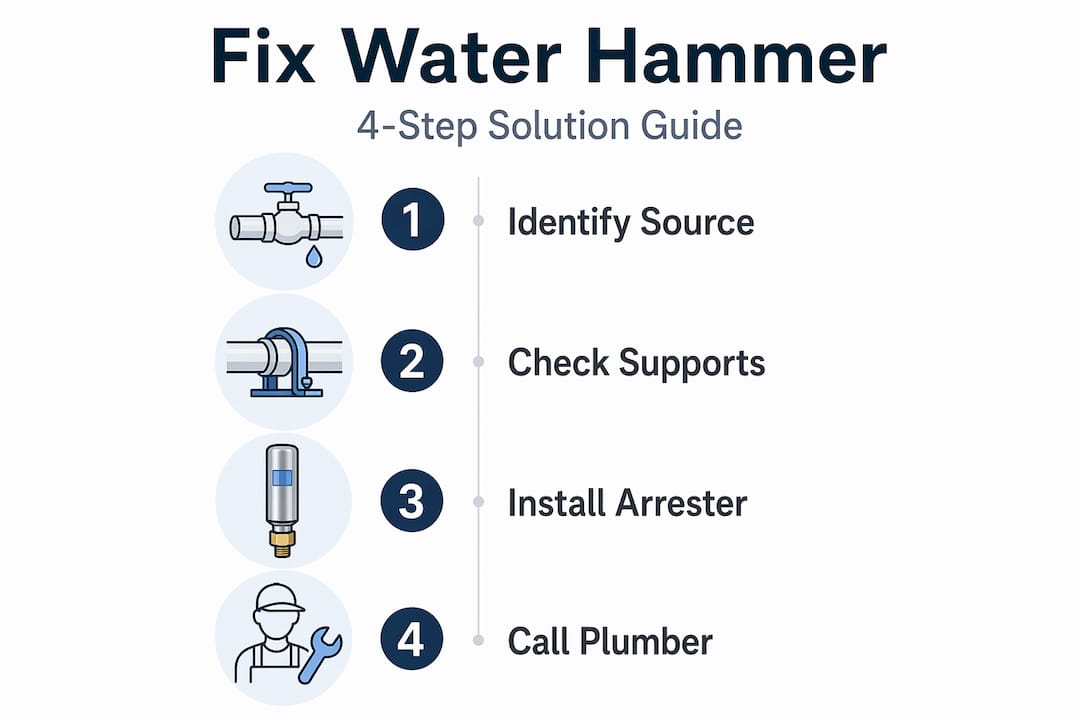
Steps to reduce or eliminate water hammer:
- Secure loose pipes — Check accessible pipework for brackets that have come away from the wall. Pipes that can move freely amplify the effect of shockwaves. Re-securing them reduces noise and stress.
- Clear waterlogged air chambers — Turn off the water supply, open all taps to drain the system, then close the taps and restore supply. This allows air to re-enter the chambers and restore their cushioning effect.
- Install a water hammer arrester near every quick-closing valve, particularly at the washing machine, dishwasher, and toilet cistern. An arrester uses a sealed air charge separated from the water by a piston, which absorbs the pressure spike rather than letting it travel through the pipes.
- Fit a pressure reducing valve if your mains pressure is consistently above 3 bar. Lower mains pressure reduces the severity of any shockwave created by valve closure.
- Replace worn or faulty valves that are not closing gradually enough to give the water time to decelerate.
Pro Tip: Air chambers alone no longer meet modern building codes in new construction. Water hammer arresters are required at quick-closing valves under current guidance, and they must be ASSE 1010 listed. Air chambers are considered unreliable because they waterlog over time. If your home has older air chambers, replacing them with certified arresters is a worthwhile upgrade regardless of plumbing code compliance requirements.
When choosing an arrester, look for one rated to handle your mains pressure and sized appropriately for the flow rate of the appliance it is protecting. A plumber can lower plumbing costs in the long run by selecting the right device first time and installing it correctly, rather than having you work through trial and error.
Knowing when to call a professional is important. If you have cleared air chambers and secured pipework but the banging persists, or if you can see any sign of moisture near pipe joints, it is time to get expert eyes on the system. A plumber can avoid costly repairs from worsening damage by resolving the root cause quickly and correctly.
Why quick fixes often fail — what most homeowners miss about water hammer
Here is something most guides will not tell you directly. The most common first response homeowners have to banging pipes is to wrap them in foam lagging or push foam strips around the pipes where they pass through joists. It reduces the noise. The banging becomes a dull thud instead of a sharp bang. And so the problem seems solved.
It is not solved. The shockwave is still there. The pressure spike is still hammering your pipe joints, your valve seats, and your fittings every single time the washing machine shuts off. You have simply insulated yourself from the sound while the damage continues unchecked beneath your floors and behind your walls.
We have seen this pattern many times. A homeowner spends a Saturday afternoon lagging every accessible pipe in the airing cupboard and declares victory. Twelve to eighteen months later, there is a slow leak from a joint behind the kitchen units, or a valve on the washing machine inlet begins to fail prematurely. The repair bill easily runs to several hundred pounds. The root cause was never addressed.
The uncomfortable truth is that quieting your pipes is not the same as protecting them. If you want to genuinely fix water hammer, the solution has to target pressure control, not noise reduction. That means fitting a quality arrester, checking your mains pressure, and replacing any air chambers that have been in place for more than a few years.
DIY plumbing solutions have their place, and clearing an air chamber or tightening a pipe bracket is well within reach for a confident homeowner. But if you find yourself reaching for the foam lagging without first addressing the valve or pressure issue, you are spending time and money to mask a problem that will eventually find a way to make itself known again, usually at the most inconvenient moment possible.
Get plumbing help and protect your home from water hammer
If you have been hearing banging pipes for a while or you want to make sure your plumbing is properly protected before a small problem becomes an expensive one, it makes sense to get a professional assessment. Water hammer is one of those issues where the cost of prevention is almost always a fraction of the cost of the damage it can cause when left alone.

At Your Local Plumber, our experienced engineers can diagnose the source of water hammer in your home, check your mains pressure, assess the condition of your air chambers, and install ASSE-rated water hammer arresters exactly where your system needs them. We offer transparent pricing and fast response times, so you are never left waiting while the problem gets worse. Whether it is a single noisy appliance connection or a whole-house pressure issue, we have the tools and expertise to sort it efficiently.
Frequently asked questions
Does water hammer cause actual damage to pipes?
Repeated water hammer can stress pipe joints, lead to leaks, and even cause pipes to burst if left unresolved. The pressure wave bounces through piping repeatedly after shutoff, compounding the impact on fittings and joints.
How do I know if my washing machine is causing water hammer?
If you hear a loud bang in the pipes immediately after the machine finishes filling or shuts off, it is a likely cause. Quick-closing appliance valves in washing machines and dishwashers are among the most common triggers in residential plumbing.
Are water hammer arresters required by modern codes in the UK?
Current guidance requires water hammer arresters at quick-closing valves, and specifies that air chambers are not a sufficient substitute. Arresters must be ASSE 1010 listed and installed within six pipe diameters of the protected valve.
Can I stop water hammer myself, or do I need a plumber?
You can try clearing waterlogged air chambers or securing loose pipe brackets as a first step. For lasting results and proper compliance, though, a plumber should assess the system and install a certified arrester at the appropriate locations.