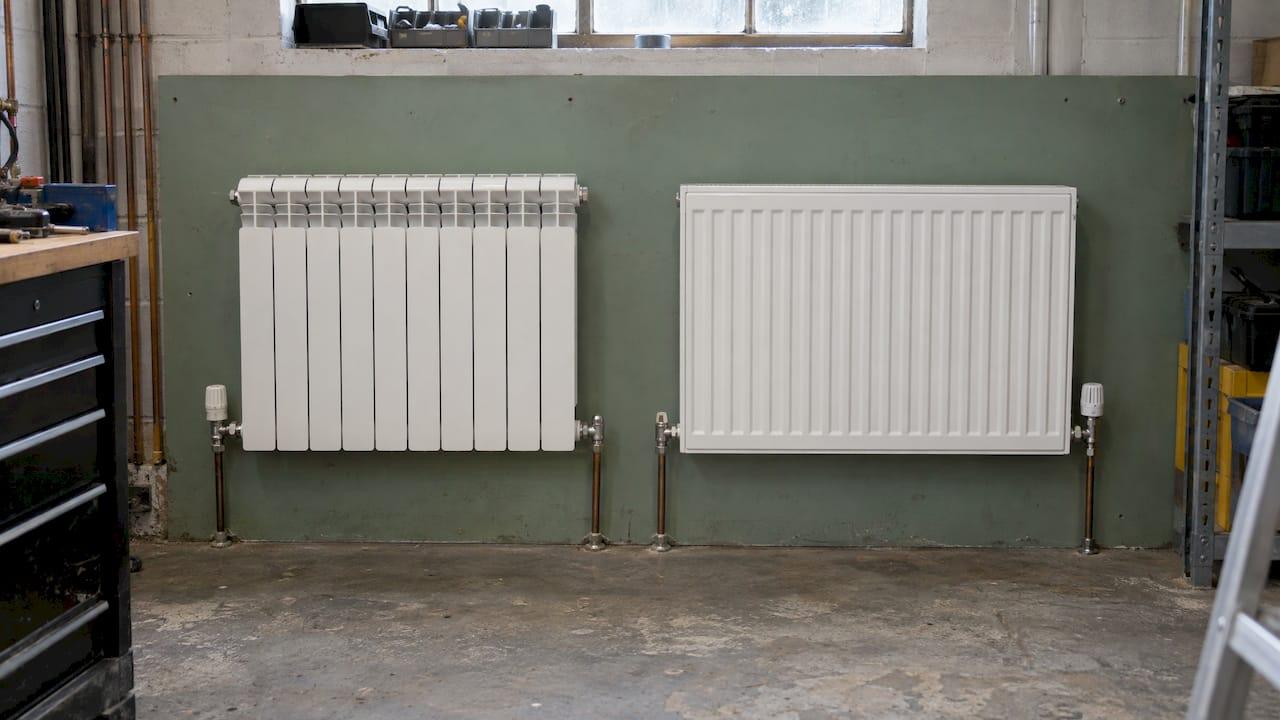
For most UK homes with a gas boiler and heating that runs for long stretches, steel panel radiators are the sensible default: they cost less, hold heat well and are easy to size. Aluminium earns its higher price in rooms you heat in short bursts, on timers or zones, and in systems running at lower flow temperatures. Whichever you pick, the radiator only performs as well as the system behind it, and that is where a heating engineer makes the difference.
TL;DR
- Aluminium warms up and cools down quickly, so it suits timed heating, zoned rooms and spare rooms. It usually costs more upfront.
- Steel takes longer to warm up but keeps giving off heat after the boiler stops. It is the budget-friendly all-rounder for rooms used all day.
- Size matters more than metal. A radiator that is too small for the room's heat loss will disappoint in either material.
- System water matters more for aluminium. It is sensitive to pH and to mixing with other metals, so the inhibitor and the system condition must suit it.
- Heat pump plans change the sums: output falls at lower flow temperatures, so radiators often need to be larger.
Table of Contents
- Aluminium vs steel radiators at a glance
- Why heat-up and cool-down speed differ
- Does aluminium give out more heat?
- Working out the size you need
- Price and lifespan
- System water: the part people forget
- Heat pumps and low-temperature systems
- Which material for which room
- Our view
- Getting the job done properly
- FAQ
- Sources
Aluminium vs steel radiators at a glance
| Steel panel | Aluminium | |
|---|---|---|
| Heat-up | Slower | Faster |
| Cool-down | Slower, keeps residual warmth | Faster |
| Water content | Higher | Lower |
| Weight | Heavier | Lighter |
| Upfront cost | Usually lower | Usually higher |
| Best for | Rooms heated for long periods, older or less insulated homes | Timers, zoned heating, occasional rooms, low-temperature systems |
| Main system risk | Internal corrosion and sludge | pH sensitivity and corrosion where metals mix |
The rest of this guide explains each row so you can choose for your own house rather than for a showroom.
Why heat-up and cool-down speed differ
The key difference is how each material handles heat. Aluminium conducts heat far better than steel. Grant UK, a boiler and heating manufacturer, says aluminium's thermal conductivity can be up to five times that of steel, and that its low water content makes it very responsive to changes in temperature demand.
Less water means less to heat before the surface is warm, and less stored heat to release afterwards. So an aluminium radiator reaches comfortable temperature quickly, and it also stops radiating soon after the boiler switches off.
Steel works the other way. Stelrad, the UK's major panel radiator manufacturer, describes steel's slower cooling as a "stove effect": the larger water volume and heavier metal keep warmth in the room for longer, while aluminium heats quicker but also cools more rapidly.
That is why neither is simply "better". It depends on how you live:
- Home during the day, heating on for hours: the slow heat-up of steel barely matters, and its stored warmth smooths out the cycles of the boiler.
- Out at work, heating on a timer: quick response means the room is warm soon after the heating starts, and you are not paying to warm a large volume of water in a room nobody is in.
Does aluminium give out more heat?
Not automatically. Stelrad's guide to heat output says aluminium radiators can deliver two to three times the BTU output of an equivalent steel or cast iron model, but it also stresses that this does not mean every aluminium radiator emits more heat than every steel one, because size matters as well. Within the standard steel range, it points to K2 (Type 22) and K3 (Type 33) models as the highest-output panels.
In plain terms, "K2" or "Type 22" means two panels with two sets of convector fins behind them, and Type 33 means three of each. More panels and fins mean more heat from the same height and width, which is why a double or triple panel can outperform a slim single. If you are weighing up panel counts for a particular wall, our guide to single vs double radiators walks through it.
The heat output figure on a radiator's label is only comparable if it is quoted at the same temperature difference. UK radiators are rated to the EN 442 standard at what is known as Delta T50, meaning the water averages 50°C above the room temperature. The Radiator Company explains that surface area is the single biggest factor in output, followed by material, water content, flow temperature and the room's heat loss. When you compare two products, compare watts at the same Delta T, not headline claims.

Working out the size you need
Sizing is where most radiator swaps go wrong. A simple way to approach it:
- Estimate the room's heat loss. Window type, wall construction, exposure and room dimensions all count. A north-facing, single-glazed bedroom needs more output than a small, well-insulated interior room.
- Pick a radiator that meets that figure at your system's actual temperature. A boiler running at a conventional flow temperature is different from a low-temperature setup.
- Check wall space and pipe positions before choosing height and width.
- Add thermostatic valves so each room can be controlled. Our piece on why thermostatic valves are worth fitting explains how they work with either material.
Being correctly sized and balanced is worth more than switching metal. After any change, balancing your radiators makes sure each one gets its share of hot water.
Price and lifespan
Aluminium radiators generally cost more than steel panels of similar output, sometimes by a wide margin for designer styles. Steel panels are the cheapest way to buy heat output, which is why they dominate UK homes. Prices vary a lot by size, finish and retailer, so get fitted prices for your specific radiators rather than relying on averages.
On lifespan, both materials can last for many years in a healthy system. One UK heating retailer's guide puts aluminium at roughly 15 to 20 years, conditional on the system being maintained. Building component tables from the Association for Environment Conscious Building give a typical radiator life of 29 years without splitting by metal. The honest answer is that system condition, not the metal alone, decides how long a radiator lasts.
Physical toughness is a smaller consideration. Aluminium is lighter and easier to carry and hang, while heavier steel shrugs off the knocks of a busy hallway or children's room.
System water: the part people forget
What circulates inside matters as much as the radiator itself. The Chartered Institution of Building Services Engineers (CIBSE) explains in a water treatment presentation that aluminium's protective oxide layer depends on the water's pH. If that layer is disrupted, for example by certain inhibitors or softened water that raises the pH, corrosion can occur quickly. The same presentation notes that mild steel and iron corrode rapidly in untreated systems, releasing rust flakes that block pumps and radiators.
Practically, that means:
- Steel in an older system: expect sludge over time. Regular bleeding, a properly dosed inhibitor and a flush when radiators have cold spots keep it in check. Our guide to bleeding radiators properly covers the routine, and common radiator problems lists the quick checks.
- Aluminium in any system: the inhibitor must be one suited to aluminium, and mixing metals (copper pipework, steel radiators, an aluminium heat exchanger) needs a correct water treatment plan. Tell your engineer you are fitting aluminium before the job, not after.
If your boiler is on its last legs, it is worth thinking about the radiators and the boiler together. Our guide to choosing the right boiler size is a good starting point.
Heat pumps and low-temperature systems
Heat pumps run the water cooler than a gas boiler, so radiators give out less heat than their label says. That is because the label figure is at Delta T50 and a heat pump may be working closer to Delta T30. Output falls with the lower temperature, as The Radiator Company notes, and aluminium and larger-surface-area steel radiators tend to perform best at low flow temperatures.
This does not make one material the winner. It makes sizing critical. Many heat pump homes simply fit larger steel panels, such as Type 22 or Type 33, because they deliver output at the lowest cost, and reserve aluminium for rooms where fast response is useful. If you are planning a move to a heat pump and want to understand how it affects your hot water too, this explanation of heat pump hot water with solar gives helpful background on how those systems are arranged.
Which material for which room
| Room | Better fit | Why |
|---|---|---|
| Living room used all day | Steel | Steady warmth, lower cost, stored heat |
| Spare bedroom, home office on timer | Aluminium | Warms quickly when needed, cools when not |
| Bathroom | Either | Choose a model rated for damp rooms and sized for the room |
| Hallway | Steel | Tougher against knocks |
| Zoned extension or conservatory | Aluminium | Responds quickly to thermostats |
| Older, draughty house | Steel | Holds heat for longer between boiler cycles |
Mixing is perfectly sensible. A common approach is steel panels in most rooms and aluminium in one or two spaces where fast response pays off.
Our view
We spend our working days inside people's heating systems, and the pattern is consistent: the best radiator is the one that is sized for the room, on a clean system, with a thermostatic valve on it.
If your heating runs for long stretches and you want value, steel panels are hard to beat. If you heat rooms in short bursts, run zones or timers, or you are preparing for lower flow temperatures, aluminium is a good choice and worth the extra cost.
What we would never skip is the system water. Before any radiator change, we look at the condition of the system, the inhibitor and the balance, because that is what decides whether the new radiators work as promised. You also get direct contact with the engineer doing the job, so you can ask exactly these questions before work begins.
Michael
Getting the job done properly
Choosing a radiator is the easy half. The harder half is fitting it so it heats properly and lasts: draining down, protecting the system water, refilling, bleeding and balancing. Our heating work is charged at £110 per hour, there is no call-out fee, and our no fix, no fee guarantee means you pay only after successful work, with a 12-month warranty on top.

If your boiler is the weak link and a replacement makes more sense than patching, new boilers supplied and fitted start from £1,300, and you can request a new boiler quote for a free on-site visit. For a cold radiator, a leak or a heating failure, book an emergency heating engineer with a 60 minute response time. We work across Reading, Newbury, Oxford, Bracknell, Basingstoke, Swindon, Bristol and many other towns; Reading readers can start with our central heating guide for Reading homeowners, and our piece on heating repair costs explains how to avoid emergency markups.
FAQ
Are aluminium radiators more efficient than steel?
They respond faster, because they have a low water content and conduct heat very well, so they suit homes with timed or zoned heating. Efficiency in practice also depends on correct sizing and good controls. Fitting thermostatic valves and sizing to the room's heat loss often saves more than the choice of metal.
What are the disadvantages of aluminium radiators?
They usually cost more upfront and cool quickly once the heating switches off, which matters in cold, draughty homes with long heating periods. They also need the right inhibitor and a pH-suited system, so tell your engineer you are fitting aluminium. In the right room and system they work very well.
Which radiator gives out the most heat?
Surface area is the biggest factor, so a larger double or triple panel (Type 22 or Type 33) often beats a smaller radiator of any metal. Compare watts at the same Delta T rather than by material alone. A heating engineer can match output to your room's heat loss.
How long do radiators last?
Both materials can last well over a decade in a well-maintained system. One UK retailer rates aluminium at 15 to 20 years, and building tables give a typical radiator life of 29 years. Regular bleeding, correct inhibitor and a clean system are what protect that lifespan.
Sources
- Aluminium Radiator FAQs: Efficiency and Benefits, Grant UK
- Steel vs Aluminium In Radiator Manufacture, Stelrad
- A Guide to the Best Radiators for Heat Output, Stelrad
- Which Radiators Give Out the Most Heat? The Radiator Company
- Which radiator material is right for me? BestHeating
- Typical Life Expectancy of Building Components, AECB
- Water Treatment in Commercial Heating Systems, CIBSE