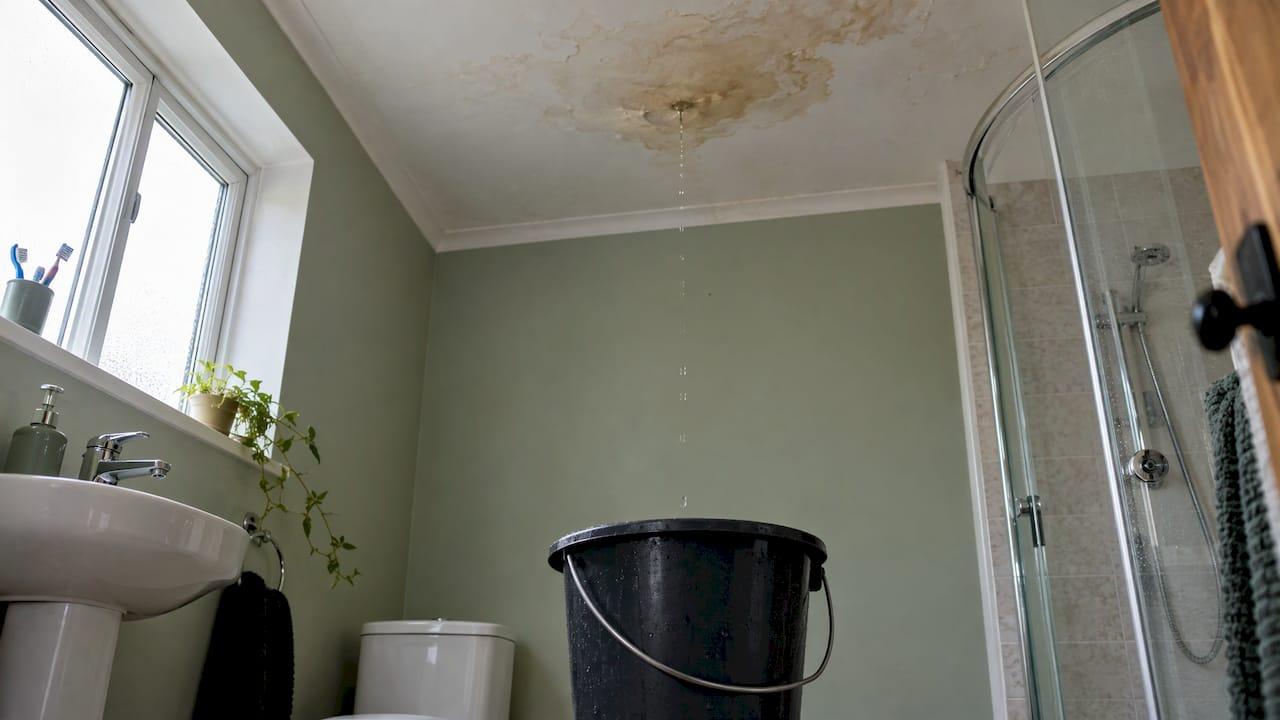
If water appears on the ceiling below your bathroom after a shower, the shower, its waste or the pipework is letting water out somewhere it should not, and it will keep doing so every time you use it. Stop using the shower, protect the room below, and have an engineer find the exact point of failure before anyone seals or re-tiles anything. We can have an engineer with you within 60 minutes on an emergency call, with no call-out fee and payment only after the work is done successfully.
TL;DR
- Stop showering, switch off the electricity at the fuse board if water is near lights or sockets, and catch the drips in a bucket.
- The usual causes are worn seals, failed grout or sealant, a leaking waste or tray connection, faulty pipework or a faulty shower valve.
- Do not run the shower again to "see where it comes from" and do not smear on more sealant as a guess.
- Ring your insurer before work starts, take photos and keep every receipt: trace and access cover may pay for finding the leak.
- A proper repair starts with locating the actual failure point. Our engineers can be with you within 60 minutes, any day of the year.
Table of Contents
- What to do in the first ten minutes
- Why a ceiling leaks after a shower
- Why you should not guess the source
- What a lasting repair involves
- How much will it cost?
- Can you claim on your home insurance?
- Promo: when you want it dealt with today
- Perspective: why the cause comes first
- Prevention: stopping it happening again
- FAQ
- Sources
What to do in the first ten minutes
A stain that grows, a drip from a light fitting or a bulge in the plasterboard all mean the same thing: act now, think later.
- Stop using the shower. Every use sends more water to the same spot.
- Turn off the water if it is running fast. Council self-help guidance says a leak that is flowing quickly, or is close to electrical sockets, switches or appliances, should be treated as an emergency, and that you should shut off the water at the stop tap. Oxford City Council's guidance on leaks sets out the same sequence. If you do not know where your stop tap is, it is usually under the kitchen sink or near where the supply enters the house.
- Switch off the electricity at the fuse board if water is near electrics. That includes downlights, ceiling roses and wall switches in the room below. Keep away from any wet fitting and do not touch the switch.
- Contain the water. Put a bucket or washing-up bowl under the drip and towels around it, but only if it is safe to stand there. If the ceiling is sagging and holding water, do not stand under it.
- Photograph everything. Take pictures of the stain, the bathroom and any damaged belongings, with the date. Your insurer will ask for them.
Our guide to what to do about a water leak in your ceiling right now covers the emergency steps in more detail, including when to relieve a bulging ceiling.
Why a ceiling leaks after a shower
Water has to get past something to reach the ceiling below, and in a bathroom there are several candidates. WaterSafe, the UK water industry's consumer body, lists worn seals, damaged grout, faulty pipework and problems with the shower valve as the typical causes of a leaking shower. It also warns that even a small leak can lead to water damage, mould and higher water bills if left alone.
In practice that breaks down like this:
| Likely cause | What you may notice | Why the ceiling shows it |
|---|---|---|
| Failed sealant or grout around the tray or screen | Gaps, black or peeling silicone, soft grout | Water runs behind the tiles or under the tray edge and drips through the floor |
| Leaking waste or tray connection | Stain appears under the shower waste, often during or just after use | The waste joint is below the tray, directly above the ceiling |
| Cracked or flexing tray | A hairline crack, or a tray that moves when you stand in it | Water escapes through the crack with every shower |
| Pipework or valve leak | Damp on the wall, dripping from the mixer, stain even when the shower is not used | Water is escaping under pressure and can run along joists |
| Blocked or partly blocked drain | Water pooling in the tray, slow draining | Overflow finds its way past the edges |
The timing matters. A stain that appears only while or soon after you shower points to the tray, waste or seals. A stain that appears when nobody has used the shower, or that keeps growing overnight, points to supply pipework, and that is an emergency because pressurised water does not stop on its own.
If the shower mixer itself drips, our guide to stopping a dripping shower mixer explains what is involved.
Why you should not guess the source
It is tempting to run the shower, watch the ceiling and decide it must be the seal. The trouble is that water travels. It follows pipes, joists and the back of plasterboard before it appears, so the stain is rarely directly under the fault. Plasterboard repair guidance for leaks makes the same point: the board has to be cut back to sound material because water tracks sideways further than the visible mark suggests.
That is why we advise against two common reactions:
- Running the shower to reproduce the leak. You add more water to a ceiling that is already soaked, and you risk the electrics below.
- Squeezing fresh silicone over the old line. If the real fault is the waste connection or a cracked tray, the sealant hides the symptom while the damp spreads. It can also leave you with a harder claim later, as the insurance section below explains.
What an engineer does instead is inspect the tray, waste, seals, valve and visible pipework, check the area under the bathroom where access allows, and work out which component has failed. Where the leak is hidden, leak detection can pinpoint it without stripping out half the bathroom.
We also have a guide for the case where the problem is a shower leaking behind the wall, which is common when pipework is chased into a stud wall or tiled partition.
What a lasting repair involves
The repair depends on what has failed, and a good engineer will tell you before starting.
- Reseal or re-grout: if the only fault is worn sealant at the tray edge or screen and the area behind it is dry, a reseal after drying out can be enough.
- Replace the waste or tray connection: a leaking waste joint is a plumbing repair at the tray, and it is one of the most common reasons water reaches the ceiling below.
- Repair or replace pipework or the valve: if water is escaping from the supply side, the pipe or valve is fixed or replaced and the shower retested.
- Replace the tray or enclosure: where the tray is cracked or has moved, a new one is fitted.
- Make good the damage: wet insulation and plasterboard in the ceiling below need to dry out, and badly soaked board is replaced before it is skimmed and decorated. Allow drying time: new board should not be skimmed until the structure has had a drying period.
The order matters. Fixing the source comes first, drying second and decorating last. Painting over a damp ceiling means the stain comes back through the new paint.
If your shower is old and has needed repeated repairs, a replacement is worth discussing with us. We install showers as well as repair them, so you can have the fault fixed and the shower assessed in the same visit.
How much will it cost?
Because the cause varies so much, no honest figure fits every job. Our own guide to shower leaks behind the wall puts typical repairs in a range from £80 to £1,500 and above, depending on whether it is a simple reseal or a repair that involves opening up walls and ceilings.
What shapes the bill:
- How hard the fault is to reach. A waste joint under a tray with an access panel is quicker than pipework behind tiles.
- How long it has been leaking. A leak caught on the day of the first stain usually means less drying and less making good.
- Whether the ceiling needs replacing. Plasterboard, drying and redecorating are separate from the plumbing repair.
On our side, heating and boiler work is charged at £110 per hour, and we do not charge a call-out fee. For plumbing and shower leaks, we assess what is wrong and tell you the price before the work begins, and you pay only after the work has been completed successfully.
Can you claim on your home insurance?
Possibly, and the order in which you do things matters.
Ring your insurer before work starts. Ageas's claims guidance explains that buildings cover may pay for damage from water escaping from pipes, tanks, heating systems, drains and appliances, and for reasonable costs of locating the leak and getting access to it. It advises getting the insurer's agreement before work begins.
Know what trace and access covers. MoneySupermarket's explanation of trace and access says it pays for locating a leak, including thermal imaging, and for making way to reach it and making good the access, but not for repairing the leak itself or the damage it caused. Its tips are to call your insurer first, use any approved tradesperson list, keep photos and receipts, and make sure workers only damage what is necessary. We cover this in more detail in our guide on calling your insurer first about trace and access.

Expect an excess. RIAS's May 2026 home insurance wording confirms a higher excess can apply to leaking water claims, and that trace and access costs are covered only where the buildings were damaged. Your own schedule will state your figure.
Expect questions about the failed part and about gradual leaks. Insurers generally separate the resulting water damage from the failed fitting itself, and gradual seepage from worn sealant is a common exclusion. Read your policy for escape of water, trace and access, limits, excesses and wear-and-tear wording.
Evidence is your job. In a Financial Ombudsman decision, a claim for water coming through a ceiling below a bathroom was fairly declined because the policyholder could not show an insured event. A plumber's statement that the leak "may be due" to water escaping from the tray was not definitive enough. That is a good reason to ask your engineer for a clear written finding of the cause, with photos, rather than a vague opinion.
Promo: when you want it dealt with today
If water is coming through the ceiling now, our emergency engineers aim to reach you within 60 minutes, 24 hours a day, including holidays. There is no call-out fee, our work carries a no fix, no fee guarantee, and you pay only after successful work. You deal directly with the engineer, and we back our work with a 12-month warranty. We cover Reading, Newbury, Oxford, Basingstoke, Bristol, Swindon, Milton Keynes and the towns around them.

Book an emergency plumber with a 60 minute response, or if the leak is slow and the shower is the only thing affected, book a plumbing visit. Over 300 Trustatrader reviews are there for you to read before you decide.
Perspective: why the cause comes first
Most of the ceiling leaks we are called to start the same way: someone notices a stain, a tube of silicone comes out, and a few weeks later the stain is bigger. We would rather you did not go down that road.
Our view is simple. A shower is a plumbing system with a waterproof enclosure around it. When water reaches the ceiling below, one of those two things has failed, and you cannot tell which from the ceiling. So we start by finding the actual fault, then we fix that, and only then do we talk about drying out and making good.
That is also why we work on a no fix, no fee basis, with no call-out fee and payment after the job is done. If we cannot put the problem right, you should not be paying for it. You also speak directly to the engineer, so the person who has seen the leak is the person who explains it to you and, where needed, gives you a clear written account of the cause for your insurer.
If your leak is an emergency, ring us. If it is slow, book it in, but do not leave it for months: damp that sits behind a ceiling grows mould and weakens plasterboard, and it only ever gets more expensive.
Michael
Prevention: stopping it happening again
Once the repair is done, a few habits keep the ceiling dry:
- Look at the sealant and grout around the tray and screen every few months, and keep the tray edge clean and dry.
- Do not ignore a tray that flexes, a slow-draining waste or a mixer that drips.
- Look at the ceiling below after heavy use, such as a house full of guests.
- Keep the area under the bath or tray accessible if you can.
Our guides to preventing bathroom leaks and stopping a shower from leaking go into the routine checks, and the routine for a bath is in five checks for a leak under the bath.
FAQ
Why is my bathroom ceiling leaking?
The commonest causes are failed sealant or grout, a leaking shower waste or tray connection, a cracked tray, and faulty pipework or valves. The timing helps: a stain that appears only during or after showering points to the tray area, while a stain that appears when no one has used the shower suggests pipework. An engineer needs to confirm which, because the stain is rarely directly below the fault.
Can I claim on my house insurance for a leaking shower?
Possibly. Buildings cover may pay for water damage and for reasonable costs of tracing and accessing the leak, but usually not for repairing the failed fitting itself, and gradual seepage from worn sealant is a common exclusion. Contact your insurer before work starts, keep photos and receipts, and check your excess.
How expensive is it to fix a leaking ceiling?
It depends on the cause and the damage. A simple reseal sits at the lower end, while a repair that needs walls or ceilings opened and made good sits at the higher end, which our guide puts at up to £1,500 and above. We tell you the price before the work begins, and you pay only after successful work.
Is it safe to use the shower while I wait for the plumber?
No. Each use puts more water into the structure and onto the ceiling below, which may be near light fittings. Stop using the shower, switch off the electricity at the fuse board if water is near electrics, and contain any drips.
How quickly can someone come out?
Our emergency service aims to reach you within 60 minutes, 24 hours a day, including holidays, with no call-out fee.
Sources
- Oxford City Council: problems with your water supply and leaks
- WaterSafe: why is my shower leaking?
- Ageas Claims: home insurance FAQ
- MoneySupermarket: what is trace and access insurance?
- RIAS home insurance policy wording, May 2026
- Financial Ombudsman Service: decision DRN-4538464