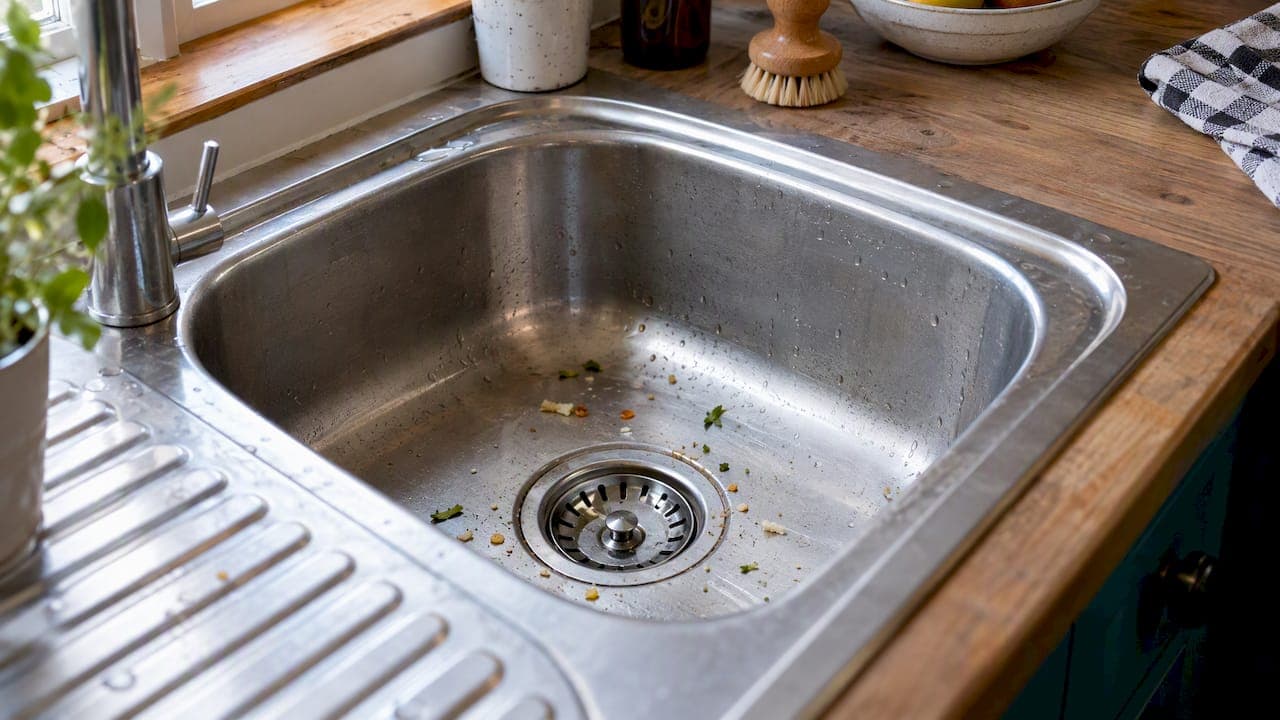
A smelly kitchen sink almost always comes down to one of two things: grease and food residue rotting in the waste pipe, or sewer gas getting past a trap that has dried out, been siphoned empty or been badly fitted. The first is a ten-minute job with a kettle. The second needs a closer look. This guide helps you tell which one you have, fix it safely, and recognise the point where it is time to ring a plumber.
TL;DR
- Most kitchen sink smells come from fat, food and grime building up in the waste pipe, or from sewer gas rising through the U-bend.
- A rotten-egg or sewage smell points to the trap or the drainage system, not to a dirty plughole.
- Start with hot water and washing-up liquid, then soda crystals. Never mix bleach with vinegar or other acidic or ammonia-based cleaners.
- A smell that returns within days, appears when the dishwasher or washing machine drains, or comes with slow draining usually needs a plumber.
- Fats poured down the sink are the biggest single cause of blockages, so what you do after cooking matters more than any cleaner.
Table of Contents
- What the smell is telling you
- Why your kitchen sink smells
- How to get rid of the smell: step by step
- Do not mix bleach with vinegar or other cleaners
- When the smell is sewage or rotten eggs
- Signs the problem needs a plumber
- Our view on kitchen sink smells
- Need a plumber for a smelly sink?
- Stopping the smell coming back
- FAQ
- Sources
What the smell is telling you
Before you reach for a cleaner, notice what the smell is like and when it appears. The same sink can have very different problems.
| What you smell | Likely cause | First thing to try |
|---|---|---|
| Sour, musty, like old cheese or a damp cloth | Food and grease film inside the pipe and plughole | Hot water, washing-up liquid, then soda crystals |
| Rotten eggs or sewage | Sewer gas coming up past the U-bend or from a drainage fault | Run the tap to refill the trap, check for leaks under the sink |
| Smell only when the dishwasher or washing machine drains | Poorly connected waste pipe, or the trap being siphoned dry | Check the appliance hose connection, then call a plumber |
| Smell after you have been away | Trap water has evaporated | Run the hot tap for a minute |
| Smell with gurgling and slow draining | Partial blockage or venting problem | Clear the blockage, then investigate if gurgling stays |
Timing is a clue too. Council drainage guidance points out that smells can be intermittent, linked to peak sewer use or changes in the weather, so noting when it happens helps pin down the cause (Sefton Council guidance on internal venting from drainage systems).
Why your kitchen sink smells
Fat, food and grease in the waste pipe
This is the most common cause and the least dramatic. Scraps slip past the strainer, and fat from pans cools and coats the pipe walls. Bacteria feed on it and the smell comes up the plughole every time warm water hits it. The Chartered Institute of Plumbing and Heating Engineering (CIPHE) says pouring cooking fats down sinks or toilets is the number one cause of drain blockages, and that fats cool and solidify in the pipe, which brings bad smells with it (CIPHE on plumbing emergencies).
The smell is typically sour or stale rather than eggy. If the water also drains slowly, grease is the first suspect.
A problem with the U-bend or trap
The curved pipe under your sink holds a small plug of water. That water is a seal: it stops gas from the drains entering your kitchen. One consumer guide explains that kitchen sink smells are typically caused by sewer gases coming up through the U-bend or by gunk building up in the waste pipe, and that a rotten-egg smell comes from sewer gas and suggests a problem around the U-bend (Domestic & General on smelly kitchen sinks).
The seal can fail in several ways:
- It evaporates. A sink in a spare kitchen, a holiday let or a home you have been away from for a couple of weeks can lose its water. Running the tap restores it.
- It leaks. A loose joint or cracked trap lets the water drain away slowly. Look for damp, staining or drips in the cupboard below.
- It is siphoned out. Rapid discharge from another appliance, or poor venting, can pull the water out of the trap (more on that below).
- It is missing or wrongly fitted. DIY pipework sometimes lacks a proper trap or has one that is too shallow.
Severn Trent, a water company, says a smell inside a property can point to private internal waste pipes, including a problem with a sink trap, as well as incorrectly installed appliances or faulty internal soil vent pipes (Severn Trent sewage smells guide).
Smells when the dishwasher or washing machine runs
If the kitchen only smells while an appliance empties, the sink itself may be fine. Council guidance says smells during appliance drainage often come from poor installation, improperly connected waste pipes, or air displacement that siphons water out of the sink trap. Incorrect venting, including failed air admittance valves, can also push foul air into the room (Sefton Council).
An air admittance valve (AAV) lets air into the pipework so water is not sucked out of traps as it flows away. Manufacturer technical guidance describes AAVs as critical for equalising pressure so the trap seal is not lost, which would otherwise let sewer odours into rooms (Polypipe technical guide on AAV installation). If you want to understand the principle in plain terms, our guide to why plumbing systems need venting walks through it.

A quick test: run the tap hard for 30 seconds with the plug out, then sniff at the plughole. Then run the dishwasher drain cycle. If the smell only appears in the second case, the appliance connection or venting is the thing to investigate, and that is a job for a plumber rather than a bottle of cleaner.
Other sources people overlook
- The strainer and plug. Rubber plugs, overflow slots and the underside of the plughole collect slime. Pull the plug and scrub it.
- A waste disposal unit. If you have one, food residue builds up on the grinding chamber walls and under the rubber splash guard.
- The dishwasher filter. A clogged filter with trapped food can smell, and the smell seems to come from the sink next to it.
- A hidden leak. A slow leak under the sink or behind the unit creates a damp, musty smell. Our guide to the signs of hidden leaks shows what to look for.
How to get rid of the smell: step by step
Work from the gentlest fix to the most involved. Stop as soon as the smell is gone and the sink drains normally.
1. Clean what you can see
Remove the plug and strainer and scrub them with hot water and washing-up liquid. Wipe the underside of the plughole and the overflow. This alone solves more smells than people expect.
2. Hot water and washing-up liquid
CIPHE's advice for a fat, oil and grease blockage is to empty surplus water from the sink, add washing-up liquid and pour boiling water over the outlet, then flush with the hot tap (CIPHE). Take care with boiling water: pour slowly, keep children away, and be cautious with older plastic waste pipes and ceramic sinks, which can be damaged by a sudden rush of very hot water. If you are unsure, use the hottest tap water instead.
3. Soda crystals
If the sink is still sluggish or smelly, CIPHE recommends soda crystals used according to the directions on the box as an alternative way to clear a blockage (CIPHE). Follow the pack, wear gloves, and rinse thoroughly with hot water afterwards.
4. A plunger
If the sink is not draining, a plunger can physically dislodge the blockage before you consider chemicals (Domestic & General). Block the overflow with a damp cloth, cover the plug hole fully with the cup, and plunge firmly. Do not plunge after pouring chemicals into the sink, as they can splash back.
5. Clean the trap
If the smell persists, the trap itself may be coated in grime. Put a bucket underneath, unscrew the trap by hand (most kitchen traps are hand-tight), empty it, rinse it and refit it with the seals in place. Run water and check the joints do not drip. If the trap is corroded, stuck or the pipework looks improvised, stop there and call someone.

6. Refill the seal
After any work, run the hot tap for a minute so the trap holds water again. If you are going away for a long period, a little water down each drain before you leave helps, though it will not last indefinitely.
Do not mix bleach with vinegar or other cleaners
People online often swap between bleach and vinegar when a sink smells. Use one product at a time, and rinse well with water between them. GOV.UK guidance on sodium hypochlorite, the active ingredient in bleach, says it should not be mixed with acidic products such as vinegar or with ammonia-containing cleaners, because the mixtures can produce chlorine gas or chloramines (GOV.UK sodium hypochlorite general information).
There is a second point: a drain that has had one product sitting in it may still contain it. If you have used a shop-bought drain cleaner, do not follow it with anything else, and tell a plumber what you used before they start work, as it affects how they handle the pipework safely. Ventilate the kitchen while you work.
Bleach also does little for the real cause of most smells, which is grease and food residue. Mechanical cleaning and hot water do more good.
When the smell is sewage or rotten eggs
A sulphur or sewage smell deserves more attention than a stale one. It means gas from the drainage system is reaching the room, so something in the barrier has failed. Check these in order:
- Run the tap to refill the trap, then see whether the smell returns within a day.
- Look under the sink for leaks, loose joints or a trap that looks wrongly assembled.
- Check other drains in the house, including the bathroom. If several smell, the cause is more likely a shared fault. Our piece on sewer smell in the bathroom covers the equivalent checks there.
- Listen for gurgling when water drains from the sink or an appliance, which suggests air is being pulled through the trap.
- Look outside for a blocked or overflowing gully or manhole near the kitchen wall.
Signs of a blocked drain include a bad smell, a toilet taking longer to flush, or sewage backing up. For problems within your property boundary, the consumer body CCW advises calling a plumber or an independent drain-clearing company, and contacting your sewerage provider if you are not sure whose responsibility it is (CCW on drain and sewer responsibility).
Who is responsible?
In England and Wales, homeowners are responsible for repairs to drains that serve their property and lie beneath the property, garden or driveway, while main sewers and shared pipework connected to a public sewer fall to the water company (CCW). A smell inside the kitchen is most often on your side of that line, in the waste pipes, trap or appliance connections. If sewage is backing up in several places, or you see it outside, ring the water company as well.
Older properties are more prone to hidden faults. If your home has ageing drainage, it can be worth reading about why old drainage systems should be inspected before a small smell becomes a larger repair.
Signs the problem needs a plumber
DIY is reasonable for a stale smell with a plain cause. Call a professional when:
- you have cleaned the sink and trap and the smell comes back within days;
- the smell is like sewage or rotten eggs and a refilled trap does not cure it;
- it only appears when the dishwasher or washing machine drains;
- the sink gurgles, drains slowly in several fixtures, or water backs up;
- you find damp, staining or a dripping joint below the sink;
- you suspect a pipe is cracked, corroded or wrongly installed.
Severn Trent says that if a smell persists after the basic checks, you should contact a plumber (Severn Trent). A plumber can trace which part of the system is at fault, which is something no cleaner will tell you.
Our view on kitchen sink smells
We get called to kitchen sink smells more than most people would guess, and a lot of them are not drain problems at all. The pattern we see is that people try three or four products from the supermarket aisle, the smell fades for a day or two, and then it returns because the cause was never touched. A trap that is leaking slowly, a dishwasher hose connected without a proper standpipe or air gap, or a vent that is not doing its job will not respond to bleach, however much you pour.
Our advice is simple. Spend ten minutes on the cheap checks: clean the plug and strainer, flush with hot water and washing-up liquid, refill the trap, look under the sink. If that works, great, and change the habit that caused it, which is nearly always fat and food scraps. If it does not, stop buying products and get the pipework looked at. You will save money, and you will not be breathing in fumes from products that were never going to work.
We also think plumbers should be clear about what they charge before they arrive. That is why we work with transparent pricing, no call-out fee, and payment only after the work is done successfully.
— Michael
Need a plumber for a smelly sink?
If the smell keeps coming back, our engineers can find out why and fix it. General plumbing work, including leak repairs and tap and waste problems, can be booked online as a plumbing job. If sewage is backing up or water is escaping and you cannot wait, use our emergency plumbing and heating engineer service, which offers a 60 minute response time.
We work with no call-out fee and a no fix, no fee approach, with payment only after successful work, and our work carries a 12-month warranty. Our engineers cover Reading, Newbury, Oxford, Basingstoke, Bristol and many other towns across the south of England and beyond, and you speak to the engineer directly. You can see everything we do on our main site.
Where heating or boiler work is needed, our published rate is £110 per hour. New boilers supplied and fitted start from £1,300 as a one-off price.
Stopping the smell coming back
Most kitchen sink smells are preventable with a few habits:
- Keep fat out of the sink. Let cooking fat cool, then scrape it into a container and bin it. The Foodservice Equipment Association warns that fat, oil and grease cause foul-smelling kitchen drain blockages and contribute to sewer fatbergs, and that sewer blockages can flood homes and communities (FEA fat, oil and grease guide). What goes down your sink does not stay your problem.
- Wipe plates before washing. Scrape scraps into the food waste or bin first, and use a fine strainer over the plughole.
- Flush weekly with hot water and washing-up liquid, especially if you cook with oil often.
- Run the tap in unused sinks every week or so to keep the trap full.
- Clean the dishwasher filter monthly, and check appliance hoses are secure.
- Do a quick look under the sink when you clean the kitchen. Spotting a damp patch early saves a cupboard.
A wider routine helps too: our plumbing maintenance checklist for UK homeowners covers the seasonal checks that catch small faults before they smell.
FAQ
Why does my kitchen sink smell even after I clean it?
The cause is probably further along the pipe than you can reach with a cloth. Grease can coat the waste pipe and trap, or the trap seal may be failing through a leak, siphoning or poor venting. If cleaning, hot water and soda crystals do not hold the smell off for more than a few days, ask a plumber to inspect the trap and waste run.
Why does my kitchen drain smell like sewage?
A sewage or rotten-egg smell suggests sewer gas is coming up past the trap, or there is a fault in the waste pipes or vent. Refill the trap by running the tap, check under the sink for leaks, and see whether the smell only occurs when appliances drain. If it persists, call a plumber, and contact your sewerage provider if you suspect the problem is outside your property.
Can I pour bleach down the sink to stop the smell?
Bleach is not a good first choice and should never be mixed with vinegar, acidic cleaners or ammonia-based products, because the mixtures can release chlorine gas or chloramines. Hot water, washing-up liquid and soda crystals used as directed are safer and tackle the grease that causes most smells. Use one product at a time and rinse well between them.
Why does the sink smell when the dishwasher or washing machine drains?
The usual causes are a poorly connected appliance waste pipe, or the rush of water siphoning the trap dry because the venting is inadequate. The smell appears at the sink because that is where the air escapes. A plumber can check the hose connection, the trap and any air admittance valve.
Who pays to fix a smelly drain?
In England and Wales, you are generally responsible for drains serving your property that lie beneath your property, garden or driveway, while the water company looks after main sewers and shared pipework connected to the public sewer. If you are unsure, your sewerage provider can tell you whose responsibility it is.
Sources
- CIPHE: Plumbing emergencies, what to do before help arrives
- Domestic & General: What to do if your kitchen sink smells
- Severn Trent: Sewage smells guide
- CCW: Who is responsible for my drains or sewers?
- Sefton Council: Possible causes of internal venting from drainage system
- Polypipe: Air admittance valve installation technical guide
- GOV.UK: Sodium hypochlorite general information
- Foodservice Equipment Association: Fat, oil and grease guide