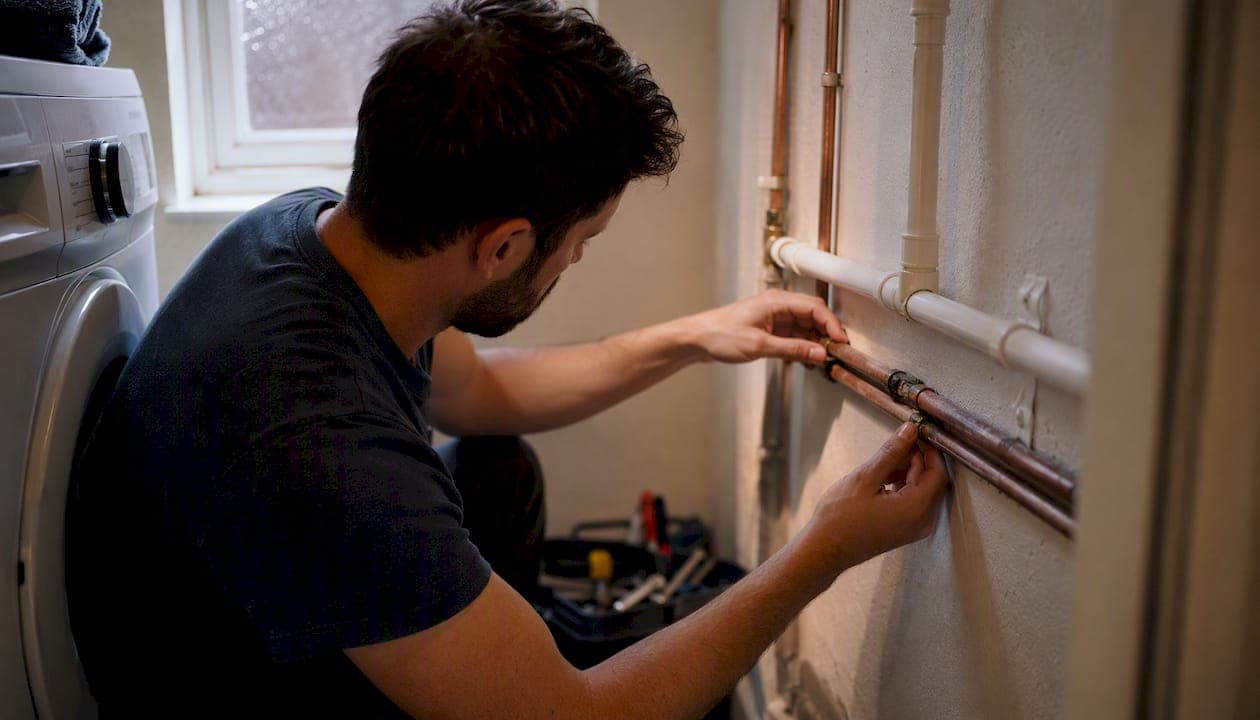
Noisy pipes are almost always caused by one of six things: water hammer, trapped air, high mains pressure, loose pipe runs, limescale or sludge build-up, or thermal expansion. Most of these are straightforward to diagnose and many can be fixed without specialist tools, though persistent severe banging or visible leaks need a professional. Before you do anything else, try these three steps:
- Listen to the timing. A bang on turn-off points to water hammer. Gurgling when the heating starts suggests trapped air. A steady whistle or hum usually means high pressure.
- Check the obvious first. Look for loose pipe clips under the floor or in the loft. A pipe rattling against a joist is one of the most common and cheapest fixes in plumbing.
- Open and close the stopcock slowly. A partially closed stopcock causes turbulence and noise. Fully opening it often stops the sound immediately.
Safety first: shut off the mains supply before working on any pressurised pipework. For anything involving a boiler or gas appliance, call a Gas Safe-registered engineer — do not attempt it yourself.
Pro Tip: If the noise started suddenly rather than gradually, water hammer or a newly loose clip is the most likely cause. Gradual onset usually points to limescale or sludge.
Key takeaways
Noisy pipes are most often caused by water hammer, trapped air, high mains pressure, or loose clips, and most cases can be resolved with basic maintenance before a plumber is needed.
| Point | Details |
|---|---|
| Start with timing and sound | Bang on turn-off = water hammer; gurgle at start-up = trapped air; ticking with heating = thermal expansion. |
| Check clips and valves first | Loose pipe clips and part-closed isolation valves are the most common and cheapest fixes. |
| Bleed radiators before winter | A radiator bleed key removes trapped air and prevents gurgling through the heating season. |
| Call a Gas Safe engineer for boiler work | Any gas appliance work is a legal requirement for a Gas Safe-registered engineer; do not attempt it yourself. |
| Your-local-plumber for persistent problems | When DIY checks do not resolve the noise, Your-local-plumber provides a full diagnostic visit with transparent fixed pricing. |
Table of Contents
- What does the sound and timing tell you about the cause?
- Common causes of noisy pipes explained
- How to locate the noisy pipe run and confirm the cause
- Practical DIY fixes you can safely try at home
- When should you call a qualified plumber or Gas Safe engineer?
- How to prevent noisy pipes from coming back
- How long do fixes take and what do they cost in the UK?
- A local plumber's honest take on noisy pipes
- Noisy pipes? Your-local-plumber can diagnose and fix the problem
- Sources
What does the sound and timing tell you about the cause?
Timing is the fastest diagnostic tool you have. A bang that happens the moment you turn off a tap is almost certainly water hammer, caused by moving water stopping abruptly and sending a pressure shockwave through the pipework. A gurgle or clatter that appears when the central heating first fires up is trapped air working its way through the system. A persistent whistle or hum while water is running points to high mains pressure or a partially closed valve.
Ticking and clicking as the heating warms up is different again. Thermal expansion causes pipes to rub against building fabric as they heat and contract, producing a rhythmic ticking that homeowners often mistake for water hammer. The distinction matters because the fix is completely different: foam or felt at the contact point, not an arrestor.
| Sound | Typical cause | Where to listen |
|---|---|---|
| Bang on tap turn-off | Water hammer | Under sink, near washing machine, boiler feed |
| Gurgling / clatter at start-up | Trapped air in heating circuit | Radiators, pipework near boiler |
| Steady whistle or hum | High mains pressure or part-closed valve | Stopcock, isolation valves, any tap |
| Ticking / clicking when heating runs | Thermal expansion | Pipes passing through joists or clips |
| Gurgling from boiler in cold weather | Frozen condensate pipe | External condensate run at rear of boiler |
| Rattling under floors | Loose pipe clips | Under floorboards, in loft |
Run through this checklist before touching anything:
- Note exactly when the noise happens (on, off, or continuously).
- Identify which appliance or tap triggers it, or whether it happens without any tap running.
- Check whether the noise is louder upstairs, downstairs, or near the boiler.
- Ask whether the noise is new or has been gradually worsening.
Common causes of noisy pipes explained
Water hammer
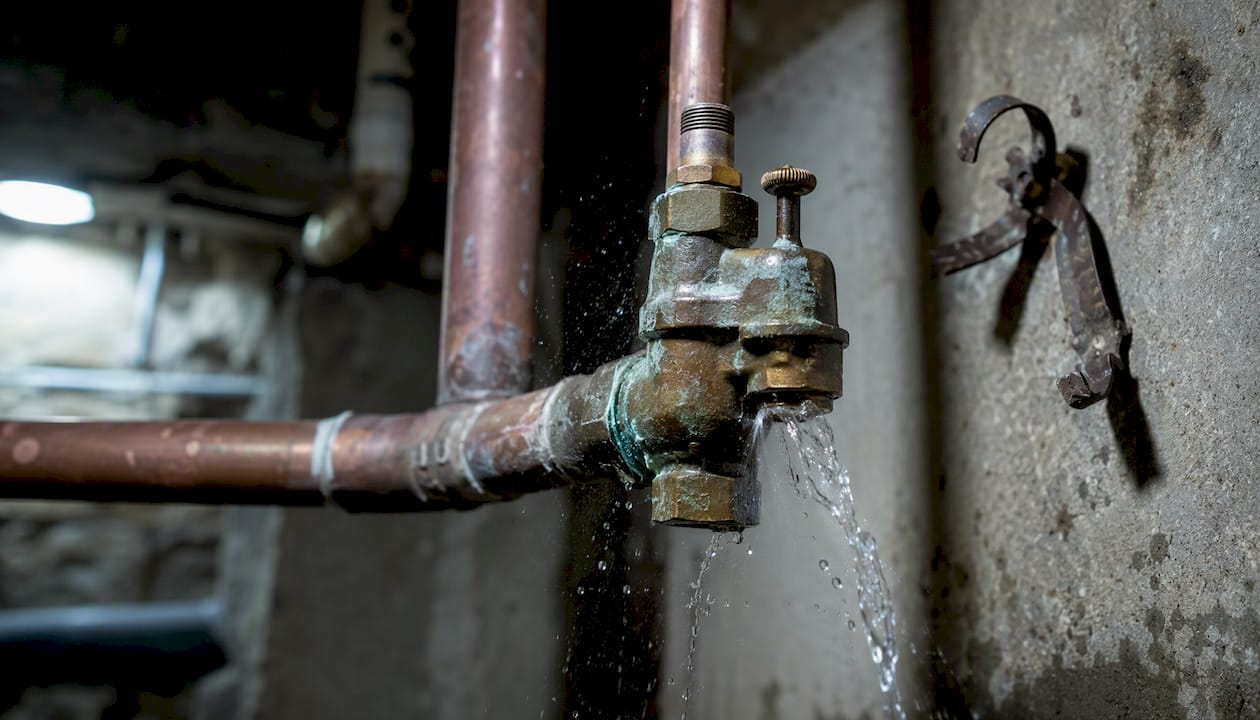
Water hammer is the sharp bang you hear when a fast-closing solenoid valve, such as those in washing machines and dishwashers, shuts off the flow instantly. Moving water stopped abruptly creates a pressure shockwave that reverberates through the pipework. Limescale narrowing the internal bore makes it worse, as does a closed valve reflecting the wave back along the run. A water hammer arrestor fitted close to the offending appliance absorbs the shockwave. A pressure-reducing valve (PRV) set to a safe incoming pressure for UK domestic systems reduces the energy behind each surge.
Trapped air
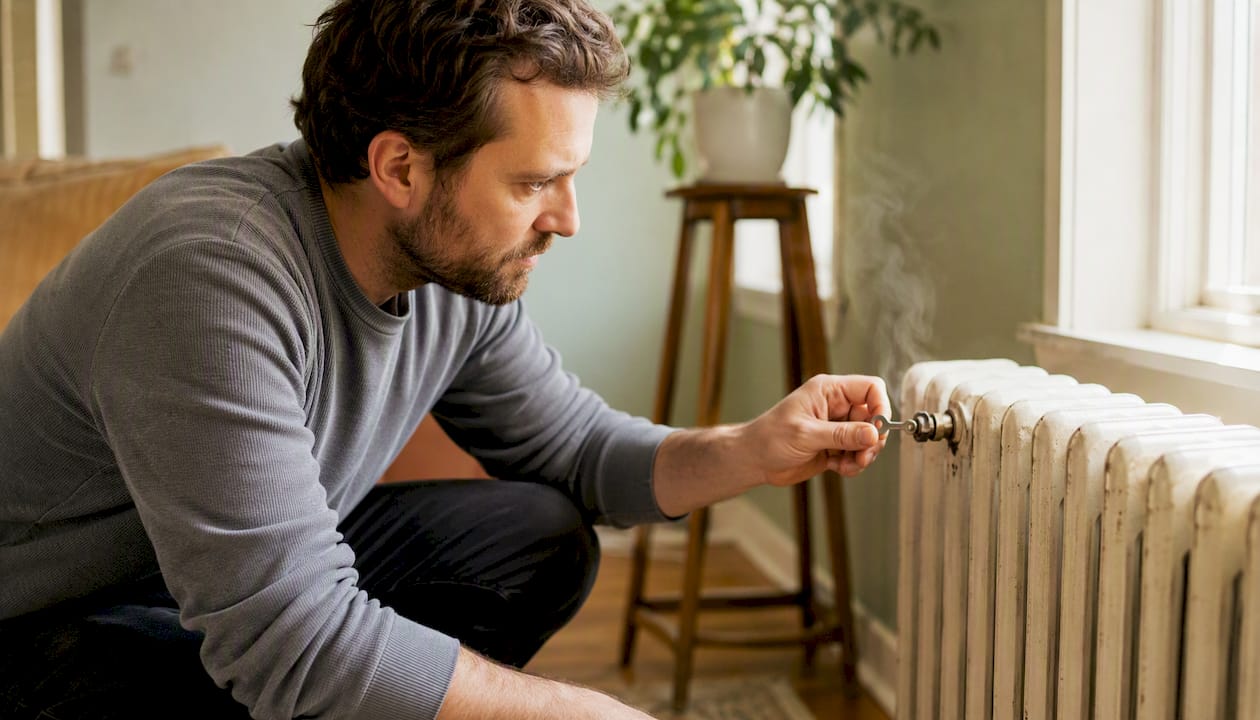
Air in a heating system causes gurgling, sputtering taps, and clattering radiators. It collects at the highest points in the circuit, usually the tops of radiators. Bleeding radiators with a radiator bleed key releases the air pocket and usually stops the noise within minutes. If air keeps returning, there may be a leak drawing in fresh air or a failing expansion vessel.
High mains pressure
UK mains pressure typically arrives higher than domestic systems need. Anything above roughly 3 bar can cause whistling, humming, and amplified water hammer. High pressure also accelerates wear on washers and valves. Fitting a PRV on the incoming supply is the standard fix, and it also protects appliances. High pressure combined with a partially closed valve is a particularly common source of whistling that homeowners spend weeks chasing before checking the stopcock.
Loose pipe clips and unsecured runs
A pipe that is not properly clipped will vibrate against joists, walls, or other pipes whenever water flows. The noise can sound alarming but the fix is simple: add pipe clips or saddles and isolate any rubbing contact points with felt or foam. Clips should be spaced at appropriate intervals on horizontal and vertical copper runs according to pipe diameter and installation standards.
Limescale and sludge
Limescale and sludge reduce the internal bore of pipes, amplify pressure surges, and cause noise in radiators and the boiler heat exchanger. A magnetic boiler filter catches iron oxide particles before they circulate. When sludge is already established, a powerflush or chemical flush clears the system. Hard-water areas of England are particularly prone to this.
Frozen condensate pipe
In cold weather, the external condensate pipe on a combi or system boiler can freeze solid, causing gurgling sounds and triggering a boiler lockout. Thawing the exposed section with warm (not boiling) water usually clears the blockage. Insulating the external run prevents it recurring.
Pump speed
Persistent banging on a heating circuit, particularly one that has no obvious air or pressure problem, often traces back to an incorrectly set circulation pump. A pump running faster than the system needs creates turbulence and noise. Reducing the speed setting, usually a dial on the pump body, can stop the noise without replacing any parts.
Pro Tip: Before buying any parts, check clips and valves first. The majority of noisy-pipe call-outs that turn out to be simple fixes involve a loose clip or a half-closed isolation valve — both take under ten minutes to address.
How to locate the noisy pipe run and confirm the cause
Systematic isolation is the key. Testing one circuit or appliance at a time stops you chasing the wrong source and wasting money on parts you do not need.
- Turn off all appliances and taps. If the noise stops completely, it is flow-related. If it continues, check the heating circuit separately.
- Turn on one tap at a time. Note which tap or appliance triggers the noise and whether it happens on turn-on or turn-off.
- Isolate the heating circuit. Switch the boiler to heating only, then hot water only, to identify which circuit is noisy.
- Check the pump speed setting. The pump is usually on or near the boiler. Most have a three-speed dial; try reducing it by one setting.
- Inspect clips under floors and in the loft. Use a torch to look for pipes touching joists, walls, or each other without any clip or insulation between them.
- Check all isolation valves and the stopcock. Any valve that is not fully open creates turbulence. Turn each one fully open (slot in line with the pipe).
- Bleed each radiator. Use a radiator bleed key, starting from the ground floor and working upward. Stop when water (not air) flows from the bleed point.
Tools you will need:
- Radiator bleed key
- Torch
- Adjustable spanner
- Pipe clips and saddles
- Foam or felt strip
- PTFE tape
Safety reminders:
- Shut off the mains stopcock before opening any pipe joint or replacing a washer.
- Switch the boiler off and allow the system to cool before bleeding radiators if the system is very hot.
- Never work on gas pipework or the boiler itself. A Gas Safe-registered engineer must carry out any gas appliance work.
If the noise is accompanied by a visible leak, a sudden drop in boiler pressure, or a boiler fault code, stop and call a professional. These are signs the problem has moved beyond simple maintenance.
Practical DIY fixes you can safely try at home
Securing loose pipe clips
- Locate the vibrating section by pressing gently on accessible pipe runs while the noise is happening.
- Fit additional pipe clips or saddles at the points where the pipe is unsupported or touching a hard surface.
- Where a pipe passes through a joist or wall, wrap it in foam pipe lagging or push a strip of felt between the pipe and the structure.
- Check that existing clips are tight; a clip that has worked loose over time is a common culprit.
Securing loose runs with additional clips or felt is often the most effective first fix before moving to more complex remedies. Pipe lagging also reduces thermal expansion noise by cushioning the contact point.
Bleeding radiators
- Turn the heating off and let the system cool slightly.
- Place a cloth under the bleed valve on the radiator.
- Insert the radiator bleed key and turn it a quarter-turn anticlockwise.
- Hold the cloth ready. When hissing stops and water appears, close the valve immediately.
- Check the boiler pressure gauge. If it has dropped below 1 bar, repressurise via the filling loop until it reads around 1.5 bar.
Bleeding radiators and venting trapped air commonly resolves gurgling and cold spots in a heating circuit.
Replacing a worn tap washer
A whistling tap is usually a worn washer. Shut off the mains, remove the tap head (most unscrew or have a grub screw under the decorative cap), and replace the rubber washer. This takes around 20 minutes and costs under £2 for the washer.
Fitting a water hammer arrestor
Arrestors are available from UK plumbing suppliers and screw onto the supply line close to the offending appliance. Shut off the mains, fit the arrestor on the hot or cold supply to the washing machine or dishwasher, and restore the supply. Arrestors must be placed close to the fixture causing the shockwave to be effective. If you are unsure about the pipework configuration, a plumber can fit one in under an hour.
Fitting a PRV
A pressure-reducing valve on the incoming mains supply is a more involved job. It requires cutting into the supply pipe and is best left to a plumber unless you are confident with compression fittings. The valve should be set to a safe pressure appropriate for UK homes. See the guide on how water pressure affects your plumbing for more detail on what to expect.
Parts and tools checklist:
- Pipe clips and saddles (various sizes)
- Foam pipe lagging or felt strip
- Radiator bleed key
- Replacement tap washers
- Water hammer arrestor (matched to pipe size)
- PTFE tape and adjustable spanner
How to reset or bleed air chambers and why it helps
An air chamber is a short capped section of pipe that acts as a cushion against water hammer. Over time, water can absorb the air and the chamber loses its effect. Resetting it is simple:
- Shut off the mains stopcock.
- Open all taps in the house and let them drain completely.
- Flush the toilet to drain the cistern.
- Leave taps open for two to three minutes to allow air to re-enter the system.
- Close all taps, then restore the mains supply slowly.
The air chamber refills as water rises, restoring the cushion. If the banging returns within a few days, the chamber may be waterlogged beyond a simple reset, or the problem is not an air chamber issue at all.
For a heating circuit, bleeding trapped air from radiators is the equivalent step. Signs the procedure has worked: radiators heat evenly from top to bottom, gurgling stops, and the boiler runs quietly.
Pro Tip: After bleeding radiators, always check the boiler pressure. Many homeowners bleed successfully but then find the boiler locks out because the pressure has dropped below 1 bar. A quick repressurise via the filling loop takes two minutes.
If banging or gurgling continues after bleeding and resetting, or if you notice water around the boiler or a persistent pressure drop, stop and call a qualified plumber. Repeated pressure loss can indicate a leak or a failing expansion vessel, neither of which is a DIY fix.
When should you call a qualified plumber or Gas Safe engineer?
Some symptoms are clear signals that DIY has reached its limit. Persistent severe banging, visible leaks, or boiler fault codes all warrant a professional inspection. Here is what to watch for:
- Banging that continues or worsens after you have secured clips, bled radiators, and checked valves.
- Any visible water leak, damp patch, or staining near pipework.
- Boiler pressure dropping repeatedly, even after repressurisng.
- Boiler fault light or error code appearing alongside the noise.
- Frozen condensate pipe that does not clear after thawing with warm water.
- Noise accompanied by reduced hot water output or cold radiators that do not respond to bleeding.
- Any smell of gas near the boiler or pipework.
A qualified plumber or Gas Safe engineer will check pump speed and settings, PRV pressure, water hammer arrestors, pipe support and clip spacing, the magnetic boiler filter, system pressure readings, condensate pipe routing, and signs of sludge or corrosion. A diagnostic visit typically takes one to two hours and gives you a clear picture of what is causing the noise and what it will cost to fix.
Gas Safe registration matters. In the UK, it is a legal requirement for any engineer working on gas appliances to be registered with the Gas Safe Register. Always ask to see the engineer's Gas Safe ID card before any gas work begins. For warning signs that go beyond noisy pipes, a professional inspection is the safest route.
How to prevent noisy pipes from coming back
Prevention is cheaper than repair. A few routine checks each year keep most pipe noise causes from developing in the first place.
Annual maintenance schedule:
- Before winter: insulate any external condensate pipe runs and check the boiler pressure.
- Autumn: bleed all radiators before the heating season starts. This removes air that has accumulated over summer.
- Every 12 months: check all visible pipe clips and tighten or replace any that are loose or corroded.
- Every 12 months: inspect isolation valves and the stopcock to confirm they open and close fully.
- Every 2–3 years: have a plumber check the PRV setting and inspect the magnetic boiler filter.
Recommended parts and why they help:
- Pressure-reducing valve (PRV): keeps incoming mains pressure within a safe range, reducing water hammer and washer wear.
- Water hammer arrestor: absorbs pressure shockwaves at the source, protecting pipe joints and appliances.
- Magnetic boiler filter: catches iron oxide particles before they circulate as sludge, reducing noise and improving efficiency.
- Pipe insulation (foam lagging): cushions thermal expansion movement and protects against freezing.
For hard-water areas, a water softener or inhibitor added to the heating system slows limescale build-up. When sludge is already present, a powerflush clears the system more thoroughly than a chemical flush alone. Building good pipe maintenance habits early prevents most of these problems from reaching the stage where a plumber is needed. Annual plumbing checks also catch developing issues before they become expensive.
How long do fixes take and what do they cost in the UK?
Time and cost vary considerably depending on the cause. Simple fixes are genuinely quick and cheap; system-level work takes longer and costs more.
Pricing disclaimer: these are rough UK market ranges only. Actual costs vary by region, access difficulty, and the specific parts required. Always get a local quote before committing to trade work. Severe banging accompanied by leaks or boiler faults is likely to sit at the higher end of these ranges and may require follow-on work.
- For cost-saving tips on plumbing decisions, the guide on cutting plumbing costs for UK homes covers when DIY is sensible and when it is not.
- Understanding pipe leaks is worth reading if the noise is accompanied by any damp or staining.
A local plumber's honest take on noisy pipes
Most homeowners who call about noisy pipes have already spent time worrying about the worst-case scenario: a burst pipe, a failing boiler, or a hidden leak. In the majority of cases, the cause turns out to be a loose clip or trapped air, both of which take under half an hour to address.
The misdiagnosis I see most often is homeowners treating thermal expansion noise as water hammer. They fit an arrestor, the ticking continues, and they conclude the plumbing is seriously wrong. It is not. Ticking that follows the heating cycle is almost always pipes rubbing against building fabric as they expand. A strip of foam at the contact point costs pennies and fixes it immediately.
The one counterintuitive point worth making: do not rush to replace parts before checking settings. Pump speed is the most overlooked variable in a noisy heating system. Turning the pump down one setting costs nothing and resolves a surprising number of persistent banging complaints.
For gas appliances and boilers, there is no grey area. Use a Gas Safe-registered engineer, ask to see their card, and expect transparent pricing before any work begins.
Noisy pipes? Your-local-plumber can diagnose and fix the problem
When you have worked through the DIY checks and the noise persists, or when the symptoms point straight to a boiler or pressurised system, a professional diagnostic visit is the most efficient next step.

Your-local-plumber sends experienced engineers to homes across the UK for exactly this kind of job. On a diagnostic visit, the engineer will check pump speed and settings, PRV pressure, pipe clip spacing, the magnetic boiler filter, system pressure, and condensate routing. If a Gas Safe engineer is needed for boiler or gas work, one will be assigned. Pricing is transparent and confirmed before work begins, with no hidden call-out surprises.
Before booking, note the noise type, when it happens, which appliances trigger it, and any DIY steps you have already tried. That information helps the engineer go straight to the most likely cause rather than starting from scratch.
Book a diagnostic visit and get a fixed-price quote for the repair.
Sources
- Fixing water hammer (banging pipes) | Plumbing Advice
- How to fix pipes making noise when the water is turned on | Homebuilding
- How to fix noise in central heating pipes? | Vaillant
- The Kingspan quick guide to water hammer and how to fix it | Kingspan GB
- Noisy Water Pipes: Causes & Solutions | Screwfix guides