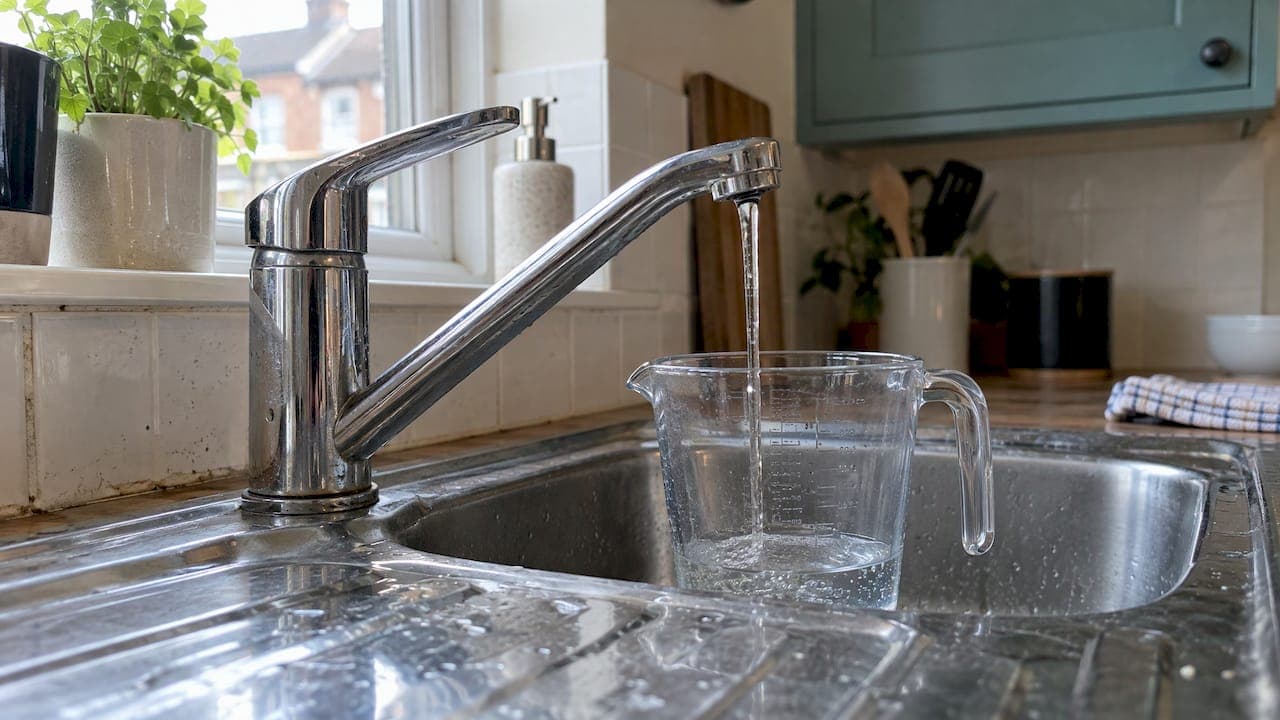
If your kitchen tap is weak, start with a one-litre jug test to see whether the problem is the tap or the water supply. If only the kitchen is affected, the cause is usually a clogged aerator, a worn cartridge, a part-closed valve or a kinked flexible hose. If every tap in the house is weak, the cause is more likely the supply pipe or your water company's network. This guide shows you how to tell which one you have, what you can safely do yourself, and when to ring a professional.
TL;DR
- Time how long your cold kitchen tap takes to fill a one-litre jug. Water companies treat around 7 seconds as the benchmark for a healthy supply.
- Weak flow at one tap only points to the tap: aerator, cartridge, isolating valves or flexible hoses.
- Weak flow at every tap points to the stop tap, the service pipe or the mains supply, and your water company can measure that for free.
- Weak hot only, with strong cold, usually means a worn cartridge or a hot-water system issue. Leave boiler and cylinder work to a qualified engineer.
- We cover kitchen tap repairs, leaks and boiler faults, with no call-out fee and a no fix, no fee guarantee.
Table of Contents
- Is it the tap or the supply? Start with a jug test
- Quick checks you can do yourself
- Hot side weak, cold side fine
- When the whole house is affected
- Is your new tap the problem?
- When to call your water company
- When to call a plumber
- Our perspective
- Get it fixed by a local engineer
- FAQ
- Sources
Is it the tap or the supply? Start with a jug test
Before you take anything apart, find out how big the problem is. Pressure is the force pushing the water. Flow is how much water actually comes out. Most people who say "low pressure" are describing poor flow, and the test below measures that.
- Turn off all other taps and appliances, including the dishwasher and washing machine.
- Hold a one-litre jug under the cold kitchen tap and open it fully.
- Time how long it takes to fill.
Southern Water's flow test uses exactly this method: under 7 seconds is fine, and longer suggests your pressure might be low. Severn Trent says the same, and explains that 7 seconds equals a flow of about 9 litres per minute, which matches its minimum target of 0.7 bar at the boundary stop tap. If it takes longer, something is restricting the flow, such as an air lock or a blockage.
One caution on interpreting the result. Yorkshire Water aims for a flow of 9 litres per minute or more at your main cold feed tap, and notes that many newer kitchen and bathroom taps are designed to deliver less than that to save water. A modern tap with a flow regulator can therefore feel gentler than your old one without anything being wrong. Do the jug test at the main cold kitchen tap, or with the aerator removed, to get a true reading of your supply.
Comparing results across the house
Repeat the jug test at the bathroom basin and another cold tap. The pattern tells you where to look:
| What you find | Most likely area | Next step |
|---|---|---|
| Only the kitchen tap is slow, hot and cold | Aerator, flexible hoses, isolating valves | Work through the checks below |
| Only the hot side is slow | Mixer cartridge or hot-water system | Check cartridge, then call an engineer |
| Only the cold side is slow | Tap cartridge or cold-side valve | Check valve and cartridge |
| Every tap is slow | Stop tap, service pipe, mains supply | Check stop tap, then contact your water company |
| Slow only at certain times of day | Local demand on the network | Note the times and tell your water company |
Quick checks you can do yourself
Work from the simplest to the most involved. Each of these takes minutes, and none needs special tools beyond a cloth, a screwdriver and possibly a pair of pliers.
1. Clean or replace the aerator
The aerator is the small mesh screen at the tip of the spout. It mixes air into the water for a smooth stream, and in hard-water areas limescale and grit collect in it. A clogged aerator is the most common reason for a weak stream from a single tap, and the easiest to fix.
- Put the plug in the sink so no small parts disappear.
- Unscrew the aerator by hand, or wrap it in a cloth and use pliers gently so you do not mark the finish.
- Rinse out grit and flick out any debris from the mesh.
- Soak it in white vinegar for around half an hour if it is crusted with limescale, then rinse and refit.
- Run the tap with the aerator off. If the flow jumps back to normal, you have found the cause. If the mesh is damaged, a new aerator of the same size and thread is cheap.
With the aerator off, you can also run the jug test again for a clean reading of what the pipework delivers.
2. Check the isolating valves under the sink
Most kitchen taps have a small valve on each supply pipe underneath. They are often flat-slot screws that can be knocked, left half-closed after a previous repair, or partly blocked with debris. Turn each one so that its slot lines up with the pipe, which is normally the open position. If the flow improves, great. If not, leave them open and move on.

3. Look at the flexible hoses
Mixer taps connect to the pipes through short braided hoses. A kink behind the cupboard back, or a hose squashed by bottles and cleaning products stored in front of it, will cut flow sharply. Straighten it out gently. If a hose looks corroded, bulging or damp, do not keep using it: leaking hoses cause real damage, and our guide on common causes of water leaks in your home shows what to watch for.
4. Check for an air lock
After plumbing work, or a mains shutdown, air can get trapped and make the tap splutter and run weakly. If your tap coughs and spits before running, see our explanation of why a kitchen tap splutters. Often it clears if you run the tap fully open for a minute or two.
Hot side weak, cold side fine
If the cold tap fills the jug in under 7 seconds but the hot side crawls, the supply to the house is fine and the fault sits in the tap or the hot-water system.
Worn cartridge
Modern mixer taps use ceramic disc cartridges with separate channels for hot and cold. Bathroom Spare Parts explains that a worn or cracked cartridge typically affects just one side, and that the hot side is more vulnerable because heat speeds up wear on the discs and seals. The result is weak hot flow while the cold runs at full strength. Replacing a cartridge is a manageable job if you are comfortable isolating the water and working carefully, and our step-by-step tap cartridge replacement guide walks through it.
Hot-water system
If the hot flow is weak at several taps, or the water also turns hot and cold, the issue may be in the boiler, the cylinder or the pipework feeding them. This is not DIY territory. Boiler heat exchangers in particular should not be descaled or flushed at home, because the wrong chemicals or pressure can damage seals and internal parts, as one heating engineers' blog points out. Any gas appliance work must be done by a Gas Safe registered engineer.
When the whole house is affected
If the bathroom and kitchen are both slow, you are looking at the supply into the home rather than a single tap.
Check the internal stop tap
Ofwat advises first checking for a partly closed internal stop tap or a leak. The stop tap is usually under the kitchen sink or where the mains pipe enters the house. It should be fully open. Turn it all the way anticlockwise, then back a quarter turn so it does not seize.
Natural and network causes
Ofwat says pressure at your tap depends on how high the service reservoir or water tower is above your home, how much water neighbours are using, and the height of your property. Homes at the top of a hill can receive lower pressure than those at the bottom. Low pressure can also come from high demand, dry spells, inadequate pumping, undersized mains, or leaks and blocked service pipes. Evening peaks, when everyone is cooking and showering, often show up as a temporary dip.
Ofwat also notes that you should not notice any difference in pressure after a water meter is installed, so a recent meter is not an explanation.
Old or narrow service pipes
In older homes, the pipe from the street can be narrow-bore lead or early iron that narrows internally over decades. PlumbingAdvice describes how a narrow pipe can give decent pressure but poor flow when several outlets are used at once, and that the fix is a replacement service pipe. Who is responsible for which section of pipe depends on where it runs, so ask your water company before arranging work.
Gravity-fed hot water
If your hot water comes from a loft tank and cylinder, the flow at the kitchen hot tap depends on the height of the tank above the outlet. The same source explains that a pump can be fitted to boost flow for gravity systems. Pumps need to be matched to the system, so ask a plumber to specify one rather than buying one off the shelf. For a fuller look at causes, see our articles on what causes low water pressure at home and how water pressure shapes your plumbing.
Is your new tap the problem?
If the weak flow began right after you fitted a new kitchen mixer, check the tap itself. Some taps are built for high-pressure mains supplies and perform poorly on low-pressure or gravity-fed systems, and others are designed for low pressure. Check the manufacturer's stated minimum operating pressure, and match it to your system type: mains-fed combi, unvented cylinder, or tank-fed. A tap with a built-in flow restrictor will also feel gentler than the old one, as Yorkshire Water points out. If you are choosing a new tap, tell your plumber what type of hot-water system you have before you buy.
When to call your water company
If the stop tap is fully open, you have no leak, and the whole house still fails the 7-second test, contact your water company. Yorkshire Water says to get in touch if your supply remains below 9 litres per minute after you have done the checks, and Ofwat says the company can take pressure and flow measurements.
It is worth knowing your rights. The Consumer Council for Water factsheet says companies should maintain a minimum of 0.7 bar (seven metres static head) in the communication pipe. If pressure falls below that on two occasions, each lasting more than an hour, within 28 days, the company must automatically make a Guaranteed Standards Scheme payment, subject to exceptions. Keep a note of dates, times and what you tested.

When to call a plumber
Call a plumber when:
- cleaning the aerator and checking the valves has made no difference;
- the hot side is weak and the cold is fine, and you do not want to change a cartridge yourself;
- you can see damp, dripping hoses, or stains under the sink;
- the hot-water problem seems to involve a boiler, immersion heater or cylinder;
- your water company says the supply to your boundary is fine, so the fault is inside the property.
A hidden leak can also reduce pressure at the taps. Our piece on signs of hidden leaks lists what to look for, such as a meter that keeps moving when everything is off.
Our perspective
In our experience, a kitchen tap that suddenly runs weak is usually a small, fixable fault, and the quickest route is to be methodical. Test the flow, rule out the aerator and valves, then decide whether you are dealing with the tap, the pipework or the water supply.
What we see too often is people replacing a perfectly good tap because the real problem is a worn cartridge, a tired hose or a half-closed valve. We would rather diagnose first. Our engineers talk to you directly, find the actual cause, and give you a transparent price before the work starts.
That is why we work with no call-out fee, a no fix, no fee guarantee and payment only after the job is done successfully. If the fault turns out to be in your boiler or hot-water system, the same engineer can deal with that too, so you are not passed between firms.
Michael
Get it fixed by a local engineer
If you would rather not take the taps apart, we can do it. We repair and replace taps, trace leaks, and diagnose boiler and hot-water faults across our service areas. Heating and boiler work is charged at £110 per hour, and new boilers supplied and fitted start from £1,300 as a one-off price. We offer no call-out fee and a no fix, no fee guarantee, and our work carries a 12-month warranty.

For tap and pipework problems, book a plumber online. If water is escaping, or you have lost hot water and heating, use our 60-minute emergency response booking. If your boiler is the cause and is due for replacement, you can request a free new boiler quote.
FAQ
Why is the pressure low at my kitchen tap but fine elsewhere?
That points to the tap or its connections rather than the supply. The most common causes are a limescale-blocked aerator, a worn cartridge, a part-closed isolating valve or a kinked flexible hose. Clean the aerator first, since it takes five minutes and costs nothing.
Why is my hot kitchen tap slow when the cold is fine?
The cold supply is healthy, so the fault is in the hot side of the tap or the hot-water system. A worn mixer cartridge is a frequent cause, because hot water wears the discs and seals faster. If several hot taps are weak, have an engineer look at the boiler or cylinder.
How do I know if my water pressure is too low?
Turn off everything else and time how long the cold kitchen tap takes to fill a one-litre jug. Water companies such as Severn Trent and Southern Water treat around 7 seconds as the benchmark. Longer than that suggests a restriction or low supply.
Can a plumber fix low water pressure?
Yes, if the cause is inside your property: tap parts, valves, hoses, internal pipework, leaks or the hot-water system. If the cause is the mains or the pipe in the street, your water company has to investigate, and a plumber can help you gather the evidence.
Sources
- Water pressure, Ofwat
- Low water pressure, Southern Water
- No water or low water pressure?, Yorkshire Water
- Supply and pressure, Severn Trent
- Signs of low water pressure factsheet, Consumer Council for Water
- Low hot water tap pressure: causes and quick fixes, Bathroom Spare Parts
- Low flow rate from all taps and showers, PlumbingAdvice
- Why your combi boiler hot water keeps turning hot and cold