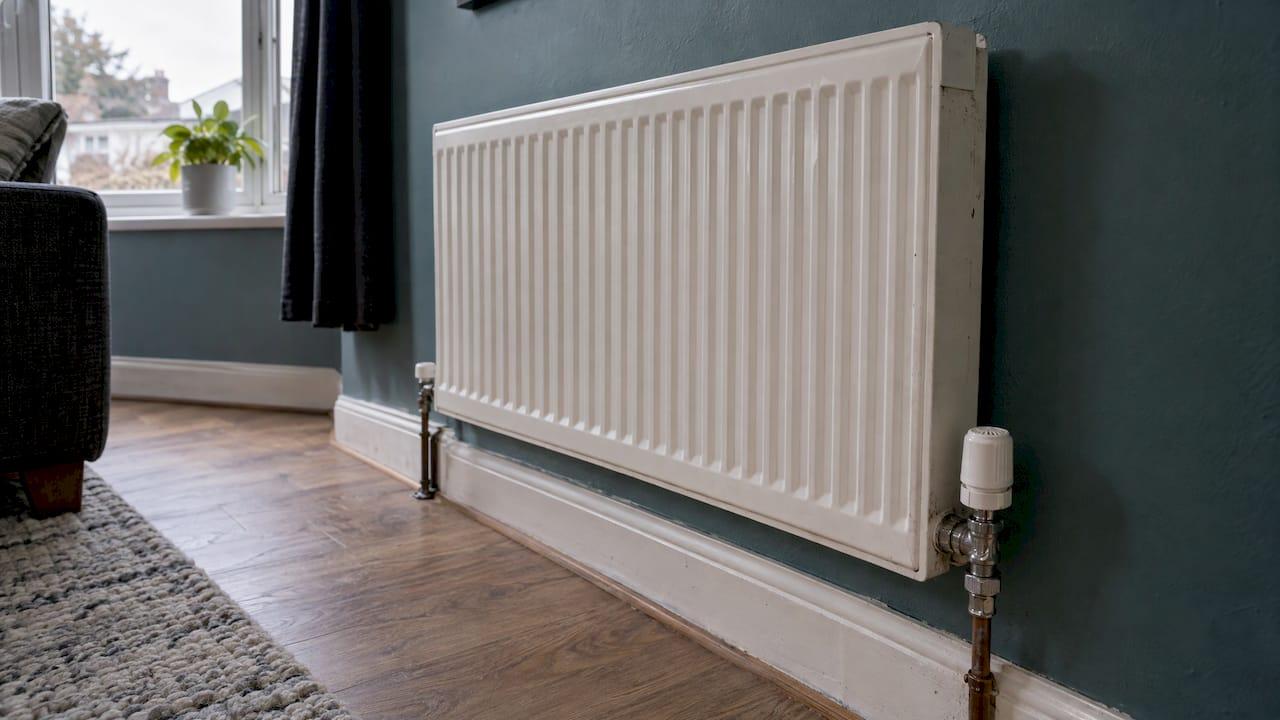
When one radiator stays cold and the rest of the house is warm, the fault is almost always local: a closed or stuck valve, trapped air, or a blockage inside that one radiator or its pipework. The checks below take about twenty minutes, run from the simplest to the most involved, and show you the point where a job needs an engineer rather than a spanner. If you are in Reading, Newbury, Oxford, Basingstoke, Bristol or anywhere else we cover and the radiator is still cold after the checks, our heating engineers can take it from there.
TL;DR
- First decide whether one radiator or several are cold. One cold radiator points to a local fault, several point to the system.
- Check both valves are fully open, then feel where the radiator is cold. Cold at the top means air, cold at the bottom means poor circulation or sludge.
- Bleed only with the heating off and the radiator cool, open the valve about half a turn, and check boiler pressure afterwards.
- A stuck thermostatic valve pin, a wound-shut lockshield valve, or a radiator that stays cold after bleeding is an engineer's job.
- Our heating work is charged at £110 per hour, with no call-out fee and a no fix, no fee guarantee.
Table of Contents
- Start here: is it one radiator or the whole system?
- Check 1: the valves at both ends
- Check 2: feel where the radiator is cold
- Check 3: bleeding a radiator with trapped air
- Why upstairs or last-in-line radiators stay cold
- Sludge and blockages
- When to call an engineer
- What it looks like when we fix it
- Book an engineer for a cold radiator
- Our view on cold radiators
- FAQ
- Sources
Start here: is it one radiator or the whole system?
The first question decides everything else. Southwark Council's troubleshooting guidance begins by asking whether one radiator or all of them are affected, because the answer changes what you check next.
If every radiator is cold, look at the boiler, its pressure, the thermostat and the timer. That is a different problem from the one in this article. If only one radiator is cold, or if the radiators upstairs are cold while those downstairs are fine, carry on here. Broxtowe Borough Council's leaflet on radiator problems says a single cold radiator with the others working points toward a local fault, with valves the first thing to check.
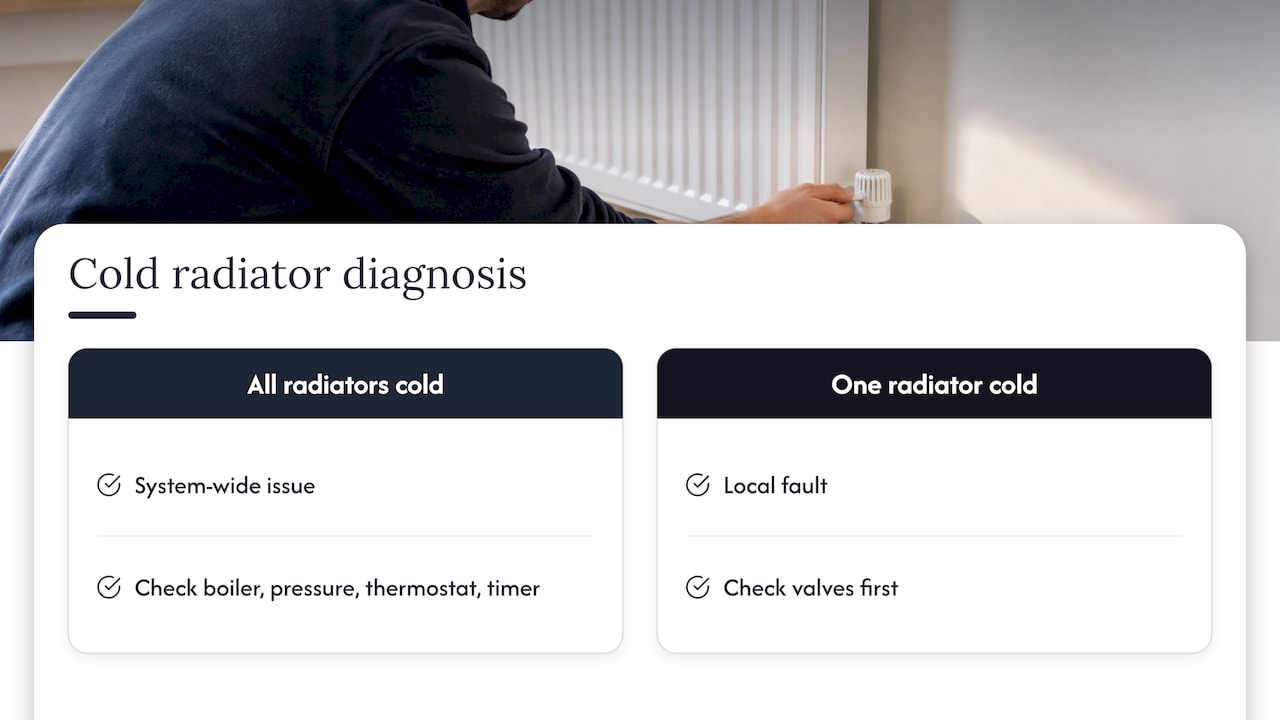
Turn the heating on and give it at least 20 to 30 minutes before judging. A radiator on a cold house takes time to warm, and a radiator at the end of a long pipe run takes longer still.
Check 1: the valves at both ends
Every radiator has two valves, usually at the bottom on either side.
- The thermostatic radiator valve (TRV) is the one with numbers, usually 0 to 5, on its head. It controls how much hot water enters the radiator. If you want to understand how it works in more detail, we explain the role of thermostatic radiator valves.
- The lockshield valve sits on the other end under a plastic cap. It is set once when the system is balanced and is rarely touched afterwards.
Turn the TRV head to its highest setting. Southwark's guidance is to turn the valves to maximum first and only then consider bleeding. Remove the cap from the lockshield and check with a small adjustable spanner that it is open. If you do not know how far it was set, note the position before you move it, because changing it can upset the balance of the other radiators.
When the thermostatic valve is stuck
A TRV contains a small pin that moves up and down. On older valves, or on radiators that have been off for months, that pin can seize in the closed position. Grant UK's guidance on radiator valve problems says a stuck TRV stops hot water entering the radiator and advises you not to force it, but to have a heating engineer inspect it.
A typical sign is a radiator that is cold all over, with a TRV head that turns freely but changes nothing, while the pipe leading to the valve is hot or warm. Pushing hard on the pin with pliers is how a valve ends up leaking onto the carpet. If you have already had a leak at a valve, our guide to stopping a radiator valve leak covers the first response.
Check 2: feel where the radiator is cold
Once the valves are open and the heating has run for a while, feel the whole panel, taking care because it can be hot. The pattern is a useful clue, not a verdict.
| What you feel | Most likely cause | What to do |
|---|---|---|
| Cold at the top, warm at the bottom | Trapped air | Bleed the radiator |
| Hot at the top, cold at the bottom | Poor circulation or sludge | Check flow and valves, then call an engineer |
| Cold all over, pipe to the valve cold | Closed or stuck valve | Re-check both valves, then call an engineer |
| Cold all over, pipe hot | Stuck valve pin or blockage at the valve | Call an engineer |
| Warm but slower than others | Unbalanced system | Balancing, see below |
The table follows the symptom-to-cause pattern set out in Energy Guide's radiator troubleshooting article. The Broxtowe leaflet makes the same point from the other side: bleed only when the symptoms suggest air, such as a cold top and warmer bottom, rather than bleeding a radiator as routine.
We have written more on each pattern: radiator cold at the top and radiator cold at the bottom.
Check 3: bleeding a radiator with trapped air
Air collects at the top of a radiator and stops hot water filling it. Bleeding lets it out through a small valve at one top corner. Do it in this order.
- Switch the heating off and wait until the radiator is cool. The system is still under pressure, and bleeding hot water can scald.
- Lay a towel under the bleed valve and hold a cloth against it.
- Fit the bleed key and turn it anticlockwise about half a turn. Crawley Council's heating controls leaflet warns that unscrewing the valve completely can cause flooding.
- Listen for a hiss. When water starts to come out steadily, close the valve by turning it clockwise.
- Check the boiler pressure. Broxtowe's leaflet explains that bleeding a sealed combi system lowers its pressure and points you to the boiler manual for repressurising.
- Turn the heating back on and feel the radiator again after half an hour.
Most sealed systems run at roughly 1 to 1.5 bar when cold, and the pressure gauge is on the front of the boiler. If it has dropped below that range, top up only as your boiler manual describes. Our guide on what to do when a boiler loses pressure goes through the filling loop step by step. For a fuller walk-through of the bleeding routine, see radiator bleeding best practice.
If no water comes out, or the air keeps coming back
A hiss that fades into nothing, with no drip of water at all, can mean the radiator is not being fed because the supply is shut off or blocked. That sends you back to the valves. A radiator that fills with air again within days is a different matter: it can point to a leak somewhere in the system, a filling problem or corrosion producing gas. Re-bleeding every week treats the symptom, and this is a good moment for an engineer to look at the cause.
Why upstairs or last-in-line radiators stay cold
If the cold radiator is upstairs or the furthest from the boiler, there are two common reasons. Air rises, so the upstairs radiators are where trapped air most often gathers. Bleed those first, starting with the one nearest the boiler and working to the furthest.
If bleeding does not help, the system may be unbalanced. The HHIC consumer guide to balancing explains that in an unbalanced system some radiators take the bulk of the hot water, leaving others with little flow. Balancing means adjusting the lockshield valves so each radiator takes its fair share. The guide says engineers typically aim for a 20°C difference between flow and return temperatures on condensing gas boilers.
Balancing is fiddly: it needs the radiators set in a particular order, usually two thermometers and some patience, and a change to one radiator affects the rest. We cover the method in balancing radiators for UK homes. Turning the boiler or pump up is not a substitute. The HHIC notes it may or may not help, and it raises energy use and can make valves noisy.
Sludge and blockages
When the top is hot but the bottom stays cold, the cause may be sludge: a build-up of iron oxide deposits that settle at the bottom of radiators and narrow the waterways. The same symptom can come from poor circulation, a faulty pump or a part-closed valve, so a cold bottom alone does not tell you what has failed. The HHIC guide notes that a faulty pump or sludge can produce cold-radiator symptoms similar to an unbalanced system.
What you can safely do yourself is to confirm the valves are fully open and check that the other radiators are heating properly. Anything beyond that, such as draining down the radiator, removing it or dealing with the pump, involves water and sometimes gas appliances. This is the point to hand it over.
When to call an engineer
Stop and call someone when:
- the TRV pin is stuck or the valve will not turn freely;
- the lockshield is seized, or you suspect the system needs balancing;
- the radiator stays cold after both valves are open and the radiator has been bled;
- air returns again and again, or boiler pressure keeps falling;
- several radiators have cold spots, which suggests a system-wide problem;
- you suspect the boiler or pump is at fault.
Boilers and gas appliances must only be worked on by a Gas Safe registered engineer. If you smell gas, do not look for the cold radiator: leave the property, open windows and call the National Gas Emergency Service on 0800 111 999.
What it looks like when we fix it
A single cold radiator is usually a short job once the cause is found. With a stuck valve, an engineer can free or replace the valve; with a lockshield problem, the radiator can be rebalanced with the rest of the system. The part that costs time is diagnosis, which is why we recommend you do the checks above first and tell the engineer what you have already tried.
Our heating and boiler work is charged at £110 per hour, with no call-out fee. We operate a no fix, no fee guarantee and you pay only after the work is done successfully. Our work carries a 12-month warranty, and you deal directly with the engineer who comes to your home.
Book an engineer for a cold radiator
If the checks have not warmed the radiator, book a heating engineer through our site. We cover towns including Reading, Newbury, Oxford, Abingdon, Bracknell, Windsor, Basingstoke, Winchester, Swindon and Bristol, and our site lists same-day response and 24/7 availability, including holidays.

If the radiator has gone cold in the middle of a cold snap along with the boiler, or a valve is leaking, use our emergency heating engineer service, which has a 60 minute response time. If the radiator is cold because the boiler is old and failing, we offer a free on-site new boiler quote, and new boilers supplied and fitted start from £1300.
Our view on cold radiators
Most of the cold radiators we are asked about have a simple cause, and the owner has often already done half the work: opened the valves, bled the radiator, and then got stuck when it stayed cold.
That is exactly where a heating engineer earns the visit. A seized valve pin, a lockshield wound shut years ago or a circulation problem cannot be solved with a bleed key, and forcing them tends to turn a cold radiator into a wet carpet.
What we want you to have is a fast, fair answer. That is why we offer no call-out fee, a no fix, no fee guarantee and payment only after the work is done. You also speak directly to the engineer, so you can explain what you have already tried and save time on the job.
If you have worked through the checks above and the radiator is still cold, call us and we will take it from there.
Michael
FAQ
Why is only one radiator not heating when the others work?
The fault is usually local to that radiator: a closed or stuck valve, trapped air or a blockage. Check that both valves are open, then feel where it is cold. Cold at the top suggests air, while a cold bottom suggests poor circulation or sludge.
Why are my upstairs radiators cold?
Air rises, so trapped air gathers in upstairs radiators first, and bleeding them often solves it. If it does not, the system may be unbalanced, with the radiators nearest the boiler taking most of the hot water. Balancing adjusts the lockshield valves to share the flow more evenly.
Can I bleed a radiator with the heating on?
It is safer not to. Switch the heating off and let the radiator cool first, because the system is still under pressure and hot water can escape. Open the bleed valve only about half a turn, close it when water appears, and check the boiler pressure afterwards.
Do I need to repressurise the boiler after bleeding?
On a sealed system, bleeding can lower the pressure. Check the gauge, and if it has fallen below the range in your boiler manual, top it up only as the manual describes. If the pressure keeps falling, have an engineer look at the system.
How much does it cost to have one radiator looked at?
Our heating work is charged at £110 per hour with no call-out fee, and you pay only after successful work under our no fix, no fee guarantee. The time needed depends on the cause, which is why it helps to tell the engineer what you have already checked.
Sources
- Radiator not heating, Southwark Council
- Radiator Problems Leaflet, Broxtowe Borough Council
- Central heating controls, Crawley Council
- Consumer Guide: Balancing the central heating system, HHIC
- What are the common radiator valve problems? Grant UK
- Radiators Not Heating Up? Causes and Fixes, Energy Guide