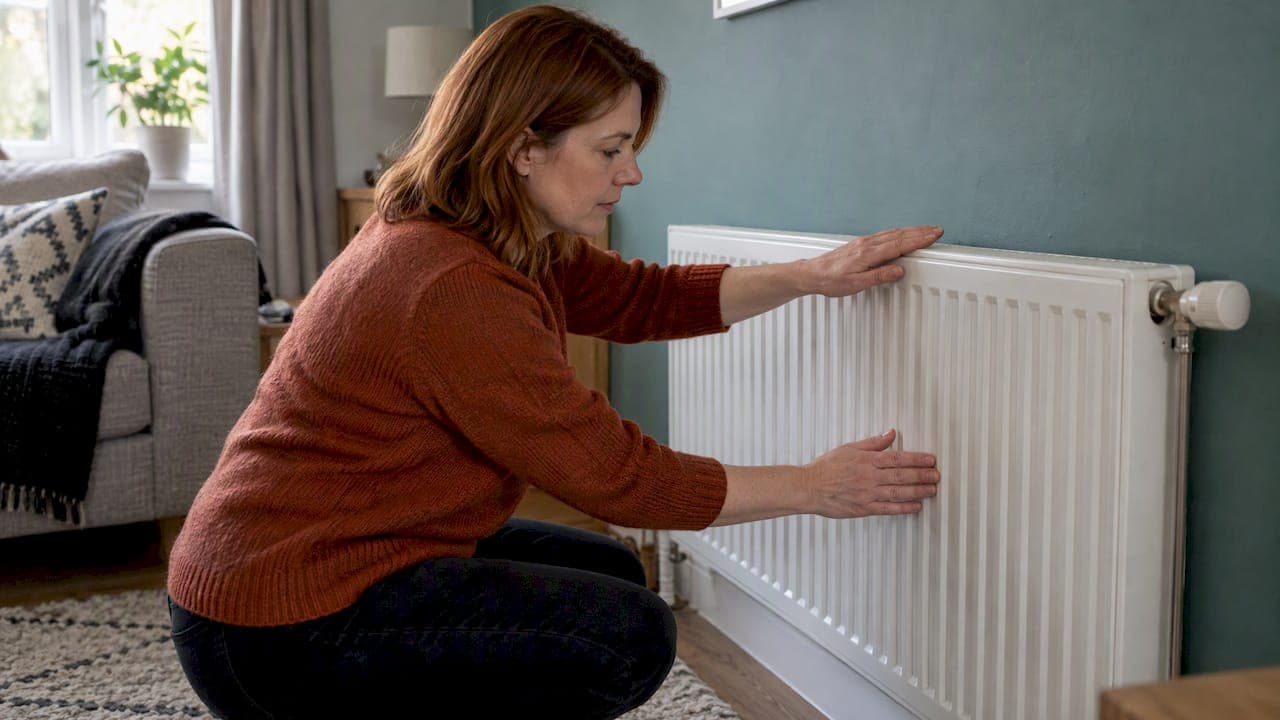
A radiator that is cold at the top but warm lower down almost always has air or gas trapped inside it. The gas rises to the highest point and sits there as a pocket, so hot water cannot fill that part of the panel. Bleeding the radiator usually clears it in about ten minutes. If the cold patch comes back, or the whole system is struggling, something else is going on, and this guide shows you how to tell the difference.
TL;DR
- Cold at the top and warm at the bottom points to trapped air or hydrogen gas that has floated to the highest point of the radiator.
- Switch the heating off and let the radiator cool before you bleed it. Combi boiler owners should then check the boiler pressure and top it up if needed.
- Cold at the bottom and hot at the top is a different fault: sludge or debris, which needs a system flush, not a bleed.
- If air keeps returning, the cause may be corrosion, a micro-leak or a pump setting, and an engineer should look at the system.
- We attend heating faults 24/7, with no call-out fee and a no fix no fee guarantee.
Table of Contents
- Why the top of a radiator goes cold
- First, work out which fault you have
- How to bleed a radiator safely
- The step people forget: boiler pressure
- When bleeding does not fix it
- A note from us
- Getting help from Your Local Plumber
- What a repair is likely to cost
- Prevent it coming back
- FAQ
- Sources
Why the top of a radiator goes cold
A working radiator should feel hot from top to bottom and side to side. The water enters hot, gives up heat to the room and leaves a little cooler, but the panel should still feel evenly warm.
Air breaks that pattern. Water is roughly 900 times denser than air, so any bubble in the system floats upwards and collects at the top of the radiator. That pocket acts as a barrier. Hot water flows along the bottom, but it cannot push into the space the air occupies, so the upper part stays cold.
There are common signs besides the cold patch. Radiators that are slow to warm up or make gurgling noises often have air in them too. Cold spots also tend to appear after the heating has been off for months, which is why many people notice them on the first cold evening of autumn. City of York Council notes that radiators trap air especially when they have been turned off over the summer.
Air or gas?
What feels like air is sometimes hydrogen. Technical guidance from a radiator manufacturer explains that hydrogen is produced by corrosion inside the system. Hydrogen is flammable, so this is one more reason to bleed with the heating off, with no naked flame nearby, and to treat repeated gas build-up as a sign the system chemistry needs attention.

First, work out which fault you have
Before you reach for a radiator key, spend two minutes with your hand. The pattern of heat tells you most of what you need.
| What you feel | Most likely cause | What to do |
|---|---|---|
| Cold at the top, warm at the bottom | Trapped air or gas | Bleed the radiator |
| Cold at the bottom, hot at the top | Sludge or debris build-up | Professional system flush; see our cold at the bottom checklist |
| Cold in the middle, hot round the edges | Sludge building in the centre | Flush, not bleed |
| One radiator cold, the rest hot | A stuck valve, air or a blockage in that unit | Check the valves, then bleed |
| Every radiator cold | A system problem such as the thermostat, timer or boiler | Check controls and boiler; see below |
The last two rows rest on guidance from Smart Energy GB: if all radiators are cold, the fault is probably not trapped air in individual units but in the central heating system itself, and a radiator that is cold at the bottom but hot at the top points to sludge or debris, which typically needs a professional flush rather than bleeding.
How to bleed a radiator safely
You need a radiator key (a few pounds from any DIY shop), an old cloth or towel, and a few minutes. Some radiators have a bleed screw that takes a flat screwdriver instead. If you do not have a key, this guide to bleeding without one covers the options, though a proper key is safer for the valve.
- Turn the heating off. Never bleed a radiator while the heating is on, because hot water and steam could cause scalds. Wait until the radiator is cool to the touch.
- Protect the floor. Lay the towel under the bleed valve, which sits at the top corner on one side of the radiator.
- Fit the key and turn slowly. Turn it anticlockwise a quarter turn. You should hear a hiss as the air escapes.
- Hold the cloth under the valve. When the hissing stops and a little water appears, close the valve with the key. Do not overtighten it.
- Wipe up and check the other radiators. Work from the radiator nearest the boiler outwards, and start with upstairs radiators, as air collects highest in the house. Our step by step bleeding guide goes through the order in detail.
- Check boiler pressure. More on this below, because it is the step most people miss.
- Turn the heating back on and feel each radiator after it has had time to warm up. The top should now be as hot as the bottom.
If you want a quicker, shorter version, our ten minute radiator bleed article covers the routine for UK homes.
The step people forget: boiler pressure
Bleeding lets air out, and the system then has slightly less volume. On a sealed system with a combi boiler, that drops the pressure. City of York Council advises that combi owners will almost always need to top up pressure after bleeding, and that anyone unsure how to find or use the filling loop should contact a qualified engineer rather than risk disabling the heating.
A quick routine:
- Look at the pressure gauge on the boiler once the system has cooled.
- If it has fallen below the range in your boiler manual, use the filling loop as the manufacturer describes.
- Close the loop fully when you finish, and recheck the gauge.
If the pressure keeps dropping after you top it up, you have a leak or a fault somewhere, and bleeding is not the answer. Our guide to what to do when a boiler loses pressure explains the usual causes. If you see water around the boiler itself, read whether a leaking boiler is an emergency before you do anything else.
When bleeding does not fix it
Sometimes you bleed a radiator, it works for a day or a week, and the cold patch returns. That pattern matters more than the cold patch itself.
Air that keeps coming back
Occasional bleeding once or twice a year is normal maintenance. Needing to bleed the same radiators every few weeks is not. Manufacturer technical guidance lists a few reasons recurring air can appear:
- Corrosion: a system should be chemically cleansed and inhibited to British Standard BS7593. If the inhibitor was never added or has stopped working, corrosion produces hydrogen gas that keeps collecting in the radiators.
- Micro-leaks on the suction side of the pump: small leaks that pull air into the water rather than letting water out, so you may see no puddle at all.
- A pump set too high: this can cause cavitation, where the pump releases oxygen from the water itself.
None of these is a job for a radiator key. They need someone who can test the system, check the pump settings, find the leak and treat the water. If you are looking at your home's overall efficiency at the same time, the same house may also benefit from energy performance upgrades, but start by making sure the heating system itself is sound.
Cold at the bottom, not the top
If you find the opposite pattern, hot at the top and cold at the bottom, stop bleeding. Sludge is the likely culprit, and releasing more air will not help. A professional flush removes the debris and lets the inhibitor do its job afterwards.

Every radiator cold
When the whole house is cold, trapped air in several radiators at once is unlikely. Work through the basics:
- Turn the thermostat up to its highest setting to see whether the boiler fires. The North Yorkshire Council winter checklist suggests this as the first test.
- Check the timer or programmer and any smart controls.
- Look at the boiler display and pressure gauge for error codes or low pressure.
- Check whether your hot water works. If it does not either, see our guides on central heating that does not work and no hot water from taps.
If the boiler shows a fault code, will not fire, or you smell gas, do not keep experimenting. Call an engineer. For a suspected gas leak, leave the property and use the National Gas Emergency line on 0800 111 999.
A note from us
Most people who call us about a radiator cold at the top have already bled it once, and many have done it correctly. They call because the problem returned, or because bleeding dropped the boiler pressure and the heating stopped altogether.
Our view is simple. A bleed is a sensible first step, and you should try it. But if you are bleeding the same radiators again and again, the air is a symptom, and treating the symptom only buys time. We would rather look at what is feeding the air in: the inhibitor, the pump, a slow leak, or sludge restricting flow.
We also think you should know the cost before anyone starts work. Our heating and boiler work is charged at £110 per hour, there is no call-out fee, and you pay only after the work is done successfully. If we cannot fix it, you do not pay. That is how we think a local plumber should work, particularly when it is cold outside and you are anxious about the bill.
One practical tip: when you bleed, note which radiators had air and how much. Telling the engineer "the upstairs back bedroom radiator needs bleeding monthly" saves real diagnostic time.
— Michael
Getting help from Your Local Plumber
If your radiator is still cold at the top after bleeding, or the heating system is losing pressure or stopped, we can help. We cover heating repairs, boiler diagnostics and repairs, leak detection and new boiler installation across a wide range of towns and cities, including Reading, Newbury, Oxford, Swindon and Bristol.
For a fault that cannot wait, book our emergency plumbing or heating engineer with a 60 minute response time. For routine work, you can book a plumber online. If the system is old and repeated repairs are adding up, our new boiler quote is free to request, and new boilers supplied and fitted start from £1,300 one-off.
Our work carries a 12-month warranty, and you can speak directly to the engineer. We have more than 300 Trustatrader reviews if you want to see what other customers say.
What a repair is likely to cost
We cannot quote a single price for "radiator cold at the top" because the cause decides the work. Here is how it breaks down in general terms:
- A simple bleed is something you can do yourself for the price of a key.
- A heating fault diagnosed and repaired by us is charged at £110 per hour, with no call-out fee.
- Recurring air with an unclear cause usually needs time to test the pump, pressure and inhibitor, which is where the hourly rate applies.
- A boiler at the end of its life is better handled with a new boiler quote than another repair.
For a broader view of how emergency markups inflate repair bills, see our guide on central heating repair costs. If you are comparing the radiator issue with other common faults, our list of common radiator problems gives ten quick checks.
Prevent it coming back
A few habits reduce the chance of cold spots:
- Run the heating briefly in summer so the radiators and pump do not sit idle for months.
- Bleed at the start of the heating season, not in the middle of a cold snap.
- Check the boiler pressure monthly while the heating is on.
- Ask about inhibitor levels at your annual service, since a depleted inhibitor lets corrosion and gas build up.
- Do not ignore noise. Gurgling, banging or a radiator slow to heat is an early warning.
If your system has never been cleansed and inhibited, or you have recently had new radiators fitted and one is cold at the bottom, an imbalance or sludge may be the cause, and the system probably needs balancing rather than bleeding.
FAQ
Why are all my radiators cold?
If every radiator is cold, the problem is not trapped air in each one. Check the thermostat, the timer and the boiler for a fault code or low pressure. If those look fine and the boiler will not fire, you need an engineer.
Do all radiators need bleeding?
No. Only radiators with air in them need it, and the usual sign is a cold patch at the top, slow warming or gurgling. If the radiators heat evenly, leave them alone. Bleeding a radiator that does not need it just lowers your boiler pressure.
What happens if you bleed a radiator with the heating on?
You risk letting out hot water and steam, which can scald, and the pump keeps pushing more air round the system. Switch the heating off and wait for the radiator to cool first.
How often should I bleed my radiators?
Once a year, at the start of the heating season, is a sensible routine. If you need to do it far more often, something is letting air or gas into the system and it is worth having it checked.
Sources
- Radiator Cold at the Top? Here's Why and What to Do
- How to bleed a radiator, Smart Energy GB
- Heating and hot water advice, City of York Council
- Air or gas in radiators, technical resources
- How to bleed a radiator without a radiator key, Ideal Home
- Check your heating is ready for winter, North Yorkshire Council