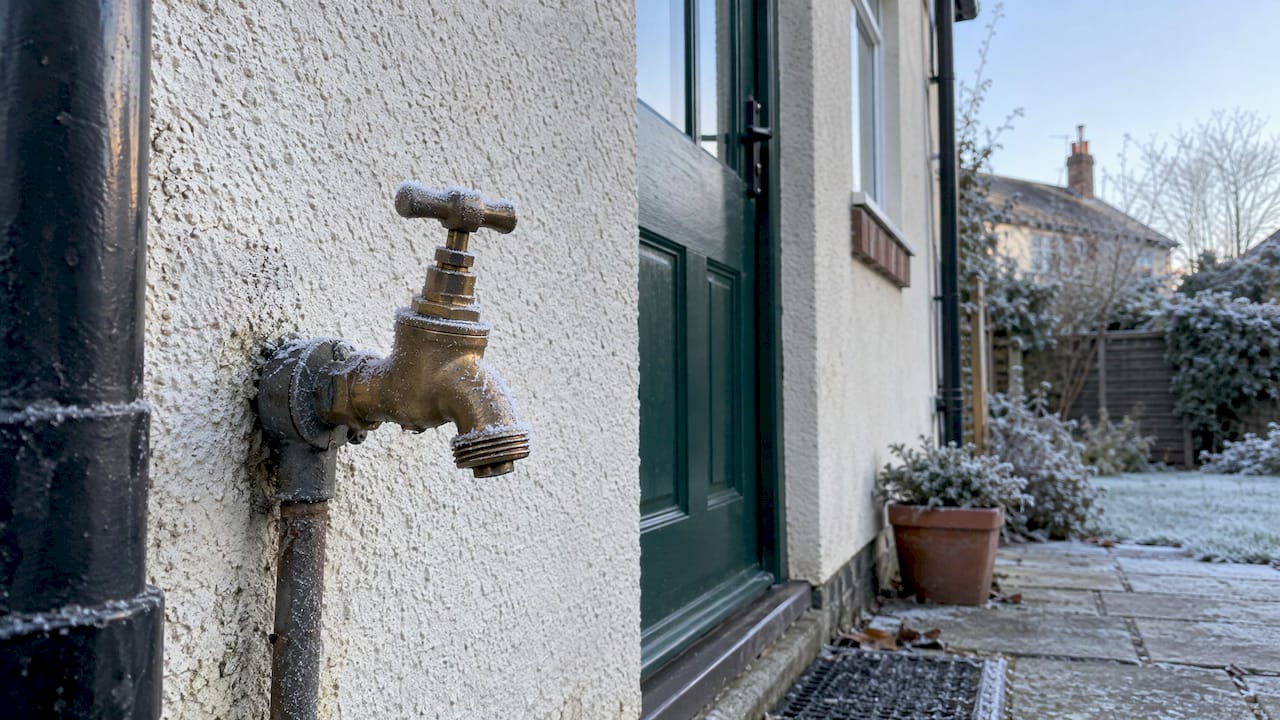
The surest way to stop an outside tap freezing is to switch off its supply from the isolation valve indoors, drain the tap and pipe, then fit an insulated cover and lag any exposed pipework. If it has already frozen, shut off the water at the stop tap and thaw it slowly, never with boiling water or a flame. If water appears anywhere after thawing, call a plumber straight away. We cover homes across Reading, Newbury, Oxford, Bristol, Basingstoke and the surrounding towns, and this guide is the routine we would give a neighbour.
TL;DR
- Close the isolation valve inside the house, open the outside tap to drain it, and leave it open over winter.
- Fit an insulated tap cover and lag exposed pipes, with the seam closed and taped.
- Disconnect and store your hosepipe, and fix any dripping tap before the cold arrives.
- If the tap is frozen, turn off the stop tap and warm the pipe gently from the tap end. Never use boiling water or a naked flame.
- Damp patches, puddles or water in more than one place mean a burst: keep the supply off and call a plumber.
Table of Contents
- Why an outside tap freezes, and why it matters indoors
- Protect the tap before the frost: a step-by-step routine
- How to insulate an outside tap: what to buy and what to expect
- If your outside tap has frozen: thaw it safely
- Signs the pipe has burst, and what to do
- Restarting the tap in spring
- Our view on outside taps and frost
- Get it sorted before the cold snap
- FAQ
- Sources
Why an outside tap freezes, and why it matters indoors
An outside tap is a short stub of pipe poking out of a warm house into freezing air. Water sitting in it has nowhere to go, and when it turns to ice it expands. Severn Trent explains that freezing raises the pressure inside the pipework, which can stretch and damage taps and pipes and lead to leaks or bursts once temperatures rise again.
That last point catches people out. The ice itself often does no visible harm. The damage shows up on the thaw, when water pours out of a split you could not see. NI Water warns that a frozen outdoor tap can cause the pipe joint inside the property to come apart and leak. So the problem is rarely the tap on the wall. It is the pipe behind it, often running through a cold wall cavity, an airing cupboard wall or a garage, where you will not notice a leak until the ceiling or wall is wet.
A dripping tap makes things worse. WaterSafe recommends repairing dripping taps, outside ones included, because the dripping water can freeze and back up into the tap. A slow drip you have ignored all summer becomes a plug of ice in the first hard frost.
Protect the tap before the frost: a step-by-step routine

Do this in autumn, before the first forecast of frost. It takes about fifteen minutes with the right kit, and you do not need to be handy to manage it.
1. Disconnect and store the hosepipe
A hose left attached holds water against the tap and keeps the tap from draining. WaterSafe says to disconnect, drain and put away hosepipes before temperatures drop, and that disconnecting also reduces the risk of backflow into the supply. Coil the hose so the water runs out, and store it in a shed or garage. The same thinking applies to any outdoor plumbing you stop using for the season, and draining outdoor plumbing before cold weather is a habit worth building into your autumn jobs.
2. Find and close the isolation valve
Most modern homes have a small isolation valve on the pipe feeding the outside tap, usually under the kitchen sink, in a utility room or near where the pipe goes through the wall. It often has a screwdriver slot or a small lever. Turn it to the closed position. If you cannot find one, trace the pipe inwards from the tap on the outside wall.
If you have no isolation valve at all, that is worth fixing. A separate valve on the outside tap supply is the single most useful thing you can have for winter, and it is a short job for a plumber.
3. Drain the tap and leave it open
With the valve closed, open the outside tap and let the remaining water run out. WaterSafe advises isolating and draining unused outside-tap pipework before winter. Leave the tap open so that any trace of water left in the pipe has room to expand. Check that nothing drips from the isolation valve itself, and if it does, the valve is worn and needs replacing.
The order matters. Close the indoor valve first, then open the outside tap. Doing it the other way round leaves a full pipe with nowhere to drain.
4. Fit an insulated cover
A tap cover, sometimes called a tap jacket, is a padded bag or hard foam shell that traps the little warmth in the wall and keeps wind off the brass. South East Water says to place the jacket over the tap and secure its strap, or follow the cover's own instructions. Redrow's homeowner guidance gives the same order: close the internal isolation valve, open the external tap to empty the pipe, then fit and secure the insulated bag or shell according to its instructions.
A cover on its own is not enough if the tap is full of water. It slows heat loss but does not stop a long cold night. Drain first, cover second.
5. Lag the exposed pipe
Any length of pipe in the open air, or in an unheated space such as a garage, loft or outhouse, needs foam lagging. South East Water's advice is to wrap waterproof foam insulation tightly around exposed pipes and secure it with tape or cable ties. Severn Trent adds that the seam should be closed and taped so cold air cannot reach the pipe.

The usual mistakes are leaving the joint at a bend uncovered, stopping the lagging short of the wall, and using thin pipe sleeves that were made for hot water. Cold air finds every gap, so the bare inch is the one that freezes.
6. Keep the house itself warm enough
The pipe behind the tap runs through your home, so the heating matters too. WaterSafe's winter advice recommends keeping the heating on at a minimum of 14°C overnight and while you are away to reduce the risk of frozen pipes. If you are heading off for a winter break, close the isolation valve for the outside tap before you leave and let the heating tick over.
How to insulate an outside tap: what to buy and what to expect
You will see two main kinds of cover on the shelf at a DIY shop or garden centre:
| Type | How it works | Good for |
|---|---|---|
| Padded bag or jacket | Fabric outer, insulating fill, strap or drawcord | Wall taps of most shapes, easy to remove for spring |
| Rigid foam shell | Moulded foam halves that close round the tap | Standard bib taps, exposed spots, tidy finish |
| Foam pipe lagging | Split foam tube, taped at joints | The pipe run feeding the tap |
Whichever you choose, the fit is what counts. A cover that gapes at the wall or hangs loose lets wind straight through. Press it snug against the brickwork, pull the strap tight and check it again after a gale. Swap out any cover that has gone soggy or brittle, because wet insulation does very little.
For taps that are awkward to cover, such as ones set in a porch, behind a gate or on a bracket where the pipe has no slope, the better long-term answer is often to reposition or replace the tap so that it drains properly. That is a straightforward job, and the same applies to a tap that has been dripping for months.
If your outside tap has frozen: thaw it safely
You may notice it when you turn the tap and nothing comes out, or only a trickle. Hubbub lists no water or only a trickle as a sign that the pipe leading to the tap may be frozen. WaterSafe adds gurgling noises and frost on the pipe as signs.
Then work through these steps in order:
- Turn off the water at the stop tap. WaterSafe says to turn off the water at the stop tap and open the affected tap, so that melting ice has somewhere to go. If you are not sure where your stop tap is, our emergency water shutoff guide shows how to find it.
- Warm the pipe slowly. Start at the tap end. South East Water says gentle warming from the tap end may take 10 to 15 minutes. A hot-water bottle wrapped in a cloth, warm towels, or a hairdryer on a low or medium setting all work, according to WaterSafe.
- Never use boiling water or a flame. Both South East Water and WaterSafe rule out boiling water and open flames, and WaterSafe specifically warns that a naked flame or blowtorch can damage pipes or cause fires. Keep a hairdryer well away from standing water.
- Check for leaks once the flow returns. Wipe the pipe and the wall around it with a dry cloth. If any water appears, leave the supply off and contact a plumber immediately.
If warming does not free the tap, or you cannot reach the frozen section, stop there. Forcing a stuck tap or hammering at a frozen joint is how small problems become burst pipes. Our guide to thawing frozen pipes safely explains the same steps in more detail for UK homes, and if the frozen pipe is the plastic drain from your boiler rather than a water pipe, see how to thaw a frozen condensate pipe.
Signs the pipe has burst, and what to do
A frozen pipe stops water. A burst pipe releases it, usually after the thaw. WaterSafe says a burst commonly shows as puddles, damp patches on a wall or ceiling, or water appearing in more than one place.
If you see any of these:
- Shut the stop tap immediately and catch any remaining water, as WaterSafe advises.
- Avoid electrics where water is present. South East Water adds that you should switch off the central heating, turn off the mains electricity if water is near it, and drain the system through the hot and cold taps.
- Call a registered plumber. WaterSafe recommends this because incorrect plumbing work can worsen a leak or risk contaminating the water supply.
- Tell your home insurer promptly, which WaterSafe also recommends.
If you are standing in a wet hallway on a freezing night, you want an engineer on the way, not a search for one. Hidden leaks are a particular worry with outside taps, as the split is often inside a wall. Our guides on signs of hidden leaks and common causes of water leaks help you recognise what you are looking at.
Restarting the tap in spring
Once the risk of frost has passed, reverse the routine. Redrow's guidance is to leave the external tap open, then reopen the internal isolation valve, run water briefly, close the tap, and check indoors for leaks or drips. Take off the cover, check the washer and the spout, and look at the lagging for splits. If the tap drips or has a leak around the spindle, see our guide on diagnosing where an outside tap leaks before the next autumn.
Also look at the wall inside where the pipe passes through. A new damp patch after the first use of the year can mean winter damaged the joint.
Our view on outside taps and frost
Most of the frozen-tap problems we hear about come down to the same three things: a tap with no isolation valve, a hose left connected, and a drip nobody got round to fixing.
The tidy fix is cheap compared with the cost of a wet ceiling. A working isolation valve, a tap that drains and shuts off properly, and a cover that fits are what get a household through winter without a call.
When something does go wrong, speed matters more than anything. We offer 24/7 availability including holidays, no call-out fee and a no fix, no fee guarantee, and you pay only after the work is done successfully. You deal directly with the engineer, and our work carries a 12-month warranty.
If your outside tap has no shut-off, drips, or is awkward to drain, fitting a proper replacement or a new outside tap before the cold sets in is the best use of an hour you can spend this autumn.
Michael
Get it sorted before the cold snap
We replace and repair taps, fit new outside taps, deal with leak repairs and attend plumbing emergencies. For urgent jobs, our emergency plumbing or heating engineer service comes with a 60 minute response time, and we cover Reading, Newbury, Oxford, Abingdon, Basingstoke, Bristol and many other towns. Heating and boiler work is charged at £110 per hour, and we are rated by over 300 Trustatrader reviews.

If your tap needs replacing, fitting with a shut-off, or has already let water into the wall, book a plumber on our site or use the emergency engineer booking when water is already escaping. For wider preparation, our essential winter plumbing tips cover the rest of the house.
FAQ
What should I do if my outside tap freezes?
Turn off the water at the stop tap, open the tap, and warm the pipe gently from the tap end with a cloth-wrapped hot-water bottle, warm towels or a hairdryer on a low setting. Never use boiling water or a flame. When it flows again, check with a dry cloth for any water and call a plumber if you find some.
How do I know if my outside tap pipe has frozen?
The usual signs are no water, only a trickle, gurgling sounds or visible frost on the pipe. These can also point to a freeze further inside the house, so check other taps too. If other taps also run slowly or the boiler behaves oddly, the freeze may be elsewhere.
What is the best way to insulate an outside tap?
Drain it first by closing the indoor isolation valve and opening the tap, then fit an insulated cover that sits snug against the wall with its strap pulled tight. Wrap the pipe feeding it in foam lagging, with the seam closed and taped so no cold air gets in.
Do I need to leave the outside tap open in winter?
Yes, after you have closed the isolation valve and drained it. Leaving it open gives any leftover water room to expand rather than split the tap. Close it again in spring only after reopening the indoor valve and checking for leaks.
Can a frozen outside tap damage the pipes inside my home?
Yes. Freezing raises pressure in the pipework, and the joint inside the wall can come apart and leak when the ice melts. Keep an eye out for damp patches near where the pipe enters the house, and call a plumber if you see one.
Sources
- WaterSafe: It's Time for Gardeners to Wrap Taps and Pipes Against Frost
- WaterSafe: How to Prevent Frozen and Burst Pipes
- WaterSafe: Winter Advice
- WaterSafe: What to Do If Pipes Freeze
- South East Water: Prepare your home for winter
- Severn Trent: Protecting your pipes
- NI Water: How to protect an outside tap from freezing
- Redrow: Preparing your outside tap for winter
- Hubbub: How to protect your home from frozen pipes