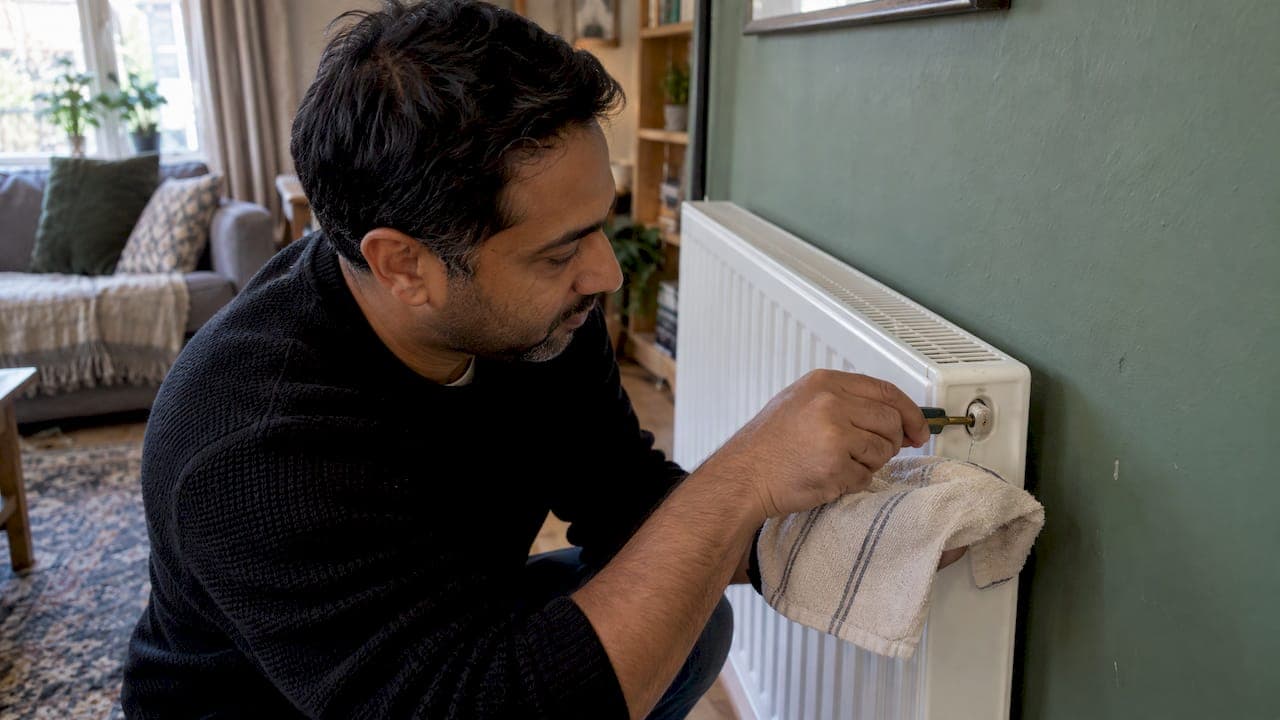
An airlock in central heating is a pocket of trapped air that stops hot water circulating properly. In most homes the fix is to bleed the radiators, then check the boiler pressure. If you have a stubborn airlock in the hot water pipework, or bleeding changes nothing, the cause is usually something else in the system, and that is the point to bring in a qualified engineer. This guide shows you how to tell which problem you have, how to clear it step by step, and how to stop it coming back.
TL;DR
- A radiator that is warm at the bottom but cool or cold at the top points to trapped air. The reverse pattern points to sludge or debris.
- Bleed the radiator with the heating off and the system cool. When the hissing stops and water appears, the air has gone.
- Check the boiler pressure gauge afterwards and top up if it has dropped.
- Airlocks in hot water pipes need a different method from radiator air. Try it once, then call an engineer if it persists.
- If bleeding does not help, the real cause may be a failing pump, a stuck valve or a blockage.
Table of Contents
- What an airlock in central heating actually is
- The symptoms of an airlock
- Is it air, sludge or something else?
- How to remove an airlock from a radiator
- Clearing an airlock in the hot water pipes
- Can a combi boiler or gravity-fed system get an airlock?
- Why air gets in, and how to stop it returning
- When to stop and call an engineer
- Our perspective on airlocks
- Need a hand with a stubborn airlock?
- FAQ
- Sources
What an airlock in central heating actually is
Air is lighter than water, so it rises and collects at the highest point of a system, typically the top of a radiator or a bend in the pipework. Once enough gathers in one place, it can cut off the flow of water past that point. That blockage is what people call an airlock. The effect is local: the boiler may be firing perfectly while one radiator, one loop or one tap gets little or nothing.
There are two quite different situations, and mixing them up is the most common reason the DIY fix fails:
- Air in the heating circuit. The sealed loop of water that runs through your boiler and radiators. The fix is bleeding.
- An airlock in the hot water pipework. The pipes that feed your taps and shower, where you get spluttering, banging or no flow. WaterSafe separates the two: for heating-system air, bleed the radiators, and for water-pipe airlocks there is a different method, covered below.
How does the air get in? Heated water can release dissolved gas and vapour that travels to the top of the system. Air also enters when the system is drained and refilled, when a radiator is removed, or after a repair that opens the circuit. That is why airlocks so often appear soon after maintenance.
The symptoms of an airlock
No single sign proves it, but a cluster of them is a strong clue. The ones to watch for:
- A radiator that is warm at the bottom and cold at the top. Worcester Bosch's radiator fact sheet says this pattern can indicate an airlock.
- Little or no heat from a radiator. Homebuilding, quoting heating expert David Hilton, says trapped air may leave a radiator heating only a little at the bottom, or not at all when the blockage is substantial.
- Cold patches in particular rooms. A radiator that stays cold while the rest of the house is warm is a typical pattern.
- Noise. Gurgling, tapping or banging in pipes and radiators. If the noise seems to come from the boiler itself, our guide to a boiler gurgling noise goes through the causes.
- Spluttering taps or no hot water. Inconsistent flow from a tap can point to air in the hot water pipes rather than the heating circuit.
- Slow recovery or overheating. Heatweb's technical guidance notes that airlocks reduce circulation and may lead to poor hot water recovery and system noise.
If one radiator is the only problem, our article on a radiator that is cold at the top covers causes and fixes in more depth.
Is it air, sludge or something else?
Before you reach for a radiator key, spend two minutes working out what you are dealing with. Switch the heating on, wait until the boiler has been running for a while, then feel each radiator carefully. Use the back of your hand, as pipes and panels can be hot.
| What you feel | Most likely cause | First thing to try |
|---|---|---|
| Warm at the bottom, cool or cold at the top | Trapped air | Bleed the radiator |
| Warm at the top, cool at the bottom | Sludge or debris | Professional flush or cleaning |
| Cold all over, others hot | Stuck valve, closed valve or thermostat setting | Check the TRV and lockshield |
| Several radiators cold, boiler running | Circulation fault or system-wide air | Bleed all, check pressure, then call an engineer |
| Radiators fine, taps splutter | Airlock in hot water pipework | Hot water pipe method below |
The top-versus-bottom pattern comes from Worcester Bosch's guidance, which treats cold at the top with warmth below as air, and the opposite as sludge or debris.
Two cheap checks catch a surprising number of false alarms. First, look at the thermostatic radiator valve. Broxtowe Borough Council's radiator leaflet advises checking whether the TRV is set low and turning it up if so. Second, if a radiator is still cold after bleeding, check for a stuck valve or a blockage, as Energy Guide suggests.
If the radiators heat but unevenly, with the nearest ones scorching and the farthest barely warm, that is a balancing issue rather than air. Bleeding removes air, while balancing distributes hot water evenly. Our step-by-step guide to balancing radiators shows how.
How to remove an airlock from a radiator
This is the fix for air trapped in the heating circuit. It takes about ten minutes for a single radiator, and a little longer for a whole house. You need a radiator key (cheap at any DIY shop) and an old cloth or small towel.
Before you start
- Turn the heating off and let the system cool. Smart Energy GB advises this first, as hot water can scald and the pump circulating water can pull in more air.
- Check you have the right kind of radiator. Electric radiators do not circulate hot water, so they do not need bleeding, according to the same Smart Energy GB guide.
- Lay a cloth under the bleed valve. The first drips are often dirty, dark water.
Bleeding step by step
- Start with the radiator closest to the boiler, or on the lowest floor, and work upwards and outwards. Many people simply start with the cold one, which is fine for a single problem radiator.
- Find the bleed valve. It is a small square or slotted fitting at the top corner on one end of the radiator.
- Fit the key and turn it slowly anticlockwise, a quarter turn at a time. You do not need to unscrew it fully.
- Listen for the hiss. That is the air escaping. Hold the cloth under the valve.
- Close the valve as soon as water appears. Per Worcester Bosch, when the hissing stops and water comes out, the airlock has been displaced. Turn the key clockwise until snug, without forcing it.
- Repeat on the other radiators, working through the house.
If you want a more detailed routine, including the order to work in and common mistakes, see our guides to radiator bleeding best practices and the ten minute radiator bleed.
What to check on the boiler afterwards
Bleeding lets air out, and the system can lose a little pressure as a result. Smart Energy GB, Broxtowe Borough Council and Worcester Bosch all say to check the boiler's pressure gauge afterwards and top up if necessary. Your boiler manual gives the correct range and the filling procedure for your model, so follow it rather than guessing. If the pressure keeps dropping, you may have a leak or a faulty component, and our guide to a boiler that loses pressure explains what you can safely check yourself.
Finally, turn the heating back on and feel the radiators again after half an hour. If the top is now as warm as the bottom, you are done.
Clearing an airlock in the hot water pipes
If your radiators are fine but your taps splutter, bang or run cold, the air is in the water pipework, not the heating circuit. Bleeding radiators will not touch this.
WaterSafe, the UK body for approved plumbers, describes the approach as turning off the water supply, opening the taps, and using a hose to connect the hot and cold taps to force the air out. Because this involves mains pressure and connecting the two sides of your supply, read the full guidance first and follow it closely. If you have any doubt about your system type, or you have a hot water cylinder and tank arrangement you do not recognise, leave it to an engineer.
Our article on crossover and cylinder fixes for airlocks in hot water goes through the same idea in more practical detail. If the water is flowing but only lukewarm, that is a separate fault, and our troubleshooting guide to tepid hot water will help narrow it down.

Can a combi boiler or gravity-fed system get an airlock?
Yes, both can. Combi boilers have a sealed circuit, and air trapped in that loop can affect performance, which often shows up as radiators that will not warm properly or a boiler that cuts out. Older gravity-fed systems, with a header tank in the loft and a cylinder in the airing cupboard, have more high points and bends where air can collect, and that is why they are well known for airlocks.
The practical difference is where you look. On a combi, bleed the radiators and check the pressure gauge. On a gravity-fed or open-vented system, pay attention to the highest radiators and any pipework that rises and falls, and be aware that an airlock there is often a symptom of something else, such as a circulation fault.

Why air gets in, and how to stop it returning
A one-off airlock after draining the system or fitting a radiator is normal. Airlocks that keep coming back are a sign of something to fix. The usual suspects:
- Refilling too quickly after maintenance. Fill slowly and bleed each radiator once the system is full.
- A leak or a weeping valve. Every time water escapes, air can be drawn in. Look for damp patches, corrosion marks and drips at valve joints.
- Falling pressure. Repeated pressure loss is a clue that the system is losing water somewhere.
- Sludge and corrosion. Debris restricts flow and encourages gas to form, so a radiator with warm top and cold bottom needs more than a bleed.
- A failing pump or faulty component. If bleeding gives no lasting improvement, the root cause may be mechanical, for example a worn pump impeller, or a fault in the filling arrangement. This is an engineer's job to diagnose.
Good habits that reduce the risk: bleed your radiators at the start of the heating season, check the boiler pressure monthly, and make a note of any radiator that regularly needs bleeding, since that is the one to mention at your next service. Our list of common radiator problems and quick checks is a good thing to work through before you pick up the phone.
When to stop and call an engineer
Do not keep repeating the same fix. Call a qualified heating or plumbing engineer when:
- You have bled the radiators and the same ones go cold again within days.
- The hot water airlock method has been tried once and the flow is still erratic. WaterSafe advises hiring a plumber if the steps do not resolve the issue.
- The boiler pressure keeps falling after you top it up.
- You hear loud banging or gurgling from the boiler or pump.
- The boiler locks out, overheats, or you have no heating or hot water at all. Our guide on what to do when central heating does not work covers quick checks to run first.
- Only the bottom of the radiators stay cold and bleeding has no effect, which points to sludge.
If you smell gas, or suspect a carbon monoxide leak, switch the appliance off, open windows and call the National Gas Emergency Service on 0800 111 999. Do not wait for a plumber.
Our perspective on airlocks
Most airlocks we are called to are not the first one the customer has had. Someone has bled a radiator, felt better for a week, and then the cold patch came back. That is the clue we look for. A single airlock after maintenance is a nuisance. A repeating one is the system telling you something: a small leak, a pump that is not moving water as it should, or sludge building up.
So we do not just bleed and leave. We check the pressure, feel the pattern across the radiators, look at the pump and valves, and tell you in plain words what we found. If it is a ten minute job, you pay for the time it takes. Our heating and boiler work is charged at £110 per hour, we do not charge a call-out fee, and our no fix, no fee guarantee means you pay only after the work is done successfully.
If it is a bigger problem, like a tired boiler that keeps losing pressure, we will say so and give you a free on-site quote for a replacement. New boilers supplied and fitted start from £1,300. Either way, you speak directly to the engineer, not a call centre, and the work carries our 12-month warranty.
Michael
Need a hand with a stubborn airlock?
If you have bled the radiators and the cold spots keep returning, or you simply would rather not tackle your hot water pipes yourself, we can help. Our engineers diagnose airlocks, find out why the air got in, and fix the cause. For heating and boiler work, our rate is £110 per hour, with no call-out fee.

If you have no heating or hot water right now, you can book an emergency heating engineer with a 60 minute response time. For general jobs, you can book a plumber online. And if your boiler is the real culprit, request a new boiler quote. We cover Reading, Newbury, Oxford, Bracknell, Windsor, Bristol and many other towns across the south of England, with over 300 Trustatrader reviews from customers.
FAQ
How do I clear an airlock in my hot water system?
For air in the pipes that feed your taps, WaterSafe suggests turning off the water supply, opening the taps and using a hose to connect the hot and cold taps so the air is forced out. Follow their full guidance carefully. If the flow is still erratic after one proper attempt, have a plumber diagnose it.
Can you get an airlock in a combi boiler?
Yes. A combi boiler has a sealed heating circuit, and air trapped in it can stop radiators heating and affect how the boiler runs. Bleed the radiators, then check the pressure gauge and top up if needed. If the problem returns, ask an engineer to look for the cause.
What are the symptoms of a radiator airlock?
The classic sign is a radiator that is warm at the bottom but cool or cold at the top. You may also notice cold patches, gurgling or tapping noises, rooms that never warm up, or a boiler pressure drop after bleeding. Warm at the top and cold at the bottom suggests sludge instead.
Why is my radiator still cold after bleeding?
Check that the thermostatic valve is turned up and that no valve is stuck closed. If those are fine, the cause could be sludge, a blockage, an unbalanced system or a circulation fault. At that point, an engineer can test the system properly rather than you repeating the bleed.
Do electric radiators get airlocks?
No. Electric radiators do not circulate hot water, so they do not need bleeding. If one is cold, the cause is electrical or a thermostat or timer setting, not trapped air.
Sources
- Worcester Bosch: Bleed radiators fact sheet
- Homebuilding: Radiator not heating up properly
- Broxtowe Borough Council: Radiator problems leaflet
- Energy Guide: Radiators not heating up
- WaterSafe: How to remove an airlock from water pipes
- Smart Energy GB: How to bleed a radiator
- Heatweb: Air locks