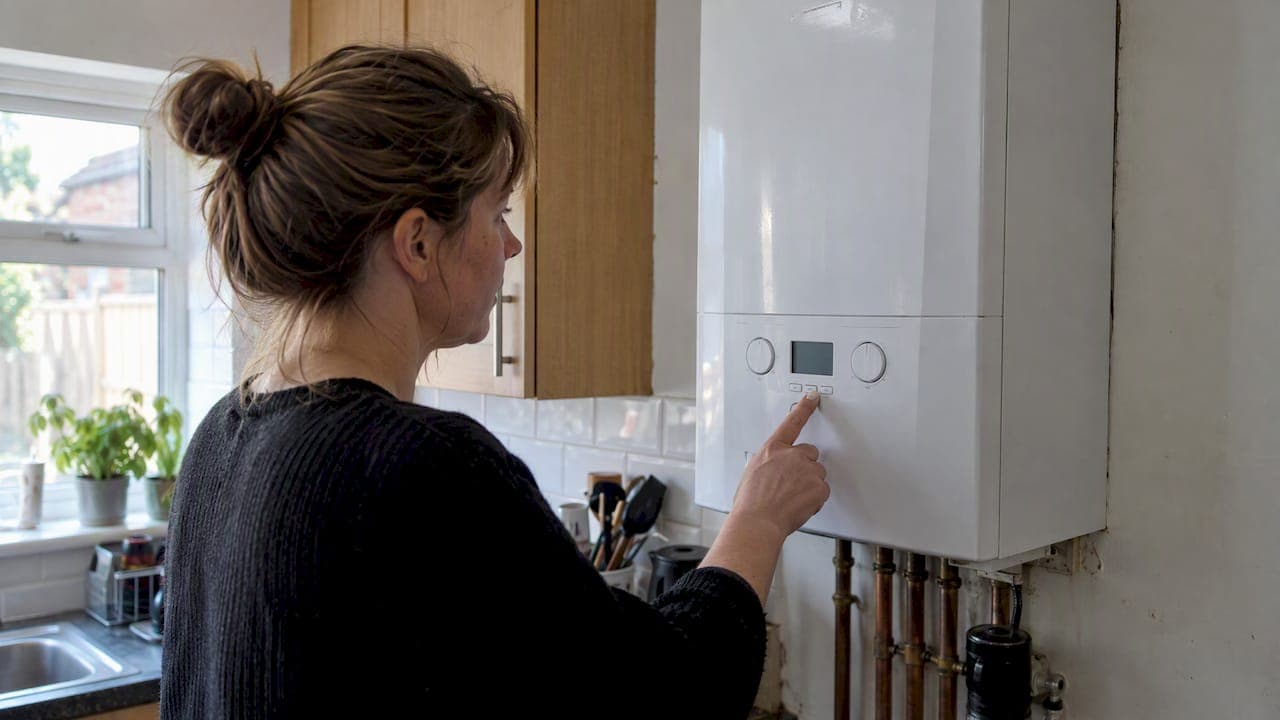
An L2 fault on an Ideal boiler is an ignition lockout. The boiler tried to light, no flame was proven, and it shut itself down to stay safe. Ideal's own guidance for the code is to reset the boiler, check any pay-as-you-go gas credit and see whether other gas appliances work. If it keeps coming back, the fault is inside the boiler or in its gas or condensate supply, and it needs a Gas Safe registered engineer.
This guide explains what L2 means, the checks that are safe for a homeowner, the likely causes an engineer looks for, and the point where you should stop and make a call.
TL;DR
- L2 (shown as F2 on some Ideal models) means ignition lockout: the boiler failed to light or lost its flame and locked itself out.
- Safe checks: reset once, look at your gas meter or credit, test the hob, and see whether the condensate pipe is blocked or frozen.
- Do not keep resetting it. Repeated resets can hide a real fault, and ignition problems can involve unsafe combustion.
- Yellow or orange flames, black staining, or a smell of gas means switch off and call a Gas Safe engineer straight away.
- We can send an engineer to diagnose a boiler lockout. Heating and boiler work is charged at £110 per hour.
Table of Contents
- What the L2 code actually means
- Check this first: is it safe to carry on?
- Safe checks you can do yourself
- What an engineer looks for when L2 keeps returning
- Why a lockout is a warning, not just a nuisance
- Our view: why repeat L2 faults are usually a service issue
- Related symptoms and what they point to
- What it costs to get an L2 fault looked at
- Need an engineer for your Ideal boiler?
- A short routine to avoid the next lockout
- FAQ
- Sources
What the L2 code actually means
Ideal boilers show a flashing L and 2 when there is a flame loss or ignition lockout. On the Logic range that is what you see on the display, and some models and older displays show it as F2. Ideal's Logic system troubleshooting page lists L2 under ignition lockout, and its first suggested check is the condensate pipe.
In plain terms, the boiler has a sequence. The fan runs, gas is released, a spark lights it, and a sensor confirms the flame. If the sensor does not see a flame, the boiler tries again. After a few failed attempts it stops and locks out. That is a safety feature, not the boiler being awkward.

It is easy to confuse L2 with other codes. Low water pressure is a different problem. For Ideal Logic boilers, the user guide gives a normal pressure range of 1 to 1.5 bar on the central heating gauge, and the boiler stops working if it falls below 0.3 bar. That usually shows as a pressure fault rather than L2. If your gauge is low, our guide to what to do when a boiler loses pressure is the better starting point.
Check this first: is it safe to carry on?
Before you touch any button, run through a safety check. Carbon monoxide is produced when gas does not burn properly, and the HSE explains that it is colourless, odourless and poisonous. A lockout caused by poor combustion is exactly the situation where that matters.
Stop and call a Gas Safe registered engineer if you notice any of these:
- A floppy yellow or orange flame instead of a crisp blue one, where you can see the flame.
- Black or brown staining around the boiler.
- A smell of gas. In that case open windows, turn off the gas at the meter, avoid switches and flames, and ring the National Gas Emergency Service on 0800 111 999.
- Headaches, dizziness or nausea that ease when you leave the house.
- A pilot light or flame that keeps blowing out.
Ideal's own user guides say that if a fault is known or suspected, the boiler must not be used until a Gas Safe registered engineer has corrected it. That is the line we follow too. You can try the simple, user-level checks below, but if any of the warning signs appear, stop.
Safe checks you can do yourself
These are the steps a manufacturer expects an owner to be able to do. None involves opening the boiler casing. The appliance should never be run with the casing removed or not sealed properly.
1. Reset the boiler once
Use the reset button or the reset position on the control, following your user guide. Wait while the boiler goes through its ignition sequence. If it lights and runs normally, note the date and time. One lockout after a power cut or a gas interruption can be a one-off.
Do this once or twice at most. Gas Safe Register guidance and engineers warn against the habit of clearing a code again and again just to keep the heating on, because it can mask a defect that affects safety.
2. Check your gas supply
Look at whether the gas is actually reaching the boiler:
- On a pay-as-you-go meter, check there is credit and emergency credit has not run out. A boiler that hits an empty meter mid-cycle will often show an ignition fault.
- Try the gas hob. If it will not light either, the problem is the supply, not your boiler. Check the meter and contact your gas supplier or network.
- Check the gas isolation valve on the boiler is open, meaning the lever lines up with the pipe.
Ideal's FAQ gives the same order: reset, check credit, then check other gas appliances.
3. Look at the condensate pipe
This is the check the manufacturer puts first for an L2 on Logic system boilers. A condensing boiler produces acidic water as it works, and that drains away through a plastic pipe, usually to a waste pipe or an outside drain. If the pipe is blocked, the boiler cannot dispose of the condensate and it will shut down as a protection.
In cold weather the usual culprit is a frozen external section. Signs include gurgling from the boiler or pipe, and a lockout on a cold morning. Pour warm (not boiling) water over the frozen section of pipe, then reset the boiler. Boiling water can crack plastic and is a scald risk.
If the pipe is blocked by sludge or runs with poor falls, it is a job for an engineer. Do not poke around inside the boiler to reach the trap.
4. Check power and the room
Make sure the boiler is receiving power, and that nothing is stored in the boiler cupboard. Ideal's guides say a compartment must not be used for storage, as blocked air flow and heat can cause problems.
What an engineer looks for when L2 keeps returning
If the checks above do not clear it, the cause sits inside the boiler. We do not recommend DIY on any of these, because they involve gas and combustion. This is what a Gas Safe engineer typically investigates:
| Possible cause | What it does | Typical sign |
|---|---|---|
| Blocked or frozen condensate pipe | Boiler cannot drain and locks out | Gurgling noise, cold weather, L2 after a short run |
| Low gas pressure or restricted supply | Not enough gas to light | Hob also weak, fault worse when other appliances run |
| Faulty ignition electrode or flame sensor | Spark or flame detection fails | Clicking with no flame, or flame lights then drops |
| Faulty gas valve | Gas does not release correctly | Fan runs, no ignition at all |
| Fan, air or flue problems | Poor combustion air or flue gas removal | Lockout with noise or after long running |
| Dirty heat exchanger or burner | Poor combustion | Often found at a service |
A proper diagnosis starts with the symptoms you have noticed, then tests gas pressure, condensate, electrodes and the gas valve in a sensible order. Guessing and replacing parts is how people end up paying twice. If you have a fault that appeared right after a service, tell the engineer.
Why a lockout is a warning, not just a nuisance
An ignition lockout is a deliberate shutdown. The Gas Safe Register stresses that internal component failures must be dealt with by a registered professional. Repeatedly forcing the boiler to restart gets you heat tonight but may cover a defect that could cause incomplete combustion.
Always ask to see the engineer's Gas Safe ID card before work starts. The HSE advises checking it, and the card shows which types of gas work the engineer is qualified for.
If you are unhappy with the standard of work from a registered engineer, the Gas Safe Register's FAQs say to contact the business first and ask them to put it right.
Our view: why repeat L2 faults are usually a service issue
We see the same pattern with ignition lockouts. A homeowner resets the boiler a few times, it works, and the fault returns a week later, usually at the worst time: a cold evening, a bank holiday, or with guests in the house. By then the original small problem (a partly blocked condensate trap, a worn electrode, a dirty burner) has had weeks to get worse.
Our advice is simple. Reset once, check gas and condensate, and if L2 comes back, book an engineer rather than carrying on. A diagnosis costs far less than a lockout that takes out your heating and hot water in January. Our standing offer is the one we apply to every job: no call-out fee, no fix no fee, and payment only after the work is done successfully. You also speak directly to the engineer, so you can describe exactly what the boiler did before it locked out.

We also tell people honestly when a repair no longer makes sense. If a boiler is old, parts are hard to find and faults are frequent, a new boiler quote is a fair question. We would rather you made that decision calmly than in a panic.
Regular servicing is the cheapest protection. Which? rated Ideal as a reliable, affordable brand, but reliability still depends on the boiler being looked after. If you want to understand what a service involves, see our guide to boiler servicing, and for what you can and cannot do yourself, read how to service a gas boiler safely.
— Michael
Related symptoms and what they point to
L2 rarely arrives alone. These related problems are worth knowing:
- Boiler will not ignite at all: see our article on the five causes of a boiler not igniting, and when to call a Gas Safe engineer.
- Boiler switches itself off repeatedly: our boiler keeps turning off checklist covers the safe checks.
- Heating works but hot water is lukewarm: try our tepid hot water guide.
- Pressure too high rather than too low: see what to do above 2.5 bar.
- A different code on the display: our list of common boiler fault codes may help.
What it costs to get an L2 fault looked at
The cost depends on the cause. A frozen condensate pipe may take minutes. A failed gas valve or an electrode needs parts and more time. For heating and boiler work we charge £110 per hour, and there is no call-out fee. You pay only once the job has been completed successfully, and our work carries a 12-month warranty.
If your boiler is beyond sensible repair, we supply and fit new boilers from £1,300 one-off. The final figure depends on the boiler and the installation, which is why we give a free on-site quote first. For a wider look at spending, see our piece on avoiding emergency markups on central heating repairs.
Need an engineer for your Ideal boiler?
If L2 has returned, or you have no heating or hot water now, our emergency heating engineer service offers a 60 minute response time and is available 24/7, including holidays. If the boiler is old and tired, you can request a new boiler quote. We cover Reading, Oxford, Newbury, Bracknell, Swindon, Bristol and many other towns across the Thames Valley and the South. Over 300 Trustatrader reviews show how we work.
A short routine to avoid the next lockout
- Book an annual service before the heating season starts, not in the first cold week.
- Note where the condensate pipe runs. If it is outside, ask your engineer whether it can be rerouted or insulated.
- Keep the boiler cupboard clear and the casing on.
- Check pressure monthly and top up only as the user guide describes.
- If you are on a prepayment meter, keep emergency credit for emergencies.
- Fit a carbon monoxide alarm and test it regularly.
None of this makes a boiler fail-proof, but it removes the common causes of nuisance lockouts and gives an engineer the chance to spot worn parts before they stop the boiler.
FAQ
Is L2 the same as F2 on an Ideal boiler?
On many Ideal models, yes. The code is shown as L2 or F2 depending on the model and display, and both point to a flame loss or ignition lockout. Check your user guide for the exact wording for your boiler.
Can I fix an Ideal L2 fault myself?
You can do the user-level checks: one reset, gas credit, other gas appliances and the condensate pipe. You should not open the boiler or work on gas components. If the fault returns, a Gas Safe registered engineer should diagnose it.
Why does my Ideal boiler show L2 in cold weather?
The most common reason is a frozen condensate pipe, because the boiler cannot drain its condensate and shuts down. Thawing the outside section with warm water, then resetting, often clears it. If it keeps freezing, ask an engineer about rerouting or insulating the pipe.
Is an L2 fault dangerous?
The lockout itself is the boiler protecting you, but the underlying cause can involve poor combustion, which can produce carbon monoxide. If you see yellow or orange flames, staining, or feel unwell, switch off and call a Gas Safe engineer. A smell of gas means calling 0800 111 999.
What pressure should an Ideal Logic boiler be at?
The Ideal Logic user guide gives 1 to 1.5 bar for the heating system, and the boiler stops operating below 0.3 bar. Pressure faults are separate from L2, which is about ignition.
Sources
- Ideal Heating: what does my boiler fault code mean?
- Ideal Heating: Logic system troubleshooting
- Ideal Logic Combi ESP1 user guide
- Ideal Logic Plus System2 user guide
- Ideal Logic Code Combi ESP1 user guide
- HSE: carbon monoxide awareness FAQs
- Gas Safe Register
- Gas Safe Register: frequently asked questions
- Which?: the best boilers for your needs and budget