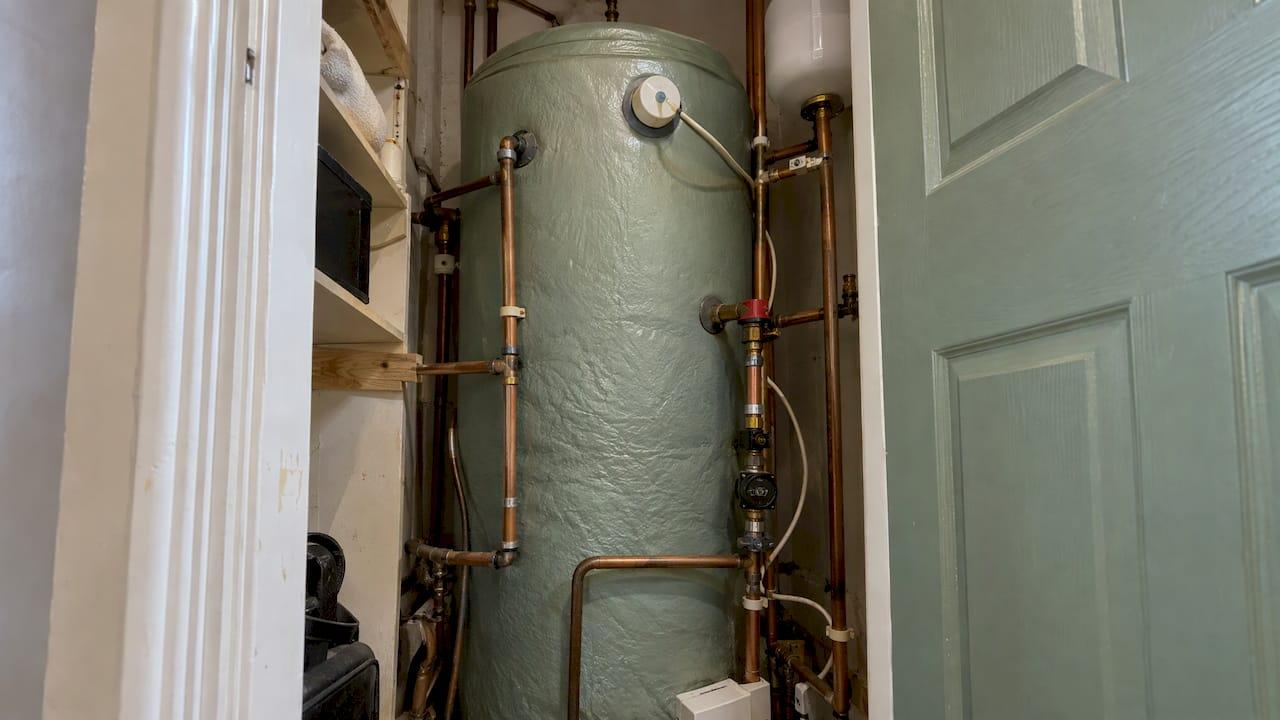
A direct cylinder heats its water with an electric immersion heater fitted inside it. An indirect cylinder gets its heat from somewhere else, usually your boiler, through a coil inside the tank. If you have a gas or oil boiler and a normal central heating system, an indirect cylinder is usually the natural match. If you have no boiler at all, a direct cylinder is the simple, self-contained answer. Most homes in Reading, Oxford, Bristol and the towns around them already point clearly to one or the other once you know what to look for.
This guide explains the difference in plain terms, shows you how to tell which cylinder you have, compares running speed and cost, and covers the mistakes we see people make when a cylinder needs repair or a boiler is replaced. We are plumbing and heating engineers, so we also say where an engineer needs to be involved.
TL;DR
- Direct cylinder: heated by one or more electric immersion heaters inside the tank. Self-contained, no boiler needed.
- Indirect cylinder: heated by a boiler (or another external source) through a coil. Most also carry a backup immersion heater.
- Choose by your heating: boiler at home, go indirect. No boiler or no gas, direct is the simple route.
- Vented or unvented is a separate choice: both direct and indirect cylinders can be either. It decides water pressure, not how the water is heated.
- Not sure which you have? Check the label and the pipework, then book an engineer on 60-minute emergency response if the cylinder is leaking or has no hot water.
Table of Contents
- What is the difference between a direct and an indirect cylinder?
- How to tell which type you have
- How each type heats and stores water
- Running cost and efficiency
- Direct vs indirect at a glance
- Which suits your home?
- Vented or unvented: a separate decision
- Looking after each type
- Replacing a boiler when you have a cylinder
- How we can help
- Our view on direct and indirect cylinders
- FAQ
- Sources
What is the difference between a direct and an indirect cylinder?
A hot water cylinder is an insulated tank that stores hot water so it is ready when you open a tap. The only difference between direct and indirect is where the heat comes from.
Direct cylinder. One or more electric immersion heaters sit inside the tank and warm the water around them. The cylinder produces its own heat and is not connected to a boiler. Think of an oversized kettle element in a well-insulated tank.
Indirect cylinder. The tank has no heat source of its own as standard. Hot water from your boiler (or a heat pump, or solar thermal) circulates through a coil of copper pipe inside the cylinder. That coil warms the stored water without the two lots of water ever mixing. The water in your radiators and the water at your taps stay separate.

The Hotwater Association, the UK trade body for the hot water industry, notes that most cylinders are heated by an external source such as a gas boiler or solar thermal, and that indirect cylinders tend to be fitted with a direct backup, meaning an immersion heater, so you still have hot water if the boiler breaks down.
That last point causes most of the confusion. An indirect cylinder with a backup immersion heater is still an indirect cylinder. The immersion is the spare, not the main heat source.
How to tell which type you have
You do not need to be an engineer to work this out. Four quick checks usually settle it.
- Look at the pipework. Two pipes running from the cylinder to the boiler (a flow and a return) mean the cylinder is indirect. No pipes to a boiler, just a cold feed in and a hot supply out, points to direct.
- Look for immersion heater caps. A round screw-in cap on the top or side, with a cable running to a thermostat box, means an immersion heater. A direct cylinder will have one or more. An indirect cylinder may have one as a backup.
- Read the label. Most cylinders carry a data plate or sticker with the model, capacity in litres and type. Manufacturers use their own codes, so the model number or a quick look at the maker's documentation will tell you.
- Think about your heating. If your hot water comes from a boiler with a programmer that switches "hot water" on and off, the cylinder is almost certainly indirect. If your boiler only does radiators, or you have no boiler, the cylinder is likely direct.
Older homes sometimes confuse things. In the past, "direct" could also mean a cylinder fed by a back boiler, with water circulating straight through. That layout is now rare, and modern usage is the one described above. If your cylinder is old and the pipework is unclear, have an engineer identify it before anyone drains it or changes the heating.
If you spot a drip, damp patch or staining around the tank, see our guide on what to do if a hot water tank is leaking before you do anything else.
How each type heats and stores water
Direct: the immersion heater does everything
A direct cylinder typically has an immersion element rated at 3 kW. Larger cylinders can have two, three or four so the whole tank heats faster. Many are wired to an off-peak electricity tariff such as Economy 7, which gives cheaper electricity overnight, so the tank is heated while rates are low. These set-ups commonly use two elements: a lower one on the off-peak supply and an upper one you can switch on for a quick top-up.
How quickly a direct cylinder reheats depends on the power of its elements. The Energy and Utilities Alliance, an industry body, explains that recovery is limited by the immersion heater power, up to 12 kW combined with three or four elements, and that these are rarely all switched on at once.
Indirect: the boiler heats a coil
When your programmer calls for hot water, the boiler sends heated water through the coil. The coil warms the stored water, and a cylinder thermostat tells the system when to stop. The hot water at your taps is drawn from the top of the tank, where it is hottest.
The Energy and Utilities Alliance explains that older vented indirect coils transfer heat at about 5 kW at most, when the boiler water is at 85°C. Modern unvented "fast recovery" coils can transfer over 20 kW, boiler power permitting. In other words, a well-matched indirect set-up can reheat a tank noticeably faster than a single immersion element, as long as the boiler has the output to feed it.
Running cost and efficiency
The honest comparison is about what you already have, not what looks best on paper.
Direct cylinders turn each unit of electricity into one unit of heat. A UK government-commissioned study on hot water cylinders and heat pumps (January 2013) puts an immersion heater at a 1:1 ratio, compared with a coefficient of performance of 1.5 or higher that a heat pump should achieve. Electricity is usually priced higher per kWh than gas, so for a home that already has a gas boiler, heating the cylinder through the boiler is the more economical route in most cases. Unit prices change with each Ofgem price cap period, so check your own tariff rather than relying on a figure in an article.
Indirect cylinders share the boiler with the heating system, so they add no separate hot water appliance to your energy use beyond the boiler itself. The immersion heater stays as a backup. The saving comes from using the fuel you already buy.
A worked example makes the point. Suppose you have a gas combi-free system with a boiler, a programmer and a 180-litre cylinder. You set hot water to come on for an hour in the morning and an hour in the evening. The boiler does the work at gas prices, and the immersion stays off. Now suppose a small flat with no gas supply: a direct cylinder on Economy 7 heats overnight and the home needs no boiler, flue or gas safety checks for the water heating. Each is the right answer for its home.
Direct vs indirect at a glance
| Direct cylinder | Indirect cylinder | |
|---|---|---|
| Heat source | Immersion heater(s) inside the tank | Boiler, heat pump or solar via a coil |
| Needs a boiler? | No | Yes (or another external source) |
| Typical fit | Flats, no-gas homes, small households | Homes with a boiler, larger households |
| Backup if boiler fails | Not relevant | Immersion heater, on most models |
| Off-peak electricity | Often wired to Economy 7 | Backup element can be |
| Reheat speed | Set by element power, up to 12 kW combined | Set by coil and boiler output, over 20 kW on fast-recovery units |
| Multiple heat sources | Not designed for it | Possible with solar or heat pump coils |
Which suits your home?
Start with what is already on the wall.
You have a gas or oil boiler and radiators. An indirect cylinder is the natural pairing. It uses the boiler you already run, gives you a backup immersion heater, and suits busier households. The Hotwater Association advises sizing to real use: the average person uses between 35 and 45 litres of hot water a day, and a bath rather than a shower can double that. A family of four who all shower will need a bigger cylinder than a couple who bathe once a week.
You have no gas, or no room for a boiler. A direct cylinder is simple and self-contained. It suits flats, small houses and rural homes with electric heating, and it works well with off-peak tariffs.
You are thinking about a heat pump or solar thermal. Indirect is the design that connects to other heat sources. If you are planning a change to your heating in the next few years, mention it when you have the cylinder looked at, so the coil and controls are chosen to suit.
You live in a hard water area. Much of Berkshire, Oxfordshire, Buckinghamshire and Hampshire has hard water, and limescale collects fastest on hot surfaces. Direct immersion elements run hot and scale up over time, which insulates the element and wastes energy. Replacing an immersion heater is a routine job, and our guide to immersion heaters that stop working lists the safe checks to make first.
Vented or unvented: a separate decision
People often mix up direct and indirect with vented and unvented. They are different questions.
- Direct or indirect tells you how the water is heated.
- Vented or unvented tells you how the cylinder is supplied with water.
A vented cylinder is fed from a cold water tank in the loft, so pressure comes from gravity and is often modest. An unvented cylinder is fed straight from the mains, which usually means stronger flow at showers and taps, and frees up loft space. The Hotwater Association notes that unvented units draw directly from the mains, so if mains pressure is sufficient they fill baths quickly. Unvented cylinders carry safety devices such as pressure relief valves and an expansion vessel, so they must be installed and serviced by a competent, qualified person. That is not a DIY job.
So you can have a direct unvented cylinder, an indirect vented cylinder, and every other combination. For more on the pressure side, read our piece on the benefits of pressurised hot water systems.
Looking after each type
Direct cylinders rely on their elements and thermostats. Elements corrode and scale with age, and a failed element means cold or lukewarm water. Typical signs are water that never gets properly hot, a tripping fuse, or a hum from the tank. Our tepid hot water troubleshooting guide walks through what to look at.
Indirect cylinders depend on the boiler, the motorised valve and the cylinder thermostat all working together. If the boiler heats the radiators but the cylinder stays cold, the fault is often a stuck valve, a thermostat or an airlock, not the tank. Our guide to airlocks in hot water systems explains the common ones. If you are unsure whether the cylinder or the boiler is failing, our eight warning signs page helps you decide how urgent it is.
Two safety points apply to both types:
- Switch off the electricity supply to an immersion heater at the isolator or consumer unit before anyone removes the cap or touches the wiring.
- If a cylinder is leaking heavily, turn off the water supply to it and the immersion heater, and call an engineer. Do not drain an unvented cylinder yourself.
Replacing a boiler when you have a cylinder
Cylinders and boilers are a pair in an indirect system, so changing one affects the other. When you replace a boiler, the output must suit the coil and the heating load. An oversized boiler wastes fuel, which our guide on what size boiler you need covers. The Energy and Utilities Alliance also points out that fast-recovery indirect cylinders suit controls that send the full boiler output to the cylinder instead of sharing it with central heating, because the large coils can absorb over 20 kW. That affects how the whole system is programmed, so it is worth settling at the quote stage rather than after installation.
If you want to understand the wider picture of how your radiators, boiler and cylinder work together, our central heating systems guide for Reading homeowners is a good companion read.
How we can help
We cover homes and businesses across Reading, Newbury, Oxford, Abingdon, Bracknell, Windsor, Basingstoke, Winchester, Swindon, Bristol, Milton Keynes and the towns in between. Our engineers work on boilers, heating, hot water cylinder servicing and cylinder immersion heaters, so the question of direct or indirect is one we deal with in people's homes every day.
Boiler and heating work is charged at £110 per hour. New boilers supplied and fitted start from £1,300, one-off, and we give free on-site quotes for new boiler installations. There is no call-out fee, and our no fix no fee guarantee means you pay only after the work is done successfully. Work carries a 12-month warranty, and you speak directly to the engineer.

If your cylinder has stopped heating, is leaking, or you are planning a boiler change, book an emergency heating engineer with a 60-minute response time, available 24/7 including holidays. For a planned replacement, request a new boiler quote. For anything else, our plumbing booking page is the quickest route.
Our view on direct and indirect cylinders
We get asked this question most often by homeowners who have just bought a house and cannot tell what is in the airing cupboard. Our answer is almost always the same: look at what heats your home today, and choose the cylinder that works with it.
If you have a boiler, an indirect cylinder lets that boiler do the job, with an immersion heater held in reserve. If you have no boiler, a direct cylinder with a properly sized element, set up on an off-peak tariff where it suits you, is a sound, simple choice. Neither is a compromise. Each is right in the home it was designed for.
What matters more than the label is that the whole system is set up properly: the right cylinder size for your household, the right controls, a sound thermostat and an immersion heater that is checked rather than forgotten. That is the work we do, with fixed pricing you can see before we start, and we only ask for payment once the job is done well.
Michael
FAQ
Is an indirect cylinder better than a direct one?
Neither is better in every home. An indirect cylinder is usually the better fit where there is a boiler, because it uses the fuel you already buy and can serve a busy household. A direct cylinder suits homes without a boiler. The best choice is the one that matches your existing heating.
Can I use the immersion heater in an indirect cylinder?
Yes. Most indirect cylinders carry an immersion heater as a backup, so you still get hot water if the boiler is out of action. As the Hotwater Association notes, that backup is a common feature. Switch the power off at the isolator before any work on it, and have an engineer check the wiring and thermostat if it trips.
Can I convert a direct cylinder to an indirect one?
It is possible in principle where a boiler is available, but it involves fitting a coil, new pipework and controls, and it depends on the cylinder and the heating system. Ask an engineer to assess it. In many cases, replacing the cylinder as part of a boiler upgrade is the cleaner solution, and we can discuss it during a free on-site boiler quote.
Does direct or indirect affect water pressure?
Not by itself. Pressure depends on whether the cylinder is vented (fed from a loft tank) or unvented (fed from the mains). Both direct and indirect cylinders come in either form.
How big should my cylinder be?
Size it to how much hot water your household really uses. The Hotwater Association gives 35 to 45 litres per person per day as an average, and a bath can double that. Count your bathrooms, baths and showers, then ask an engineer to confirm the capacity before you buy.
Sources
- The Hotwater Association: what's the dilemma
- Energy and Utilities Alliance: cylinder recovery rates
- Investigation of the interaction between hot water cylinders, buffer tanks and heat pumps (UK government, January 2013)