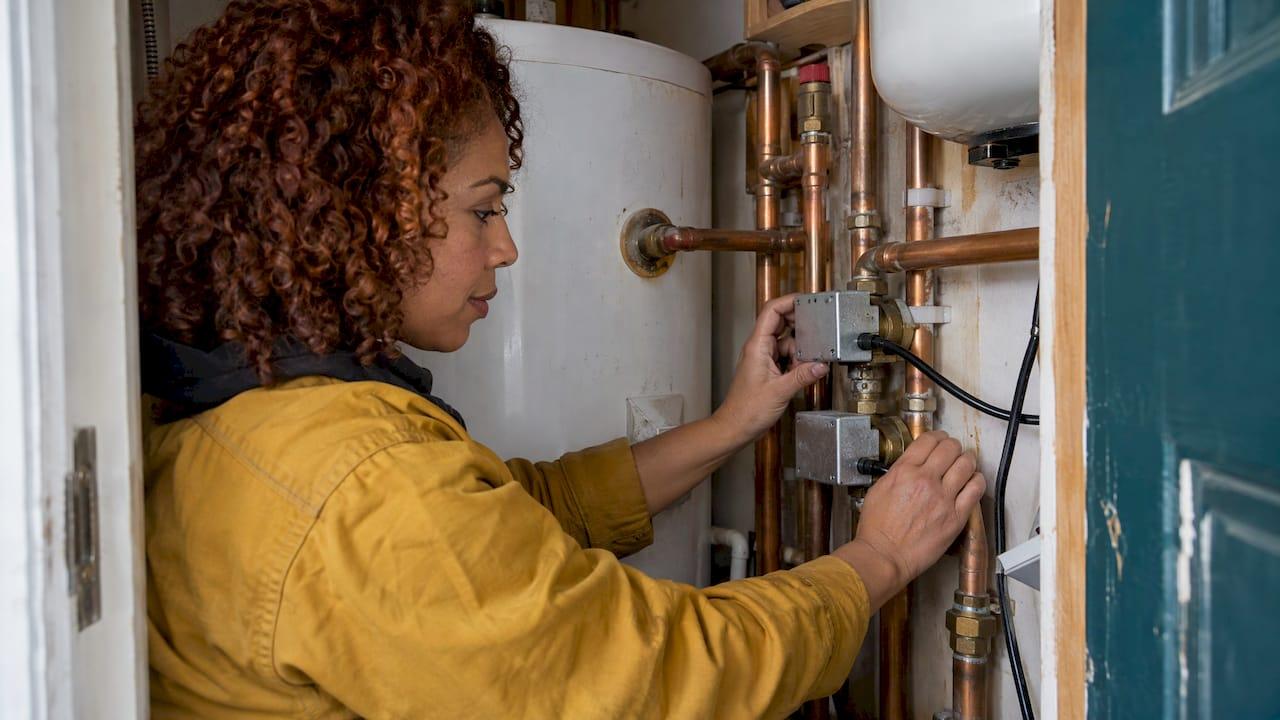
The difference between an S plan and a Y plan is the valve. An S plan uses two separate two-port motorised valves, one for heating and one for hot water. A Y plan uses a single three-port mid-position valve to do both jobs. For most homes the S plan is the more flexible choice, and it is the one to have if you ever want more than one heating zone. A Y plan is compact and perfectly workable in a smaller home with a single heating circuit.
Below we explain how each one works, how to tell which one you have by looking at your pipework, what the building rules say, and when it is worth changing.
TL;DR
- S plan: two two-port valves, so heating and hot water are controlled independently, and extra zones can be added later.
- Y plan: one three-port mid-position valve, fewer parts and a tidier installation, but limited to one heating zone.
- Spot the difference: look at the motorised valves near your hot water cylinder. Two valves means S plan, one valve with three pipes means Y plan.
- Bigger homes: guidance points to two independently controlled heating zones once a home is over 150 m².
- Faults: a stuck valve or failed actuator is a common reason for no heating or no hot water, and a heating engineer can diagnose it quickly.
Table of Contents
- What is an S plan heating system?
- What is a Y plan heating system?
- S plan vs Y plan: side-by-side comparison
- Is an S plan better than a Y plan?
- How to tell whether you have an S plan or Y plan
- Heating zones and the 150 m² rule of thumb
- Energy use: does S plan save more?
- Common faults on each system
- Should you convert a Y plan to an S plan?
- Our perspective
- Need a valve checked, or a new boiler?
- FAQ
- Sources
What is an S plan heating system?
An S plan is a fully pumped system with two motorised two-port valves. One valve serves the hot water cylinder and is controlled by the cylinder thermostat. The other serves the heating circuit and is controlled by the room thermostat. City & Guilds teaching material describes the valves opening on a call for heat and closing once the thermostat is satisfied, so each circuit is controlled separately.
Because each valve works on its own, the system can supply hot water only, heating only, or both at once. Resideo's S plan support guide describes exactly this arrangement, with two spring-return valves. When a valve is fully open, it switches on the boiler and pump.
In everyday terms
Imagine two taps on the same supply. One feeds your radiators, the other feeds the coil in your cylinder. Either can be open, both can be open, or both can be shut. The programmer and thermostats decide which, and the boiler fires only when one of them is asking for heat.
What is a Y plan heating system?
A Y plan uses one three-port mid-position valve. The boiler's flow goes into the valve, and the valve sends it to the hot water cylinder, to the heating circuit, or to both. Flameport's wiring guide explains that with no power the spring holds the valve so water flows to the cylinder only. When the motor is powered to the middle position, both heating and hot water are selected.

The Y plan was for many years the most common layout because it needed only one valve. It can still be fitted, but the same guide notes it is not suitable for a system with more than one heating zone.
The catch with one valve
A single valve has to do three jobs, which means more moving parts inside one component. If it sticks, wears or its internal switch fails, you can lose heating, hot water or both, depending on how it fails. With an S plan, a failed valve usually affects one circuit only, which also makes the fault easier to narrow down.
S plan vs Y plan: side-by-side comparison
| Feature | S plan | Y plan |
|---|---|---|
| Valves | Two two-port motorised valves | One three-port mid-position valve |
| Control | Heating and hot water run independently | One valve shared between both circuits |
| Heating zones | Can be extended with extra zone valves | One heating zone only |
| Complexity | More components and wiring | Fewer components, more compact |
| If a valve fails | Usually one circuit affected | Can affect both circuits |
| Best for | Larger homes, multiple zones, future upgrades | Smaller homes with a single heating circuit |
This summary matches PHPI's Honeywell guide, which says the S plan is generally more flexible because separate valves isolate the heating and hot water circuits. It adds that extra zones can be added as an S plan Plus. The same guide describes the Y plan as more compact, with fewer components, but limited to a single heating zone.
Is an S plan better than a Y plan?
For most homeowners, yes, an S plan is the better long-term layout, mainly because of flexibility. It gives you independent control, it can grow with the house, and a fault is easier to isolate.
That does not make a working Y plan a problem. If you live in a modest home with one heating circuit, a correctly installed and commissioned Y plan does the job. The real question is not which is better in theory but which fits your house and what you plan to do with it.
An S plan is the stronger choice when:
- you are extending the house, converting a loft or adding a large extension;
- you want separate upstairs and downstairs heating;
- you are adding underfloor heating on part of the ground floor;
- you want to fit smart or zoned controls now or later.
A Y plan is usually fine when:
- the home is small to medium with one thermostat controlling the whole house;
- the system works well and there are no plans to change the layout;
- the cost and disruption of altering pipework would not bring a benefit you would use.
How to tell whether you have an S plan or Y plan
You do not need to open anything. The giveaway is the number of motorised valves, which you can usually see near the hot water cylinder, in the airing cupboard, or sometimes in a loft or under the floor near the boiler.
- Find the motorised valves. They are small boxes, often white or grey, with a cable coming out and a lever or actuator head on top.
- Count them. Two separate valves, each with two pipes, is an S plan. One valve with three pipes (one in, two out) is a Y plan.
- Check the pipework. On a Y plan the three pipes meet at a single body, often in a Y or T shape. On an S plan the valves sit on separate pipes, one to the cylinder and one to the radiators.
- Look at the wiring centre or programmer. This can help confirm what you have, but wiring should only be handled by a competent person.
The City & Guilds material gives the same basic distinction: two-port valves for an S plan, a three-port mid-position valve for a Y plan.
If you find three or more valves, you may have an S plan with extra zones, or a different arrangement altogether. If you have no cylinder at all, for example with a combination boiler, neither layout applies.
Heating zones and the 150 m² rule of thumb
Zoning is where the two systems really part ways. An S plan can be extended with extra two-port valves and thermostats. A Y plan's single valve is not suitable for more than one heating zone.
Size matters for the rules too. BEAMA's guide to Part L (2018, England) says a dwelling up to 150 m² with a hot water cylinder should have boiler interlock, one space heating circuit with independent time control, a room thermostat and thermostatic radiator valves, plus a separately timed hot water circuit with a cylinder thermostat. A Y plan can deliver that for a single circuit.
For larger properties, City & Guilds says that over 150 m² an additional S plan zone valve should be fitted so two zones, typically upstairs and downstairs, can be controlled independently. PHPI similarly reports that for properties over 150 m² it is good practice to make zones independently timed and temperature-controlled, with a separate zone valve for each.
These figures apply to new-build and major work under the building regulations in England. Scotland, Wales and Northern Ireland have their own rules, so ask your installer which apply where you live.
Energy use: does S plan save more?
You will often read that an S plan is more efficient. The honest answer is that the valve layout itself does not save energy. What saves energy is how well the controls let you heat only what you need.
An S plan gives you more scope for that, because separate valves and extra zones mean you can avoid heating rooms you are not using. Controls matter in either system. The guide from the Hot Water Association and partners covers boiler interlock, zoning, thermostats, thermostatic radiator valves, time control and additional controls as the building blocks of compliant, efficient control.
Practical steps that help whichever layout you have:
- set the room thermostat to the lowest comfortable temperature;
- use separate timings for heating and hot water;
- fit thermostatic radiator valves, which we explain in the role of thermostatic radiator valves;
- consider smart heating controls that learn your routine.
Common faults on each system
Many heating complaints trace back to the valves, the thermostat or the programmer rather than the boiler itself.
- Hot water works, heating does not (or the reverse): on an S plan this often points to the valve or actuator for the affected circuit. On a Y plan it can be the mid-position valve failing to reach its middle position.
- Heating and hot water both come on together when only one is wanted: a valve stuck partly open or an actuator that is not returning.
- Boiler fires but radiators stay cold: a valve that has not opened, a pump issue or a blockage.
- No heating response at all: check the programmer and thermostat first. Our guide to a room thermostat not working and one on a heating timer not working walk through safe checks.
If you have a general breakdown, central heating not working: fix it fast covers what to check before calling anyone out.
Valve actuators are mains-powered. Resideo's wiring guide says wiring must comply with IET and Building Regulations, and fixed wiring must include a mains-disconnecting switch with at least 3 mm contact separation in all poles. That is work for a qualified person, not a weekend job. Isolating water supplies during a repair is a different matter, and our guide to water isolation valves shows where to find yours.
Should you convert a Y plan to an S plan?
Conversion makes sense when the layout is holding you back. The usual triggers are:
- an extension or loft conversion that takes the home beyond a single comfortable heating circuit;
- a desire for separate upstairs and downstairs control;
- repeated failures of the three-port valve;
- a new boiler installation where the controls are being updated at the same time.
The work involves replacing the three-port valve with two two-port valves, adjusting pipework and rewiring the controls. It is much easier to do alongside other heating work than as a standalone job. Your installer should also check the programmer, thermostats and wiring centre are suitable for the new arrangement.
If you are replacing a boiler, BEAMA's 2018 guide says a new gas combination boiler in an existing English building needs one additional measure from a short list: flue gas heat recovery, weather compensation, load compensation, or a smart thermostat with automation and optimisation. A heating engineer can tell you what applies to your boiler and home.
If you are weighing up a bigger change, such as underfloor heating on one floor, an S plan style zone is usually the natural fit. Our underfloor heating guide explains the basics.
Our perspective
We see S plan and Y plan systems every week, and the question we are asked most is whether a working Y plan needs replacing. Usually it does not. If your heating and hot water behave and you have one thermostat for the whole house, leave it be.
Where we do recommend an S plan is when the home is changing: an extension, a new boiler, or a wish for separate zones. At that point the extra valve costs little compared with the flexibility you gain, and a fault on one circuit no longer takes out the other.
What matters most is that the system is diagnosed properly. A sticking valve is easy to mistake for a boiler fault, and replacing a boiler that was never the problem is an expensive error. That is why we speak to you directly, quote clearly and fix before you pay: no call-out fee, and a no fix, no fee guarantee.
Our heating and boiler work is charged at £110 per hour, and new boilers supplied and fitted start from £1,300. Both are published up front, because you should know the cost before anyone picks up a spanner.
Michael
Need a valve checked, or a new boiler?
If your heating is playing up, we can identify whether you have an S plan or a Y plan, find the fault and fix it. We cover homes and businesses across Reading, Oxford, Newbury, Bristol and many other towns, with 24/7 availability and a 12-month warranty. Payment is only after successful work.

For a fault that cannot wait, our emergency heating engineer service has a 60 minute response time. Planning a replacement? Ask for a free new boiler quote, or see everything we do on our main site.
FAQ
Is an S plan better than a Y plan?
For most homes, yes, because separate valves give independent control and let you add heating zones later. A Y plan is still a sound choice for a smaller home with a single heating circuit. If it works well and you are not changing the house, there is rarely a reason to replace it.
Can I have two heating zones with a Y plan?
No. A Y plan's single valve is not suitable for more than one heating zone. To zone a house, the system needs to move to an S plan style arrangement with a separate two-port valve for each zone.
How do I know if I have an S plan or Y plan?
Look at the motorised valves near the cylinder or boiler. Two separate two-port valves mean an S plan. A single valve with three pipe connections means a Y plan. If you are unsure, a heating engineer can tell you in a few minutes.
Is an S plan more energy efficient?
Not by itself. Efficiency comes from good controls: thermostats, thermostatic radiator valves, time control and boiler interlock. An S plan simply gives you more room to heat only the areas you need, especially in larger homes.
Do combination boilers use S plan or Y plan?
No. These layouts control a boiler feeding a separate hot water cylinder. A combination boiler heats water on demand and has no cylinder, so valve layouts like these generally do not apply.
Sources
- City & Guilds plumbing sample presentation
- Resideo S Plan Support Guide
- PHPI Online: Honeywell Sundial plans
- Flameport: Y plan central heating system
- BEAMA guide to Part L
- Hot water heating and controls compliance guide
- Resideo Heating Controls Wiring Guide