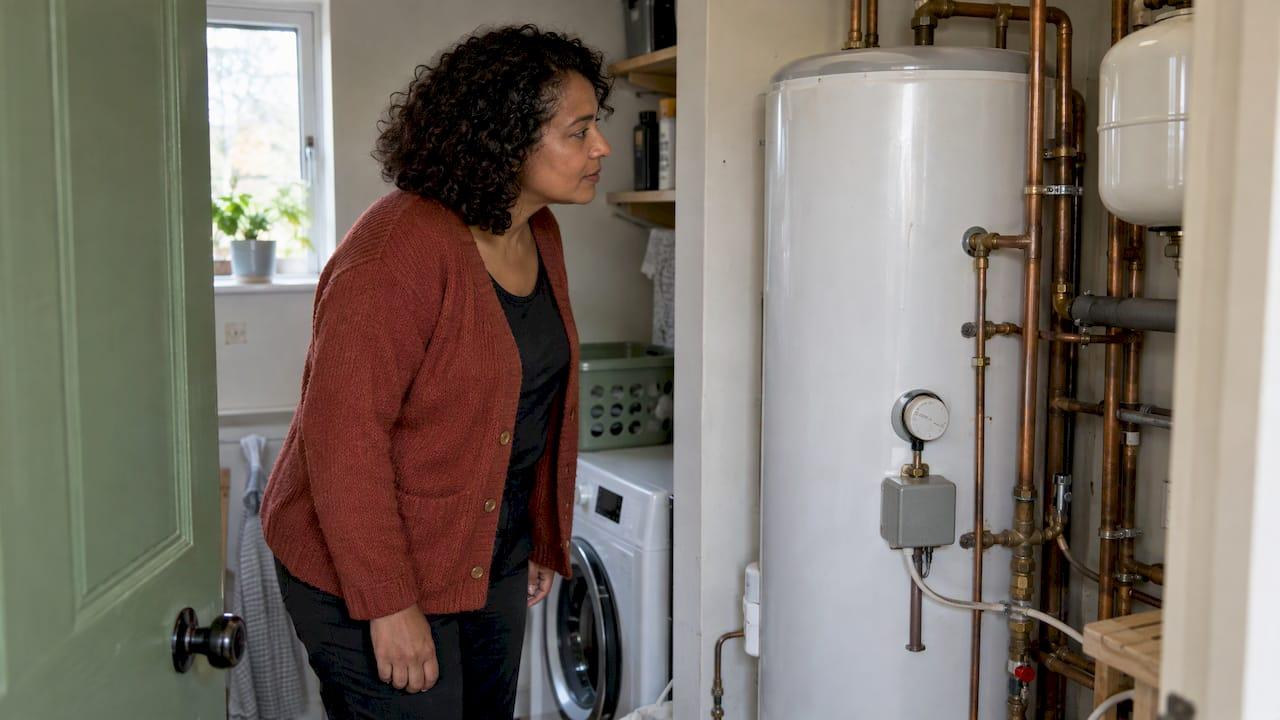
A noisy hot water cylinder is usually telling you one of four things: scale is building up on the heating element, air is trapped in the system, water is surging through the pipes, or something is loose and vibrating. Most of these are fixable. A few, such as constant bubbling, very hot taps or a steady discharge of water, need the heating switched off and an engineer on site the same day. This guide helps you tell which is which, shows the safe checks you can make from the landing, and explains where a job stops being a homeowner job.
TL;DR
- Banging, popping and kettle-like sounds most often point to scale on the immersion heater or expansion of the metal as it heats.
- Whooshing, gurgling and humming usually mean air in the system, a pump set too high or water surging through pipework.
- Rattles when you draw hot water are often loose pipes that need extra clips, not a faulty cylinder.
- Excessive noise or bubbling together with scalding taps or steam means switching off the immersion heater and calling a qualified plumber.
- If your cylinder is unvented (mains pressure), leave valves and safety devices to a qualified engineer.
Table of Contents
- First, know which type of cylinder you have
- What the sound is telling you
- Banging, popping and rumbling: scale
- Whooshing, gurgling and humming: air and flow
- Banging when a tap closes: water hammer
- Rattling and ticking: loose pipes and expansion
- Safe checks you can make yourself
- When to stop using it and call a plumber
- What a repair usually involves
- Our view on noisy cylinders
- Get a noisy cylinder looked at
- FAQ
- Sources
First, know which type of cylinder you have
The right advice depends on what is in your airing cupboard, so spend a minute on this.
Vented (open-vented) cylinders are fed from a cold water tank in the loft. They run at low pressure, and a vent pipe runs up from the cylinder and ends over that tank. Taps and showers on these systems often feel gentler.
Unvented (pressurised) cylinders are fed straight from the mains. They are sealed, usually have an expansion vessel or an internal air bubble to absorb the expansion of heated water, and carry safety devices such as a temperature and pressure relief valve. You will normally see a discharge pipe ending at a tundish, a small funnel-shaped fitting, near the cylinder or outside.
If you have no loft tank and the hot water comes out at strong, mains-like pressure, you almost certainly have an unvented cylinder. Our guide to the benefits of pressurised hot water systems explains the difference in more detail.
What the sound is telling you
Noise is a symptom, so describe it carefully before you guess at the cause. Note when it happens: while the water is heating, when a hot tap is opened, or all the time.
| Sound | When you hear it | Most likely cause | What to do |
|---|---|---|---|
| Banging or popping | While the cylinder heats | Scale on the immersion element causing localised boiling, or metal expanding | Arrange descaling or element replacement |
| Rumbling or kettle-like sound | During heat-up | Scale and sediment around the heating surfaces | Engineer inspection, element check |
| Whooshing or gurgling | When a hot tap is opened or the heating comes on | Air in the circuit, or water surging | Vent and balance the system, check pump setting |
| Humming or vibration | When hot water is running | Pump speed too high, or loose pipework | Check pump setting, secure pipes |
| Single bang when a tap shuts | Immediately after closing a tap | Water hammer | Check supports and pipe layout |
| Rattling on draw-off | When hot water is drawn | Loose or unsupported pipes | Add clips |
| Constant bubbling, hissing or steam | Any time, with very hot taps | Thermal control failure | Switch off heating, call a plumber now |
The causes in the table line up with those listed in installer guidance. One cylinder manufacturer's manual for a modern cylinder lists noise or vibration causes as air in the primary circuit, pump speed too high, water hammer, scale or unsupported pipework, with remedies of venting and balancing, checking the pump setting and supports, and investigating scale.
Banging, popping and rumbling: scale
This is the classic complaint, and it is most common in hard water areas. Limescale is the chalky deposit left when hard water is heated. On an electric immersion heater it forms a crust on the element. Water trapped under the crust flashes into steam, then collapses, which is the popping and rumbling you hear. The crust also insulates the element, so it works harder and heats less efficiently.
Much of southern England sits on chalk and limestone, so the towns we cover, including Reading, Newbury, Basingstoke, Winchester, Swindon, Cheltenham and Oxford, are well used to hard water. If your kettle furs up quickly, your cylinder will be getting the same treatment.
Health and safety guidance for large hot water systems notes that in hard water areas softening the cold water supply should be considered to reduce scale deposits at the base of the storage vessel and on heating coils. That guidance is written for commercial systems, but the principle applies at home: less scale means a quieter, more efficient cylinder.
What helps:
- A new immersion heater element is a routine, inexpensive repair. Scaled elements often fail eventually anyway, so replacing a noisy one is usually sensible.
- Descaling or flushing the cylinder where sediment has built up at the base.
- A scale-reduction measure on the incoming cold supply if you are in a hard water area.
Our guide to limescale in boilers covers hard water and scale in more depth.
Immersion heater work carries an electrical and scalding risk. Isolate the electricity at the consumer unit before anything is touched, and do not drain an unvented cylinder yourself.
Whooshing, gurgling and humming: air and flow
A whoosh or splash heard in the cylinder area when you open a hot tap first thing in the morning is a very common report. It tends to come from air that has collected in the pipework or in the primary circuit, the loop that carries boiler water through the cylinder coil. Air can enter after a drain-down, from a small leak or a failing vent, or through a pump that is not purging correctly.
Signs that air is involved:
- Gurgling that comes and goes.
- Hot water that sputters at the tap before running smoothly.
- Noise that changes when the heating pump starts.
The fix is to vent and balance the system, which means releasing trapped air from the circuit and adjusting flow so water is shared properly. Our guide to airlocks in hot water systems walks through the signs, and if the noise seems to come from your boiler as much as the cylinder, boiler gurgling noise is worth reading too.
Pump speed is another cause. A circulating pump set too high pushes water through the coil and pipes faster than they like, producing a hum or a rushing sound. Reducing the pump setting is a quick adjustment for an engineer and often cures the noise outright.
A steady hum while the heating is on can also be mechanical. If hot water seems to run constantly, a motorised valve sticking open can keep the pump circulating when it should have stopped. That is a job for a heating engineer.
Banging when a tap closes: water hammer
Water hammer is a single sharp thump, or a shudder through the pipes, just after you shut a tap or a valve like the one on a washing machine. Moving water stops suddenly and the pressure surge rattles the pipes. It can get worse where pipes are unsecured and free to move.
Practical points:
- Check that pipes near the cylinder and along the run are properly clipped.
- Note which tap triggers it. A worn tap washer or a fast-closing valve is often the trigger.
- Persistent hammer can be reduced with arrestors or by adjusting the pipework layout.
We cover this in more detail in what causes noisy pipes.
Rattling and ticking: loose pipes and expansion
A copper cylinder and its pipes expand as they heat, then contract as they cool. If a pipe is tight against a joist or the cylinder is not sitting correctly in its cradle, it will tick, creak or knock as it moves. These sounds typically appear during heat-up or cool-down rather than when you use a tap.
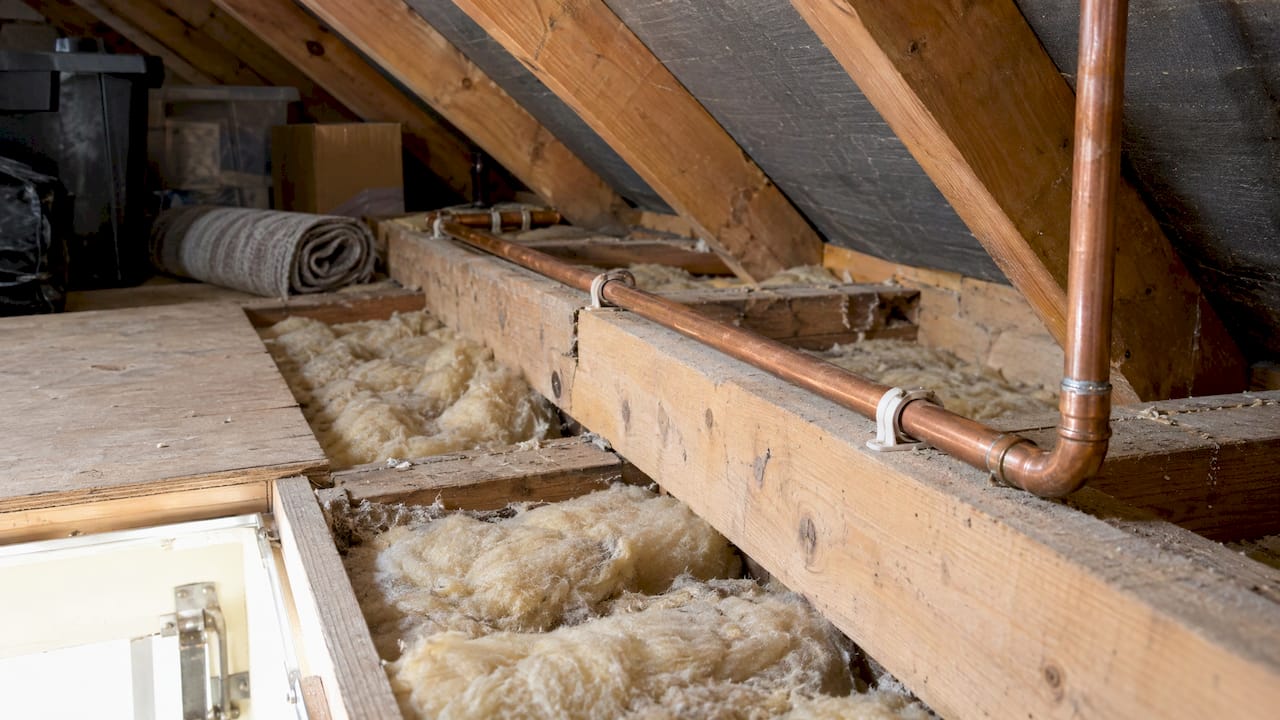
If the noise happens when you draw off hot water, loose pipework is a leading suspect. A manual for unvented cylinders lists noise during draw-off as caused by loose pipework, with the remedy of installing extra clips. It is a simple fix, but you need to be able to reach the pipes safely, and nobody should work near an unvented cylinder's pipes while the system is hot.
Safe checks you can make yourself
These need no tools and no contact with valves.
- Listen and log. Write down when the noise starts: heating, tap opening, tap closing or all the time. A short phone video helps an engineer a great deal.
- Look for leaks and staining. Check the cylinder, the pipework and the floor beneath for drips, damp or white scale marks. If you find a leak, see our guide on a hot water tank leaking.
- Feel the pipes carefully. Use the back of your hand briefly. A pipe that is too hot to leave your hand on is a warning sign.
- Check the tundish on an unvented cylinder. Look, without touching. If water is dripping continuously from the discharge pipe, switch the heating off and call for help.
- Check whether taps run excessively hot. Scalding water at taps alongside noise is a stop signal, covered below.
- Note the house and cylinder age. Older cylinders, particularly with a plastic cold water tank in the loft, are worth a closer look.
Hot water safety matters too: stored water is generally kept at 60°C or above to control legionella, and HSE guidance says outlets should reach 50°C within one minute. Do not turn your thermostat down to quieten a cylinder without advice, because the cure for noise is not lower stored temperature.
When to stop using it and call a plumber
Some noise is a nuisance. Some is a warning. The Health and Safety Executive says that signs such as excessive noise or bubbling from the cylinder, excessively hot tap water or steam in the roof space mean you should switch off the immersion heater system and seek advice from a competent person such as a qualified plumber.
In plain terms, stop and call if you notice:
- Bubbling, hissing or steam, especially with very hot taps.
- Water running continuously from the tundish or discharge pipe of an unvented cylinder. A cylinder manual states that continuous discharge from the relief valve indicates thermal control failure with very hot water, requiring all thermal controls to be checked and replaced if faulty.
- Noise that gets steadily louder over days.
- A cylinder that is hot to the touch on its outer surface in places it should not be.
If you have a gas boiler heating the cylinder and smell gas, leave the property and contact the National Gas Emergency Service on 0800 111 999.
Why unvented cylinders are not a DIY job
Unvented cylinders store water under mains pressure and rely on safety devices. The building regulations for hot water safety, Approved Document G, require precautions to stop stored water exceeding 100°C and a safe, visible route for any safety-device discharge. It says unvented systems should have at least two independent safety devices in addition to any thermostat, and be installed by someone registered with a competent person scheme or holding the relevant unvented skills card.
The same expectation applies to servicing. One manufacturer's manual says that in-depth fault finding on unvented systems should only be completed by a qualified engineer. Another says the routine checks of opening the relief valves in turn, checking the discharge pipework, cleaning the strainer and checking the expansion vessel should be performed by a competent person, noting that the discharged water may be very hot.
So if your cylinder is pressurised and noisy, do not adjust valves, and do not open the relief valve to see what happens. Note the symptoms and book an engineer. If you want to know what a proper service involves, our unvented cylinder service checklist sets it out.
Older houses and plastic loft tanks
The HSE's scalding alert notes the risk is greatest where plastic cisterns sit above bedrooms, most likely in houses built between 1945 and 1975. It also says that since 1 April 2004 fitting an independent safety cut-out has been recommended for any repair, replacement or installation work on domestic immersion heaters. If you live in a house of that age and your cylinder is noisy, tell the engineer so that they can check the immersion heater's protection.
What a repair usually involves
An engineer diagnosing a noisy cylinder will normally work through the same sequence:
- Listen to the noise under the conditions you described.
- Check the immersion heater and thermostat.
- Check the pump setting and system balance.
- Vent the circuit and look for air entry points.
- Inspect pipework supports and the cylinder cradle.
- On unvented cylinders, test the safety devices and expansion vessel charge. One manual gives the expansion vessel air charge as 2.1 bar for copper cylinders and 3 bar for stainless steel.
If the cylinder itself is old, failing or heavily scaled, replacement may be better value than repeated repairs. Our list of signs your water heater is failing helps you judge that, and if lukewarm water is part of the story, see fixing tepid hot water.
Our view on noisy cylinders
Most noisy cylinders we hear about are not mysteries. The sound gives you a good first clue, and an engineer who listens to it properly usually narrows the cause quickly.
What we would urge is that nobody lives with a cylinder that bubbles, hisses or sends out scalding water. That is a safety issue, not a noise issue. Switch off the immersion heater and call someone who is qualified.
We keep our approach simple. You speak to the engineer directly, our pricing is transparent, there is no call-out fee, and our no fix no fee guarantee means you pay only after successful work. Work comes with a 12-month warranty, and we are available 24/7 including holidays. For a noisy cylinder, that means a clear answer on the cause and a fixed way forward.
Michael
Get a noisy cylinder looked at
If your cylinder is banging, humming or bubbling, we can send an engineer to find the cause. Heating and boiler work is charged at £110 per hour, and there is no call-out fee. For a bubbling cylinder, scalding taps or steam, our emergency engineer with a 60 minute response time is the quickest route. For a noise that is annoying rather than alarming, you can book a plumber online. More than 300 Trustatrader reviews are there to read.

If the cylinder is at the end of its life and you would rather replace it than keep repairing it, we supply and fit new boilers from £1,300 one-off and give free on-site quotes through our new boiler quote page.
FAQ
Why is my hot water cylinder making a banging noise?
The most common cause is scale on the immersion heater element, which makes water boil in small pockets and collapse noisily. Metal expanding as the copper cylinder heats can also cause bangs and ticks. An engineer can check the element and the cylinder's cradle and pipe connections.
Is a noisy hot water cylinder dangerous?
Not always, but bubbling, steam or scalding taps alongside noise are warning signs. In that case switch off the immersion heater and contact a qualified plumber. Constant discharge from an unvented cylinder's tundish also needs prompt attention.
How do I stop water hammer?
Start by making sure the pipes are properly clipped and not free to move. If the thump follows one particular tap, the tap or valve may be worn or closing too quickly. An engineer can fit arrestors or adjust the pipework if the problem persists.
Can I fix a noisy unvented cylinder myself?
You can listen, log the noise and look for leaks. Valves, the expansion vessel and safety devices should be left to a qualified engineer, because the system runs at mains pressure and the discharged water can be very hot.
Why does my cylinder whoosh when I turn on a hot tap?
This is usually air in the pipework or primary circuit, or water surging at high pump speed. Venting and balancing the system and checking the pump setting normally resolves it.
Sources
- HSE: Legionnaires' disease technical guidance, HSG274 Part 2
- HSE: Scalding risk from domestic hot water systems
- Approved Document G: Sanitation, hot water safety and water efficiency, with 2024 amendments
- Super Cylinder installer manual
- Unvented cylinders installation, commissioning and service manual
- Megaflo Eco unvented cylinder installation and user guide
- Atlantic Direct unvented cylinder manual