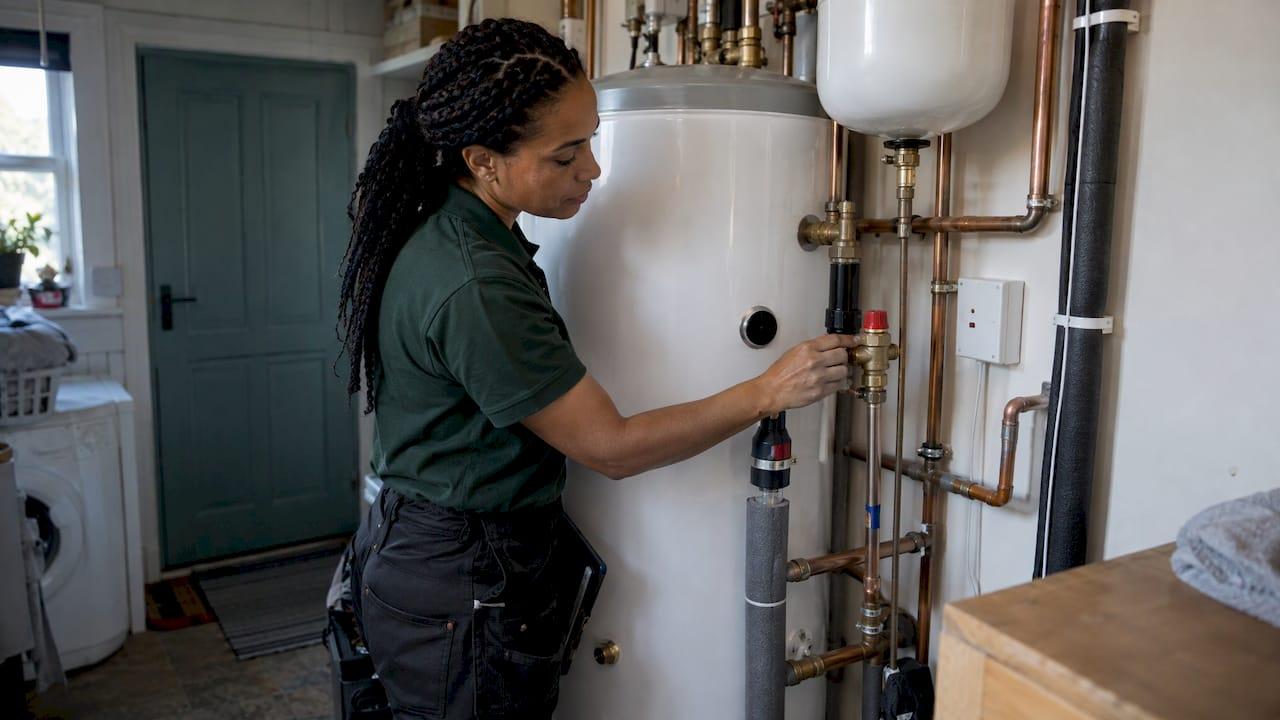
An unvented cylinder needs a service every 12 months, carried out by a competent engineer who tests the safety valves, checks the expansion system and discharge pipework, confirms the heating controls and signs the service record. Below is the full checklist, so you know what a proper visit covers. It also covers who is qualified to do it and what to do when something is wrong. If your cylinder is due, we service hot water cylinders and can book you in online.
TL;DR
- Service an unvented cylinder every 12 months. The Hot Water Association guide says this applies to direct and indirect products, and it is usually a condition of the manufacturer's warranty.
- The core of the visit is operating the temperature and pressure relief valve and the expansion relief valve, checking the expansion vessel, and inspecting the tundish and discharge pipes.
- A proper service ends with the service record completed and signed. Keep it, because long guarantees often depend on it.
- Water pouring from the tundish is a warning sign. Switch off the heat sources, leave the water on and call an engineer.
- Hard water shortens the life of components, so scale is part of the conversation at every service.
Table of Contents
- How often should an unvented cylinder be serviced?
- Why unvented cylinders need regular checks
- The unvented cylinder service checklist
- Who can service an unvented cylinder?
- Hard water, scale and storage temperature
- What if the service finds a fault?
- What you can do between services
- Our view on unvented cylinder servicing
- Book your cylinder service
- FAQ
- Sources
How often should an unvented cylinder be serviced?
Once a year. That is the interval in the Hot Water Association Servicing Guide, which says checks for all unvented direct and indirect products should happen every 12 months. It adds that regular servicing by a competent engineer is, in most cases, a condition of the manufacturer's warranty.
Manufacturers say the same thing in their own manuals:
- The Worcester Bosch manual states that the product needs servicing every 12 months and that the service record must be maintained to protect the 25-year guarantee (10 years on heat pump models).
- The World Heat service manual makes its 25-year guarantee on stainless steel cylinders up to 300 litres conditional on annual servicing and on the log book being filled in after each visit.
- The Neptune manual calls for annual servicing to keep the cylinder working safely, perform well and keep its guarantee.
- The Heat Geek × World Heat manual says at least once a year, or more often where the risk assessment, water quality, operating conditions or a component manufacturer require it.
The practical rule: put the date in your diary when the cylinder is installed, and treat the service record as part of the paperwork for the house, alongside gas certificates and warranties. A missed year can put a long guarantee at risk, and a guarantee on a cylinder is worth protecting.
Why unvented cylinders need regular checks
An unvented cylinder stores water at mains pressure and heats it, so it holds a lot of energy in a sealed vessel. That is why the design includes several layers of protection: a temperature and pressure relief valve, an expansion relief valve, an expansion vessel or internal air bubble to absorb the water's expansion, and thermal cut-outs on the heat sources. Each of these only protects you if it still works.
Valves can stick, scale can collect on seats, and expansion vessels lose air pressure over time. None of that is visible from the outside. A service is the only way to find out the safety devices will operate on the day they are needed. The benefit for the household is the one you want from any pressurised system: strong showers, hot water that comes up to temperature and a cylinder that carries on doing its job quietly. If you want more on how these systems work, see our guide to the benefits of pressurised hot water systems.
The unvented cylinder service checklist
The list below combines the Hot Water Association checklist with the annual service checklist in the Heat Geek × World Heat manual. Individual manufacturers add their own items, so the engineer should have your cylinder's instructions to hand.
Before the engineer touches anything
- Manufacturer's instructions available. The HWA checklist starts here. The exact requirements for your cylinder are in its maintenance manual, and the engineer signs the record when finished.
- A conversation about existing problems. Tell the engineer about dripping from the tundish, noises, fluctuating temperatures, slow recovery or a tripped immersion heater. These are clues the visit should follow up.
- A visual check of the cylinder. The engineer looks at the casing, insulation, supports, pipework and joints for damage, staining or leaks.
Safety valves and discharge pipework
- Operate the expansion relief valve and the temperature and pressure relief valve. The World Heat manual says both must be operated annually and the water allowed to flow for at least 5 seconds. The HWA guide describes running water through each valve for roughly 30 seconds to flush loose scale or debris before it is resealed. The valve must discharge freely and seat properly afterwards.
- Inspect the tundish and discharge pipes. The Heat Geek × World Heat checklist covers D1 (the short pipe from the valve to the tundish), the tundish itself, D2 (the pipe beyond it) and the termination, looking for blockage, damage, leaks or unsafe alterations.
- Check the tundish arrangement. According to the Mixergy manual, the tundish should be vertical, in the same space as the cylinder, fitted as close as possible to and lower than the safety device, with no more than 600mm of pipe between the valve outlet and the tundish.
Pressure, expansion and water inlet
- Clean the inlet strainer. The line strainer protects the controls from debris and is on both checklists.
- Check the expansion vessel. The World Heat manual gives the air pressure as 2.1 bar for copper vessels and 3 bar for stainless steel vessels, checked with the cylinder pressure dropped, and says it can be topped up with a standard bicycle pump if low. Your own cylinder's manual gives the figure that applies to it.
- Check the expansion system pressure as part of the HWA requirements.
Heat sources and controls
- Check the immersion heater, thermostat and cut-out. The engineer should confirm the operating thermostat controls the stored temperature. A non-self-resetting cut-out stays off after it trips until someone resets it, so cooling alone will not bring the heating back, as this revision guide explains. If your immersion heater is misbehaving, our immersion heater checks are a sensible first read.
- Check primary controls. On indirect cylinders this means zone valves, pump, bypass and the high-limit shutdown interlock, plus any external-control interlocks.
- Check outlet temperature. The HWA guide uses outlet temperature to assess thermostat function.
- Inspect electrical wiring and housings associated with the cylinder, immersion heater and controls, and the anode if one is fitted. Also check any flexible hoses.
Finishing the job
- Restore the supply properly. Before heating the cylinder or doing functional tests, the supply should be restored and the cylinder refilled and vented following the manufacturer's procedure.
- Complete the service record. The HWA guide names the Benchmark service record, and the World Heat manual its log book. Check it is dated, signed and kept somewhere safe.
A quick reference table
| Item | What the engineer checks | Why it matters |
|---|---|---|
| Temperature and pressure relief valve | Operated, flows freely, reseats | Final protection against over-temperature and over-pressure |
| Expansion relief valve | Operated, flows freely, reseats | Protects against excess pressure |
| Tundish, D1 and D2 | No blockage, leaks or alterations | Discharge must reach a safe place |
| Inlet strainer | Cleaned | Keeps debris out of controls |
| Expansion vessel | Air pre-charge | Absorbs heated water's expansion |
| Thermostat and cut-out | Operation and reset | Controls and limits stored temperature |
| Wiring, anode, hoses | Visual condition | Spots wear before it becomes a failure |
| Service record | Completed and signed | Supports the guarantee |
A typical visit is quoted by many providers as 30 to 60 minutes, although the time depends on the installation and on what is found.
Who can service an unvented cylinder?
Unvented hot water systems fall under Building Regulation G3 in England and Wales. The Megaflo manual says installation must be carried out by a competent plumbing and electrical installer in line with G3, Technical Standard P3 in Scotland or Building Regulation P5 in Northern Ireland. The Neptune manual says servicing should only be done by competent installers, and the Heat Geek × World Heat manual asks for a competent person with current unvented hot water competence.
In practice that usually means an engineer holding an unvented hot water qualification. The G3 course from one training provider, for example, gives a certificate valid for five years covering systems up to 500 litres and 45kW. BPEC describes its unvented course as helping plumbers and heating engineers meet the relevant Building Regulations and Standards.
A qualified engineer will not mind you asking about it. Ask whether they are currently competent on unvented systems, whether they have your manufacturer's instructions and whether they will complete and sign the service record. For wider background on the rules, see our guides to UK plumbing regulations and plumbing compliance.
A gas boiler heating the cylinder is a separate matter. Gas work requires a Gas Safe registered engineer; our Gas Safe explainer sets out what that means for homeowners.
Hard water, scale and storage temperature
Scale is the quiet enemy of an unvented cylinder. It can coat heating elements, clog strainers and foul valve seats. The World Heat manual advises that in hard water areas the storage temperature should be reduced to 50 to 55°C to help reduce scaling, and that water quality should meet European Council Directive 98/83 EC, with chloride and sulphate each at a maximum of 250 mg/l and the two combined at no more than 300 mg/l. Ask the engineer to check your cylinder's own manual before changing any thermostat setting.
Much of southern England has hard water. Anyone who has seen how washing a car in hard water leaves spots behind has seen the same minerals that settle inside a cylinder and its valves. We cover the boiler side of the problem in limescale in boilers.

What if the service finds a fault?
A fault found at a service is a service doing its job. Here is how the manuals say to respond.
- Water flowing from the safety valves through the tundish indicates a fault in the heating system. The Neptune manual says that if the water is hot you should turn off the boiler and any immersion heaters, not turn off the water until the discharge runs cool, and call a competent installer to diagnose the fault.
- A valve that keeps discharging after the other checks are done needs the engineer to find which valve is at fault and replace it. The Mixergy manual says to use a replacement supplied by the manufacturer, and the revision guide adds that a replacement must match the cylinder's approval data, because a valve can thread in and still have the wrong set point.
- An immersion heater that is not heating properly has, according to the Mixergy manual, failed, has an electrical fault, or has had its cut-out operate because the control thermostat is set too low or is faulty.
- Leaks from the cylinder body or joints are a separate problem. Our steps for a leaking hot water tank cover what to do while you wait.
If water is coming out hot and fast, or the cylinder is in an emergency state, call for help immediately. We offer an emergency plumbing or heating engineer with a 60-minute response time.
Poor temperatures without any alarm are usually a lesser fault. Our guides to tepid hot water and fluctuating shower temperature help you narrow it down.
What you can do between services
Some things belong to the homeowner. Know where the tundish is and glance at it now and then: it should be dry. Know where the isolation valve and the immersion heater switch are. Keep the area around the cylinder clear so the engineer can reach everything. Keep the service record with the boiler paperwork. Do not alter the discharge pipework, cap or block any valve, or fit a replacement part that does not match the cylinder's approval data. Valves and pipework are safety equipment, and the manuals treat unsafe alterations as a defect.
Our view on unvented cylinder servicing
We think the annual service is the cheapest insurance a household with an unvented cylinder can buy. The checklist is not long, but every item on it is there because it stops a small problem becoming a big one.
Our approach is built around being easy to deal with. We charge no call-out fee, we work on a no fix, no fee basis, and you pay only after the work is done successfully. We give a 12-month warranty on our work and you speak directly to the engineer. For heating and boiler work our rate is £110 per hour, so you know where you stand before we start.
Our advice is simple: book the service on the anniversary of the installation, ask for the record to be completed and signed, and tell us about anything odd, such as drips at the tundish or lukewarm water. We would always rather look at a small symptom than come out to a failure.
Michael
Book your cylinder service
We service hot water cylinders and repair immersion heaters, taps, leaks and heating faults, with 24/7 availability including holidays and same-day emergency response. You can book through our plumbing booking page, and our team covers Reading, Newbury, Oxford, Swindon, Bristol, Winchester and many other towns across the south of England.

If the cylinder is old and the service keeps turning up faults, the question may become replacement. New boilers supplied and fitted start from £1,300, and a new boiler quote is free on site. Over 300 Trustatrader reviews are there if you want to see how other homeowners found us.
FAQ
How often should I service my unvented cylinder?
Every 12 months. The Hot Water Association guide says checks on all unvented direct and indirect products should be carried out annually. Manufacturers such as Worcester Bosch, World Heat and Neptune tie their long guarantees to annual servicing, so keep the record each year.
How long does an unvented cylinder service take?
The time depends on the installation, but providers commonly quote between 30 and 60 minutes for a standard annual visit. Extra time is needed if parts such as valves, strainers or heaters need replacing, or if the discharge pipework has problems.
Can I service an unvented cylinder myself?
No. The manufacturers' manuals say servicing should be done by a competent person with current unvented hot water competence. The cylinder holds water at mains pressure and stored heat, and its safety valves and discharge pipework are regulated under Building Regulation G3 in England and Wales. Book an engineer and keep the signed service record.
Why is water coming out of my tundish?
Water flowing through the tundish means a safety valve is discharging, which points to a fault in the system. If the water is hot, switch off the boiler and immersion heaters, leave the water supply on until the discharge runs cool, and call an engineer straight away.
Does a missed service affect my guarantee?
It can. Several manufacturers make long guarantees conditional on annual servicing and a completed service record. Check your cylinder's manual for its exact terms, and keep each year's signed record.
Sources
- Hot Water Association Servicing Guide
- World Heat unvented cylinders installation, commissioning and service manual
- Heat Geek × World Heat Super Cylinder installer manual
- Worcester Bosch unvented cylinder manual
- Neptune installation and maintenance manual
- Mixergy X installation and servicing manual
- Megaflo Eco SystemReady installation, servicing and user guide
- Unvented Hot Water G3 course
- BPEC Domestic Hot Water Storage Systems qualification
- Servicing an unvented cylinder: annual safety checks
- Washing a car in hard water