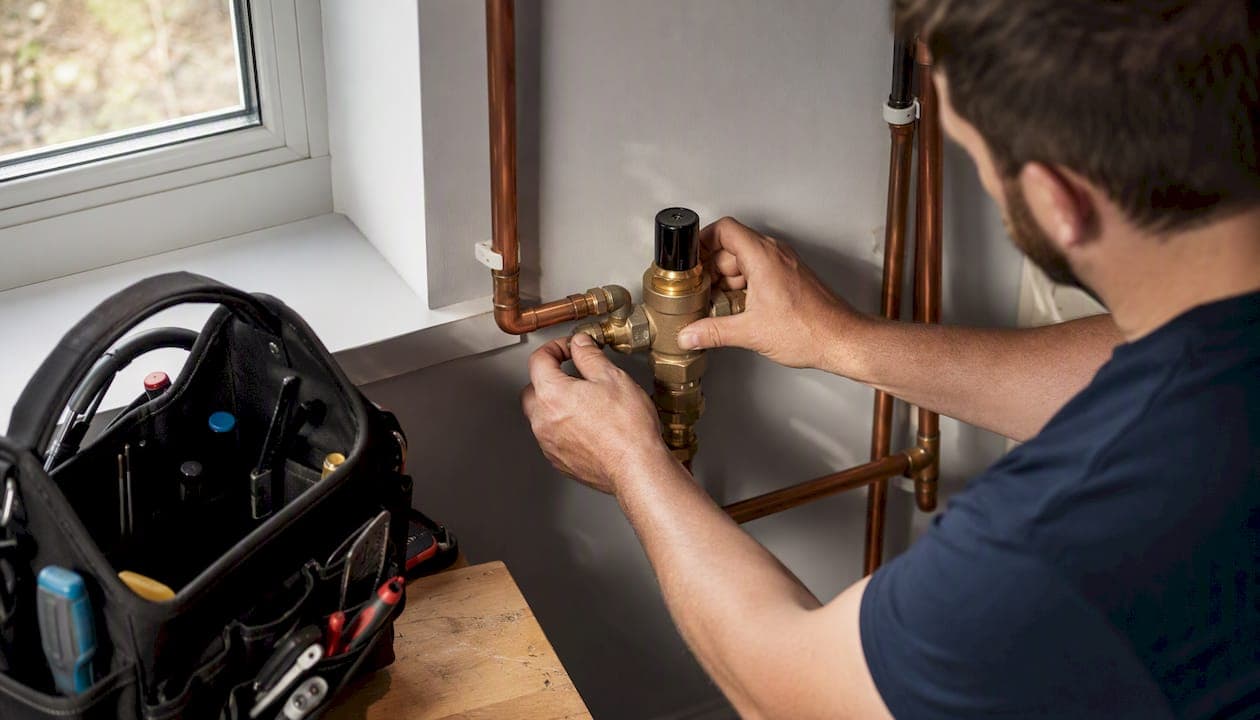
The highest-impact plumbing upgrades for a modern UK home are dual-flush WCs, low-flow taps and showers, thermostatic mixing valves (TMVs), instant boiling-water taps, oxygen-barrier PEX or multilayer composite pipework, smart leak detectors, and underfloor heating. Together, they cut water and energy bills, reduce the risk of costly damage, and make a home noticeably more comfortable to live in and easier to sell.
Before booking any work, check three things: whether your bath supply already has a TMV (required under Approved Document G to cap hot water at 48°C), whether your existing pipework is suitable for the circuits you want to add, and whether the scale of work triggers a building control notification. Your-local-plumber can carry out a site survey that covers all three.
Quick-reference: top upgrades at a glance
- Dual-flush WCs with low average flush volume guidance
- Low-flow taps and showers with flow rates capped for basin taps
- Thermostatic mixing valves for baths
- Instant or boiling-water taps
- Smart leak detectors with automatic shut-off
- Oxygen-barrier PEX or MLCP pipework for heating circuits
- Underfloor heating (wet systems)
- Water softeners or inline filters where water hardness is high
Table of Contents
- What are the best plumbing upgrades for modern homes?
- Smart showers, taps and leak detection: what actually delivers
- What do UK building regulations require for water efficiency?
- Which pipe material should you use in a modern home?
- Heating and hot-water upgrades that make the biggest difference
- How much do plumbing upgrades cost and how disruptive are they?
- What to ask a plumber before you approve any quote
- Three realistic UK project examples
- Key takeaways
- The upgrades most homeowners overlook
- Your-local-plumber: surveys, installs and fixed-price plumbing work
- Useful UK sources and standards
What are the best plumbing upgrades for modern homes?
Not every upgrade suits every property, but the list below covers the options that deliver the clearest returns for most UK homeowners, whether the goal is lower bills, better comfort, or stronger resale appeal.
- Oxygen-barrier PEX or MLCP pipework. For sealed central heating circuits, barrier pipe prevents oxygen diffusion that corrodes radiators and boilers over time. Flexible and fast to install in long concealed runs. ROI direction: high for longevity of the heating system.
Smart showers, taps and leak detection: what actually delivers
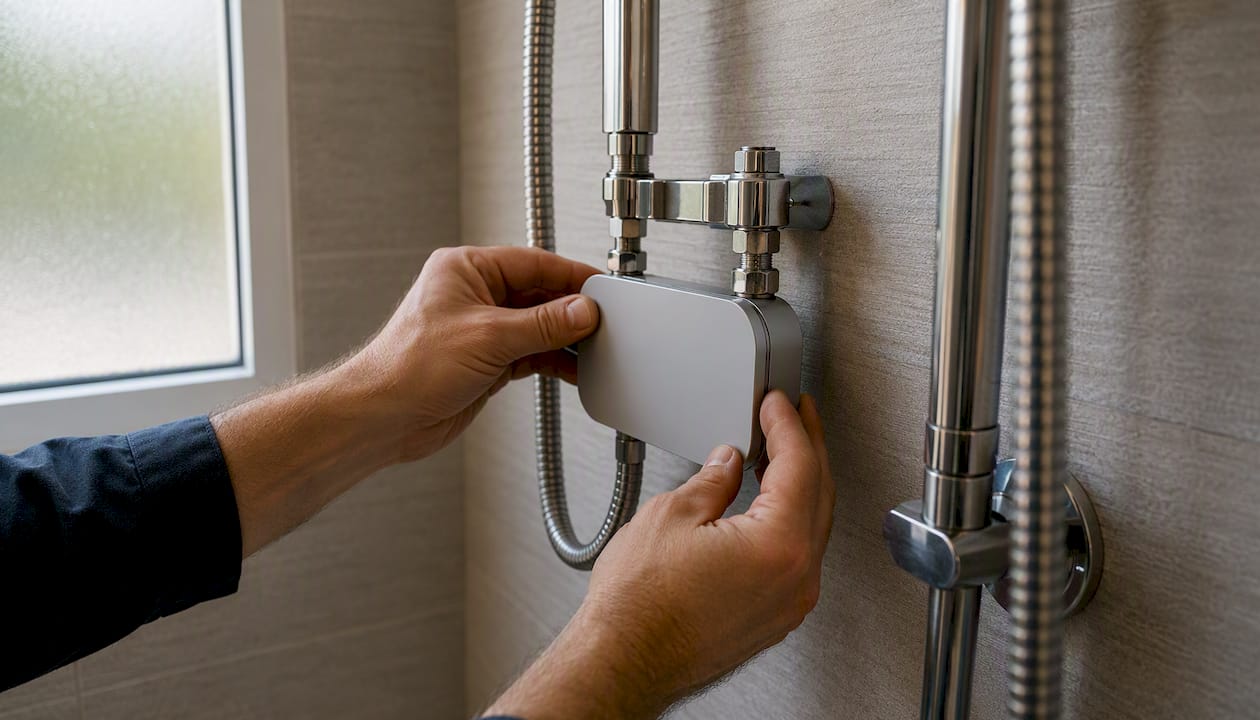
Smart plumbing fixtures have moved well past novelty. The ones worth specifying fall into two clear categories: those that save water and energy measurably, and those that protect the home from damage.
Smart showers and tap controllers work by limiting flow and allowing temperature pre-sets. A digital shower that holds a precise temperature eliminates the cold-to-hot adjustment period, which wastes both water and the energy used to heat it. Eco modes on some models cap session volume and alert the user when a set limit is reached. For a family of four, the cumulative saving across daily showers adds up quickly.
When choosing smart fixtures, check three things before buying:
- Compatibility with your existing water pressure (some digital showers need a minimum dynamic pressure of 0.1 bar, others need 1.0 bar or more)
- Whether the unit is battery-powered or mains-connected (mains units need a Part P-compliant electrical installation in a bathroom zone)
- Whether retrofit is possible or whether the valve body needs replacing entirely
Smart leak detectors are arguably the most cost-effective upgrade on this list relative to their price. A small sensor placed under a kitchen sink or behind a washing machine can detect a slow drip before it saturates a floor joist. Automatic shut-off models connect to a motorised valve on the mains supply and close it the moment a leak is detected. Placement matters: prioritise locations near the stop tap, under the kitchen sink, adjacent to the hot water cylinder, and at any washing machine or dishwasher connection.
Pro Tip: Battery-powered leak sensors are straightforward to fit yourself, but any automatic shut-off valve wired to the mains supply should be installed by a qualified plumber or electrician. Mixing plumbing and electrical work in a bathroom or utility room without the right qualifications creates a safety and insurance risk.
What do UK building regulations require for water efficiency?
Approved Document G sets the rules for sanitation, hot water safety, and water efficiency in England. For homeowners planning upgrades, the most relevant requirements are:
Hot water temperature. Hot water supplied to a bath must be limited to a maximum of 48°C. A TMV is the standard way to achieve this. The Part G FAQ confirms that these safety obligations apply across all system types, not just unvented cylinders.
Water consumption targets. For new dwellings and material changes of use, Part G sets a design target of 125 litres per person per day. Where planning conditions require it, a tighter target of 110 litres per person per day applies. These figures drive the fittings specification.
Fittings guidance. Scottish building standards and UK technical guidance both point to dual-flush WCs averaging around 4.5 L and basin taps at ≤6 L/min as the practical benchmarks for hitting those consumption targets. The NHBC notes that household water use has been rising, making low-flow fittings an increasingly important part of any new build or significant renovation specification.
Roughly 30% of a household's heating bill is tied to heating water, according to Scottish building standards guidance. Reducing hot water consumption through low-flow fittings cuts both water and energy costs simultaneously.
When do these rules apply to you?
- New dwellings: full Part G compliance required
- Material change of use (e.g. converting a commercial building to residential): full compliance
- Extensions and renovations: the new or altered work must comply; existing parts of the system are not automatically required to be upgraded, but it is good practice to bring safety-critical items (TMVs, pressure relief valves) up to standard
- Retrofit tap or WC swaps: no building control notification typically required, but fittings should still meet efficiency guidance
Pre-work compliance checklist:
- Confirm bath supply has a functioning TMV set to ≤48°C
- Check cylinder has a temperature and pressure relief valve and an energy cut-out
- Record the flush volume and flow rate of new fittings for the water-efficiency calculation
- Notify building control if the work constitutes a material change of use or involves notifiable electrical or gas work
- Use a Gas Safe registered engineer for any boiler or gas pipework
| Requirement | Figure | Source |
|---|---|---|
| Maximum bath temperature | 48°C | Approved Document G |
| Standard water consumption target | 125 L/person/day | Approved Document G |
| Optional tighter target | 110 L/person/day | Approved Document G |
| Dual-flush WC guidance | ~4.5 L average | Scottish building standards / UK guidance |
| Basin tap flow rate guidance | ≤6 L/min | Scottish building standards / UK guidance |
For a full breakdown of what triggers a building control notification, the UK plumbing regulations guide on the Your-local-plumber blog covers the key thresholds in plain language. You can also read more about plumbing sustainability measures that complement these regulatory requirements.
Which pipe material should you use in a modern home?
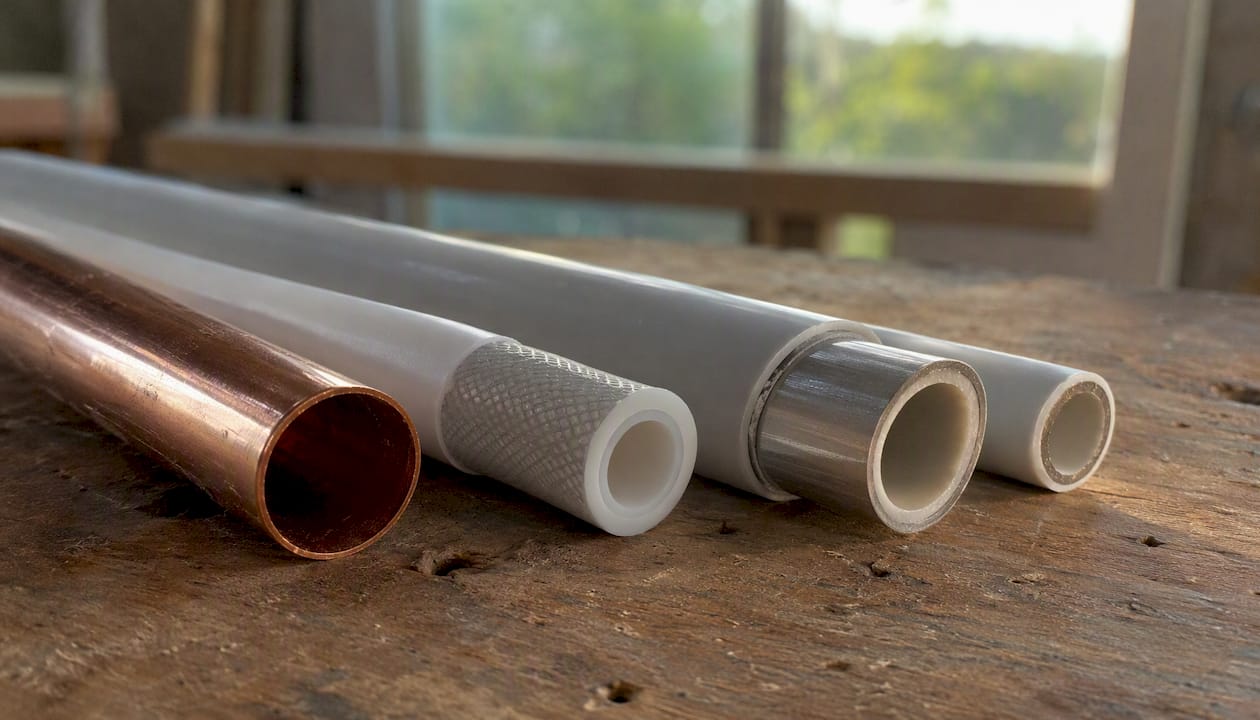
Copper, PEX, polybutylene (PB), and multilayer composite pipe (MLCP) each have a place in a modern home. Choosing the wrong one for a given circuit is one of the most common and costly installer mistakes.
Copper remains the benchmark near boilers and hot water cylinders. Its heat tolerance is unmatched among common domestic pipe materials, and it does not require an oxygen barrier. The trade-off is cost and the skill required to solder joints correctly. For short, accessible runs adjacent to heat sources, copper is still the right call. Building Products Info guidance confirms copper as the preferred choice near boilers and cylinders.
PEX (cross-linked polyethylene) is flexible, resistant to freezing damage, and fast to install in long concealed runs. For sealed central heating circuits, you must specify oxygen-barrier PEX. Without the barrier layer, oxygen diffuses through the pipe wall into the system water, corroding radiators and the boiler heat exchanger from the inside. The damage accumulates slowly and is expensive to fix.
PB (polybutylene) shares many of PEX's practical advantages and is widely used in domestic plumbing. It performs well for cold and hot water supply but, like PEX, requires the oxygen-barrier variant for heating circuits.
MLCP (multilayer composite pipe) combines a plastic inner and outer layer with an aluminium core. It holds its shape when bent, which makes it useful for neat installations in visible locations. It also offers an inherent oxygen barrier, making it suitable for heating circuits without the need to specify a separate barrier grade. BEAMA guidance lists PE-X, PB, and multilayer PE-X/Al/PE-X as the standard pipe types for underfloor heating, with the oxygen barrier requirement applying to all plastic UFH pipe.
The single most common installer mistake with plastic pipe is skipping the pipe stiffener insert on push-fit joints. The insert supports the pipe wall inside the fitting; without it, the pipe can deform under pressure and the joint will eventually weep. Always insist that your installer uses the correct insert and pressure-tests the system before any joints are concealed. The buildwiz knowledge base on 22mm push-fit barrier pipe covers this in detail, along with the practical importance of specifying barrier pipe on heating circuits.
Pro Tip: Ask your plumber to confirm in writing which pipe grade they are using for each circuit, and request a pressure-test record before any floor screed or plasterboard goes over concealed joints. A verbal assurance is not enough if a leak appears two years later.
Homeowner checklist for pipework discussions:
- Copper specified for boiler and cylinder connections
- Oxygen-barrier PEX or MLCP for all sealed heating circuits (radiators, UFH)
- Pipe inserts confirmed for all push-fit plastic joints
- Pressure test carried out and recorded before concealment
- Thermal expansion accounted for on long plastic runs (expansion loops or flexible connections)
- Manufacturer warranty confirmed for fittings and pipe grade used
For a plain-language explanation of each material, the plumbing materials guide on the Your-local-plumber blog is a useful reference to share with your installer.
Heating and hot-water upgrades that make the biggest difference
The heating and hot-water system is where most of a home's energy spend sits, and it is where the right upgrade delivers the fastest return.
Boiler replacement is the most impactful single upgrade for most homes. A modern condensing combi boiler running at high efficiency replaces an older unit that may be wasting a significant portion of every unit of gas it burns. For homes with a stored hot water demand (large families, multiple bathrooms), a system boiler paired with a well-insulated unvented cylinder often outperforms a combi on running costs. The choice between the two depends on peak demand, available space, and incoming mains pressure.
Cylinder upgrades matter more than many homeowners realise. An older vented cylinder with minimal insulation loses heat continuously, even when no hot water is being drawn. Replacing it with a modern unvented cylinder that carries the correct safety devices (temperature and pressure relief valve, energy cut-out, and expansion vessel) brings both efficiency and compliance. Any stored hot water system must include these devices; the Approved Document G amendment booklet and the Part G framework set out the technical requirements.
Underfloor heating suits extensions, new wet rooms, and open-plan ground floors particularly well. A wet UFH system runs at flow temperatures of around 35–45°C, compared with 70°C or more for a conventional radiator circuit. That lower flow temperature means the boiler operates in condensing mode more consistently, which improves efficiency. The trade-off is the time and cost of installation: screed floors need time to cure before the system is commissioned, and the pipework layout must be designed to avoid cold spots.
TMVs and controls are the safety and efficiency layer that ties the system together. A TMV on the bath supply is a Part G requirement for new and materially changed dwellings. Smart thermostats and zone controls reduce consumption by heating only the rooms in use at the times they are needed.
Upgrades that pay back fastest:
- Large families with high daily shower and bath use (low-flow fittings and efficient cylinder)
- Homes with an ageing boiler over 15 years old (replacement delivers immediate efficiency gain)
- Extensions adding a new wet room or bathroom (underfloor heating and TMV from the start)
- Properties in hard-water areas where limescale is shortening boiler and cylinder life (softener or inhibitor)
- Homes with no zone controls (adding smart thermostats and TRVs costs relatively little and cuts bills noticeably)
For context on whether your hot water system is driving high energy bills, the hot water system efficiency guide from Priority Plus Plumbing offers a useful diagnostic framework.
How much do plumbing upgrades cost and how disruptive are they?
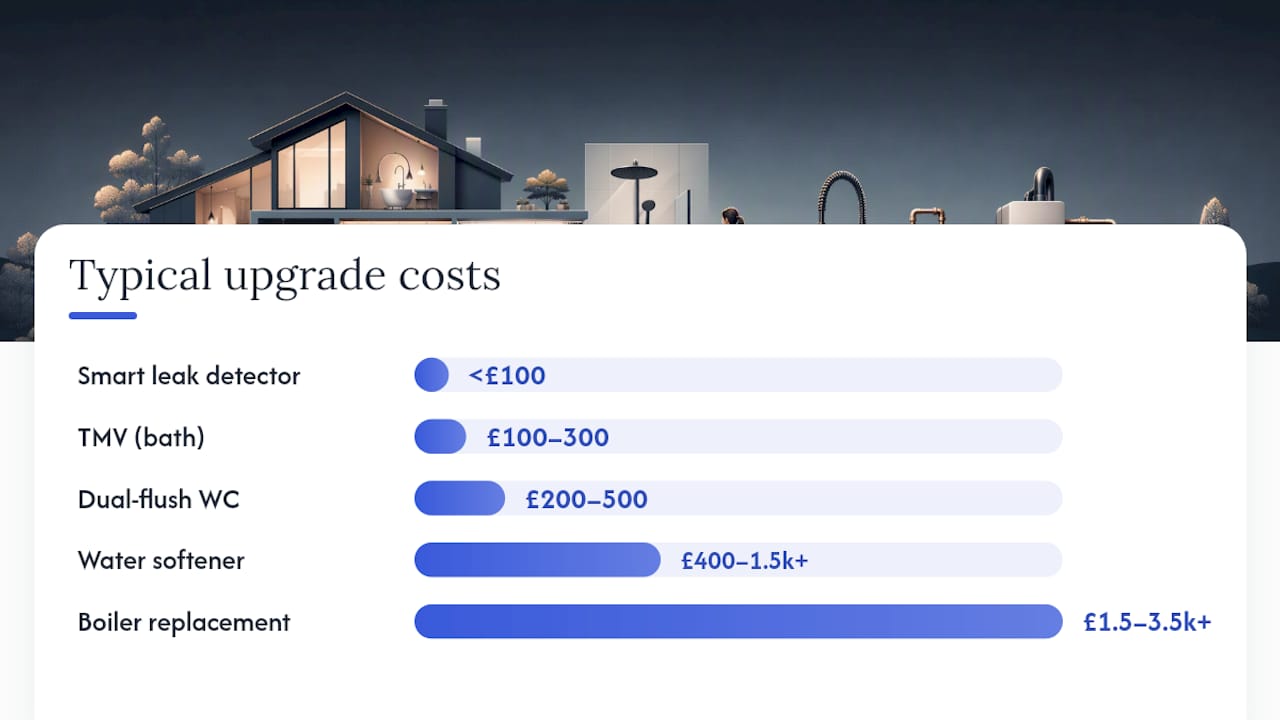
Cost and disruption vary enormously depending on access, the age of the existing system, and whether work is being done as part of a larger renovation or as a standalone job. The table below gives realistic ballpark bands; actual quotes will depend on your specific property.
| Upgrade | Typical cost band | Typical duration | Disruption level |
|---|---|---|---|
| Tap or showerhead swap | Low | 1–2 hours | Minimal |
| Dual-flush WC replacement | Low–medium (£200–£500) | Half day | Low |
| TMV installation (bath) | Low (£100–£300) | 1–3 hours | Low |
| Smart leak detector (battery) | Low (under £100 per unit) | Under 1 hour | Minimal |
| Boiler replacement | Medium–high (£1,500–£3,500+) | 1–2 days | Medium |
| Unvented cylinder upgrade | Medium (£800–£2,000+) | 1 day | Medium |
| Underfloor heating (wet, per room) | High (£1,000–£3,000+ per room) | 3–7 days | High |
| Full pipe re-route (partial) | Medium–high (£500–£2,000+) | 1–3 days | Medium–high |
| Water softener installation | Medium (£400–£1,500+) | Half to full day | Low–medium |
A few factors push costs higher: limited access to existing pipework (under screed or behind tiled walls), older properties with non-standard pipe sizes, and any work that requires draining the entire heating system. Trades overlap (plumber and electrician on the same day for a smart shower, for example) adds coordination time.
Getting a reliable quote:
- Always request a written scope of works, not just a price
- Confirm whether the rate is fixed or hourly, and what triggers additional charges
- Ask specifically whether pressure testing is included and whether a test record will be provided
- Check that fittings specified meet Part G guidance (flush volumes, flow rates)
For a step-by-step view of what to expect during an installation, the plumbing installation process guide on the Your-local-plumber blog is worth reading before you confirm a booking. Homeowners in the Reading area can also find targeted cost-saving advice in the guide to cutting plumbing costs.
What to ask a plumber before you approve any quote
Choosing the right installer matters as much as choosing the right upgrade. A well-specified job done by the wrong person can fail inspection, void warranties, and cost more to fix than it would have cost to do correctly the first time.
Questions to ask every installer:
- Are you Gas Safe registered? (Required for any gas boiler or gas pipework work — check the register at gassaferegister.co.uk)
- Are your fittings WRAS-approved? (Water Regulations Advisory Scheme approval confirms fittings meet UK water regulations)
- Will you provide a written scope of works and a pressure-test record?
- What pipe grade are you using for heating circuits, and will you confirm it is oxygen-barrier?
- What warranty do you offer on labour, and what are the manufacturer warranties on parts?
- Can you provide references or examples of similar recent work?
Permitted vs notifiable works in brief:
Most tap, WC, and shower swaps are permitted works that do not require building control notification. However, work becomes notifiable when it involves: a new boiler or gas appliance installation, an unvented hot water cylinder, electrical work in a bathroom (Part P), or a material change of use. When in doubt, check with your local building control authority or use a registered competent person scheme. The plumbing compliance guide on the Your-local-plumber blog sets out the distinction clearly.
Red flags in a quote:
- No mention of pressure testing before concealment
- Pipe materials listed generically ("plastic pipe") without specifying grade or barrier type
- No reference to Part G compliance for hot water temperature or fittings
- Vague scope ("bathroom upgrade") with no itemised list of works
- No written warranty terms
Pro Tip: Ask for the installer's Gas Safe registration number and check it at gassaferegister.co.uk before work starts. A legitimate engineer will give you the number without hesitation.
Three realistic UK project examples
1. Bathroom revamp with dual-flush WC and TMV
A semi-detached house in the East Midlands with an original 1990s bathroom suite. The homeowner replaced the single-flush WC with a dual-flush model averaging 4.5 L, fitted a new basin tap with an aerator restricting flow to 6 L/min, and had a TMV installed on the bath supply to meet the 48°C Part G limit. The shower head was swapped for a low-flow model.
- Scope: WC, basin tap, shower head, TMV
- Cost band: low to medium (under £800 total for parts and labour)
- Timeline: one full day
- Outcome: immediate reduction in water use, Part G compliance on the bath, and a noticeably fresher bathroom that the homeowner cited as a selling point when the property went on the market the following year
Critical compliance point: the TMV was the item building control would have queried on any future inspection; fitting it proactively removed that risk.
2. Single-storey extension with new PEX pipework and radiators
A terraced house in the South East adding a kitchen-diner extension. The installer ran new oxygen-barrier PEX from the existing manifold to two new radiators and an underfloor heating loop under the tiled kitchen floor. Copper was used for the final connections at the boiler.
- Scope: 18 metres of barrier PEX, two radiators, one UFH loop, manifold connections, pressure test
- Cost band: medium (£1,200–£1,800 for pipework and radiators, excluding floor screed)
- Timeline: two days for pipework; screed cure time added a further week before commissioning
- Outcome: the UFH loop runs at 40°C flow temperature, keeping the boiler in condensing mode and reducing gas consumption compared with the previous radiator-only circuit
Critical compliance point: pressure testing before the screed was poured confirmed no joint failures; the installer provided a written test record.
3. Small flat fitted with smart shower, leak detectors and instant hot tap
A one-bedroom flat in a converted Victorian terrace. The owner fitted a digital thermostatic shower controller, two battery-powered leak sensors (under the kitchen sink and behind the washing machine), and a boiling-water tap in the kitchen.
- Scope: shower controller swap, two leak sensors, boiling-water tap installation
- Cost band: low to medium (£600–£1,200 depending on shower valve compatibility)
- Timeline: one day
- Outcome: the boiling-water tap replaced a kettle that had been left on standby; the digital shower eliminated the 30-second cold-water wait. The leak sensor under the sink detected a slow drip from a compression fitting within the first month, preventing what could have been significant cabinet damage
Critical compliance point: the shower valve replacement was carried out by a qualified plumber; the leak sensors were self-installed. The boiling-water tap required a dedicated electrical spur, installed by a Part P-registered electrician.
Key takeaways
The most effective plumbing upgrades for a modern UK home combine water efficiency, safety compliance, and durable materials, with TMVs, barrier pipework, and low-flow fittings delivering the clearest returns.
| Point | Details |
|---|---|
| Prioritise safety first | Fit a TMV on the bath supply to meet the 48°C Part G limit before any cosmetic upgrades. |
| Target water efficiency | Dual-flush WCs (~4.5 L) and basin taps (≤6 L/min) are the fastest route to hitting the 125 L/person/day target. |
| Specify barrier pipe for heating | Oxygen-barrier PEX or MLCP on all sealed heating circuits prevents corrosion and protects the boiler. |
| Always pressure-test before concealment | Insist on a written pressure-test record before any joints are covered by screed or plasterboard. |
| Your-local-plumber for surveys and installs | Your-local-plumber carries out site surveys, TMV installs, pipework replacements, and boiler work with fixed pricing and written scopes. |
The upgrades most homeowners overlook
Most articles on this subject lead with boiler replacement and stop there. That is not wrong, but it misses the upgrades that deliver the best return per pound spent.
A TMV costs a fraction of a boiler and is a legal requirement for new and materially changed bathrooms. Yet a surprising number of UK homes still lack one, which means they are both non-compliant and carrying a scalding risk. Fitting one takes a few hours and removes a liability that no amount of smart technology can compensate for.
Barrier pipe is another one. Installers sometimes use non-barrier plastic on heating circuits because it is cheaper and they assume the inhibitor in the system water will compensate. It does not, not fully. Oxygen diffusion through non-barrier pipe is slow and invisible, but the corrosion it causes in radiators and heat exchangers is cumulative and expensive. Specifying the right pipe grade at installation costs almost nothing extra; replacing a corroded boiler heat exchanger costs considerably more.
The third overlooked upgrade is leak detection. A single undetected leak under a kitchen floor can cause structural damage that runs to thousands of pounds. A battery-powered sensor costs under £50. The asymmetry between the cost of prevention and the cost of the damage it prevents is stark, yet most homeowners only think about leak detection after they have experienced a leak.
The pattern here is that the upgrades with the highest real-world return are often the least glamorous. A smart shower is satisfying to show a buyer. A TMV, a barrier pipe, and a leak sensor are what protect the investment underneath it.
Your-local-plumber: surveys, installs and fixed-price plumbing work
Knowing which upgrades to prioritise is one thing. Getting them installed correctly, to Part G standards, with the right materials and a written scope, is another. Your-local-plumber covers the full range of work discussed in this article: site surveys and water-efficiency assessments, TMV installations, pipework replacement with barrier pipe, boiler diagnostics and new boiler installation, underfloor heating connections, smart leak detector fitting, and hot water cylinder upgrades.

Every job comes with transparent, fixed pricing or a clearly written hourly rate, and pressure-test records are provided as standard on any concealed pipework. No vague scopes, no surprise charges. To arrange a site survey or book a specific installation, visit the plumbing services booking page or call directly for a same-day response.
Useful UK sources and standards
The following documents are the primary references for anyone planning plumbing upgrades in England, Scotland, or Wales. Share them with your plumber or building control officer when arranging work.
-
Approved Document G (with 2024 amendments) — the definitive reference for hot water safety (48°C bath limit, TMV requirements) and water efficiency targets in England and Wales. The 2024 amendments update several technical provisions.
-
Approved Document G (gov.uk overview) — the official publication page, including links to supporting documents and the 125 L/person/day and 110 L/person/day consumption targets.
-
Part G FAQ — clarifies scope, system types covered, and practical notification questions. Useful when deciding whether a specific job requires building control involvement.
-
Approved Document G amendment booklet — technical amendment notes covering Parts G4–G6, references to BS 6465, and sanitary provision guidance. Relevant for larger renovation projects.
-
BEAMA underfloor heating pipework guide — authoritative guidance on PE-X, PB, and MLCP pipe types for UFH, including the oxygen barrier requirement and EN/ISO standards that apply.
-
Building Products Info: copper vs plastic pipe — practical trade-off guide covering when to use copper, PEX, and MLCP, with installer cautions on inserts and barrier pipe.
-
Buildwiz: 22mm push-fit barrier pipe — installer-level detail on push-fit barrier pipe, the importance of inserts, and pressure testing before concealment.
-
Scottish building standards: water efficiency — sets out the 4.5 L dual-flush and ≤6 L/min tap guidance alongside the broader water-efficiency framework for Scottish domestic buildings.
-
NHBC: water efficiency in new homes — background on rising household water consumption, the role of low-flow fittings, and greywater and rainwater recycling as complementary strategies.