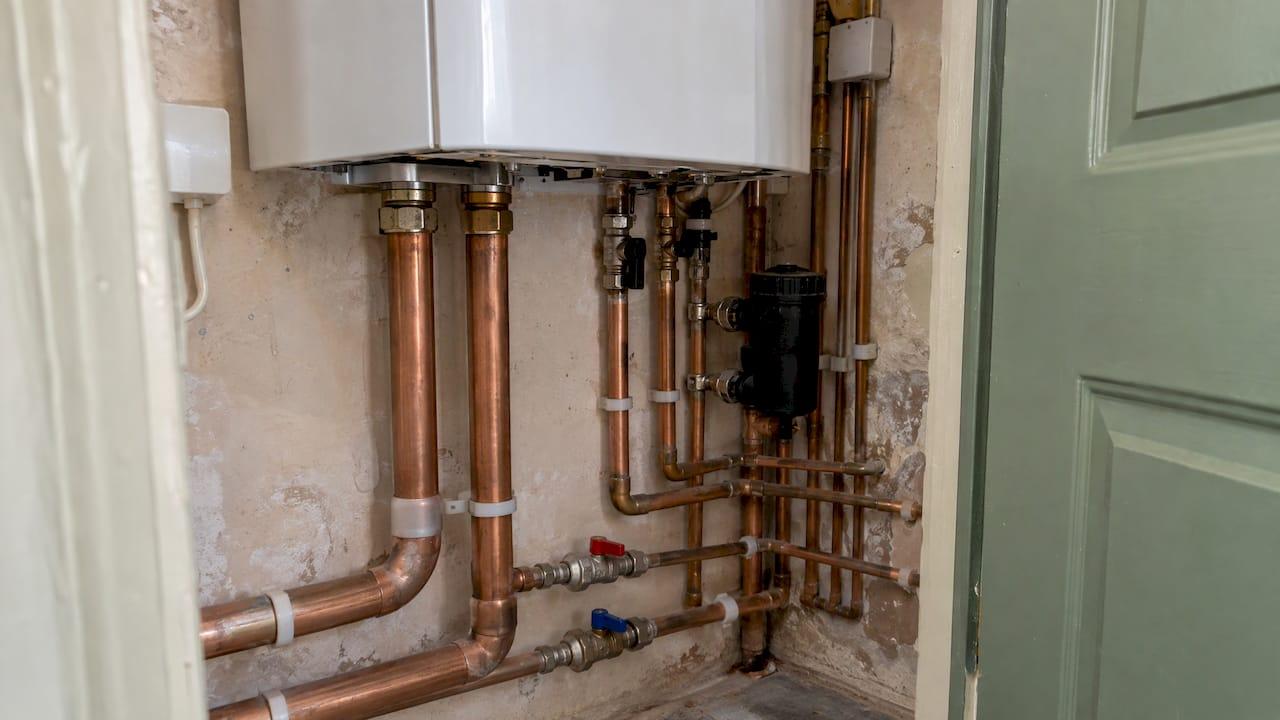
Microbore is any heating pipe narrower than 15mm, usually 8mm or 10mm copper, while standard pipe in a UK home is 15mm for radiator tails and hot and cold supplies, with 22mm for the main runs. The difference matters because narrow pipe clogs with sludge more easily and has less flow to spare, so a microbore system needs cleaner water and more careful design. If your radiators heat unevenly, or an engineer has mentioned microbore, this guide explains what you have and what to do about it.
TL;DR
- Microbore means 6mm, 8mm or 10mm soft copper. 15mm is a standard size, not microbore.
- Microbore systems run from a manifold, a distribution block that splits the flow, and they block more easily with sludge and limescale than 15mm pipework.
- Pipe sizes in the UK describe the outside diameter, so a 15mm pipe has a bore of about 13.6mm.
- Microbore can work well on smaller homes with clean, inhibited water. It is usually the first suspect when only some radiators stay cold.
- A heating engineer can identify your pipework in a single visit and tell you whether to keep, flush or replace it.
Table of Contents
- What microbore actually is
- Pipe sizes: why 15mm is not microbore
- How they behave: flow, heat and noise
- Sludge, limescale and kinks
- How to tell which pipe you have
- Keep it, flush it or replace it?
- A word on microbore and standard pipe in your own area
- Getting your heating looked at
- FAQ
- Sources
What microbore actually is
Microbore pipework is pipe with a diameter of less than 15mm. In practice that means 8mm and 10mm soft copper, supplied in coils and bent by hand around joists and through stud walls. It was popular in the 1970s and 1980s for its affordability, flexibility and ease of installation, and the same source estimates it is still present in about 4 to 5 million UK homes.
A typical layout looks like this. Normal 22mm pipes leave the boiler and feed a manifold. From that manifold, 8mm or 10mm pipes run out to each radiator, usually with the manifold within about 5 metres of the radiators it serves. Every radiator gets its own flow and return pipe, so the system is always a two-pipe arrangement. Many microbore radiators also use twin-entry valves with a 10mm spreader pipe inside the radiator.
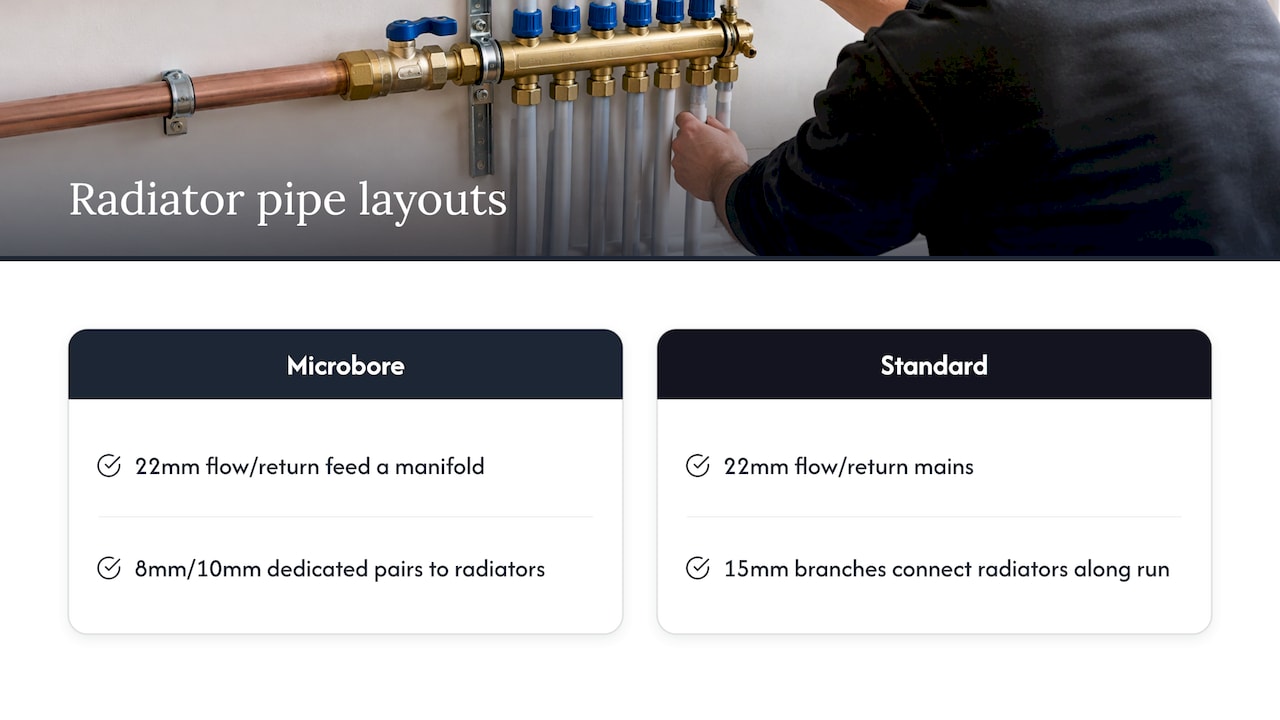
A standard system uses 15mm pipes branching from larger 22mm flow and return mains. Radiators are connected along the run rather than each having a dedicated pair of pipes back to a central point.
Pipe sizes: why 15mm is not microbore
This is the question people most often get wrong. British copper tube is metric and is measured on the outside diameter. The smallest sizes, 6mm, 8mm and 10mm, are the microbore range. 15mm is the standard size for hot and cold supplies and radiator tails, the short pieces that connect a radiator to the pipework.
Because the figure is the outside measurement, the actual waterway is smaller. Copper tube for water and heating is made to BS EN 1057, and the supplier data shows 15mm pipe has a 0.7mm wall and a bore of about 13.6mm, while 22mm pipe has a 0.9mm wall and a bore of about 20.2mm.
| Pipe (outside diameter) | Typical use | Approximate bore |
|---|---|---|
| 8mm | Microbore to radiators | 6.8mm |
| 10mm | Microbore to radiators | 8.8mm |
| 15mm | Radiator tails, hot and cold supply, standard heating branches | 13.6mm |
| 22mm | Main flow and return, microbore trunk lines | 20.2mm |
The 8mm and 10mm bores come from a pipe sizing guide; the 15mm and 22mm figures come from the supplier data above.
To put that in perspective, a 22mm pipe has roughly twice the bore of a 15mm pipe, so it carries far more water over the same distance for the same pressure drop. A 10mm microbore pipe has a waterway under two thirds the width of a 15mm one, and the cross-sectional area falls much faster than the width does.
Older houses may also have imperial sizes. A half-inch steel pipe is about 21.3mm across, which is why a half-inch measurement can mislead you if you are comparing it with a metric copper size. If you want a primer on the vocabulary engineers use, our guide to plumbing terminology covers it.
How they behave: flow, heat and noise
Water has to move fast enough to carry heat and keep debris suspended, but not so fast that it makes noise or wears the pipe. The Energy Saving Trust's heat pump installer toolkit says flow velocity in heating pipework should stay within 0.5 to 1.5 m/s, with best practice around 0.9 to 1.0 m/s. Its worked example shows the same 0.062 l/s flow running at 1.04 m/s in a 10mm final metre of pipe but only 0.42 m/s in 15mm.
That single comparison explains most of the character of microbore:
- Narrow pipe, higher velocity. Water speeds up and the pump has to work harder against friction. Microbore pipe means increased pump resistance and wear compared with larger pipe.
- Wider pipe, slower water. Pipe diameter is a trade-off: too large and sluggish flow lets sludge settle, too small and you can get poor delivery and flow noise. The recommended velocity range in that copper industry guidance is 0.3 to 1.5 m/s.
- Less water in the system. Microbore systems hold less water, so a smaller-capacity boiler can be used, and the reduced pipe surface area means less heat loss.
- Natural balance. Because each radiator has its own run from the manifold, a microbore system is generally well balanced by design, with a trunk and branch layout of 22mm and 10mm or 8mm pipes.
The flip side is capacity. A single narrow branch has limited power throughput of about 2.5kW, which suits most bedrooms and living rooms but not a very large radiator or a long run. That is why microbore is only suitable for smaller domestic properties: longer runs add frictional resistance, and the available flow is limited unless more manifolds are used.
Sludge, limescale and kinks
The real-world weak point of microbore is not the pipe itself but what travels through it. Narrow bores clog sooner, so microbore is more vulnerable to sludge. In hard water areas, limescale can build up in circulating pipework and especially affects microbore, so a suitable additive or water-softening device is essential. Pipe that has been kinked during installation can impede flow and give sludge somewhere to collect.
The usual symptoms are:
- one or two radiators staying cold while the rest work normally;
- a radiator that is hot at the top and cold at the bottom, or cold in patches;
- the boiler cycling or the pump sounding strained (see our guide to a noisy central heating pump);
- radiators that take far longer to warm than they used to.
Not every cold radiator means a blocked microbore pipe. Trapped air is a far more common cause and takes ten minutes to rule out, as described in our guide to bleeding radiators. If bleeding does not help, our central heating troubleshooting guide walks through the next checks.
How to tell which pipe you have
You do not need tools to get a first answer, but be careful and never open a valve or fitting on a sealed system yourself.
- Follow the pipes from a radiator. Thin, flexible-looking pipes that disappear into the floor or wall, one pair per radiator, point to microbore. Thicker pipes that continue along the wall to the next radiator point to a standard layout.
- Look for a manifold. Microbore pipes meet at a manifold, often under floorboards, in an airing cupboard or near the boiler. The mains feeding it are up to 28mm. Adding a radiator means an unused port or a new manifold.
- Check the valves. Twin-entry valves, a single valve body with two connections at one end of the radiator, are common on microbore.
- Measure a bare, straight length. Wrap a strip of paper round the pipe away from fittings, lagging or paint. A circumference of about 47mm means 15mm pipe, about 31.4mm means 10mm and about 25.1mm means 8mm, as set out in this pipe measuring guide.
If you are unsure, a visit from a heating engineer settles it quickly, and the pipe type then shapes every decision about repair or replacement.
Keep it, flush it or replace it?
Microbore is not automatically a fault. With clean, inhibited water and a sensible layout it can serve a smaller home for years. Here is how to think about each option.
Keep it when the system heats evenly, the water is treated with an inhibitor and nothing has been altered. The inhibitor matters: the corrosion protection in the water is what stops the narrow pipes silting up.
Clean it when the symptoms point to sludge. A cleaning flush clears the circuit, and an engineer will often fit a magnetic filter afterwards to catch debris before it reaches narrow pipes.
Replace sections or all of it when pipes are kinked, leaking, repeatedly blocking or too limited for the radiators you want. For new installations, 15mm is the recommended size for radiator tails unless the system has been specifically designed for microbore, because 10mm or 8mm pipe has a higher pressure drop and is more prone to blockage from sludge. Replacing a boiler is also a natural moment to review the pipework, since a new boiler is only as good as the circuit it feeds. Our guide to central heating repair costs explains what drives the price.
Planning a heat pump
If a heat pump is in your future, microbore is not a bar. Mitsubishi Electric's technical white paper found that, with correct design, heat pumps can be integrated with existing microbore systems by matching flow temperature and the temperature difference (ΔT) across the radiators. Its modelling suggested a ΔT of 10°C may be enough for a typical renovated microbore house, while 20°C allowed the whole house to be heated on microbore. It also advises checking the microbore for damage, leaks or blockages first, and cites limits of 350 Pa per metre and 1 m/s.
In a well-insulated home with radiators of around 700W, trade press reports that 10mm copper can work with a heat pump, while 10mm plastic is likely to be a problem because its smaller internal diameter raises pressure loss and noise. The same article makes the case for calculating heat loss, flow rates and velocities rather than relying on generic schematics. One industry voice argues microbore is not inherently problematic: it is small, flexible and cheap.
If you want to know whether copper or plastic suits your repair, see our comparison of copper vs plastic pipes and our overview of plumbing materials.
A word on microbore and standard pipe in your own area
Homes built or extended in the 1970s and 1980s across Reading, Newbury, Bracknell, Basingstoke, Swindon and Milton Keynes are the likeliest to have microbore somewhere in the system, often in a loft or under a ground floor. Newer builds and later extensions are more likely to be plumbed in 15mm, so a house can easily have both. Mixed systems are normal, and an engineer will tell you where the changeover sits.
What we think
Most calls we get about cold radiators are not about the pipe size. They are about water that has not been looked after. Whether you have 8mm, 10mm or 15mm pipework, the first question is the same: is the system clean and protected?
Our view is that you should know what is in your walls before you decide anything. If it is microbore and it works, keep it and keep the water treated. If it is blocking, fix the cause rather than just the symptom. We work on heating faults and boiler installations, and we price them openly: heating and boiler work is £110 per hour, with no call-out fee and a no fix no fee guarantee.
That matters with pipework, because diagnosis is the job. You should pay only once the work is done and the radiators are hot.
Michael
Getting your heating looked at
Our engineers cover heating repairs and boiler work across Reading, Newbury, Oxford, Bristol and the surrounding towns. Heating and boiler work is charged at £110 per hour, there is no call-out fee, and you pay only after successful work. Repairs carry a 12-month warranty, and you speak directly to the engineer. For a heating or hot water emergency we aim to arrive within 60 minutes.

If the pipework points to a new boiler, we supply and fit boilers from £1,300, with a free on-site quote first. Book a heating or boiler visit or request a new boiler quote.
FAQ
Is 15mm pipe microbore?
No. Microbore is the 6mm, 8mm and 10mm range of soft copper. 15mm is a standard size used for radiator tails and hot and cold supplies. Because UK pipe sizes are outside measurements, a 15mm pipe has a bore of about 13.6mm.
Can I connect microbore to 15mm pipe?
Yes, mixed systems are common. Reducing fittings join 8mm or 10mm pipe to 15mm, and many systems use 22mm trunks into a manifold and microbore beyond it. The joint is simple, but how the whole circuit flows depends on pipe lengths and radiator sizes, so a heating engineer should make changes.
Is microbore bad?
Not in itself. It uses less water, loses less heat and can be well balanced, and it suits smaller homes. Its sensitivity is to sludge and limescale, so treated water and a magnetic filter keep it working as designed.
Why is one radiator cold when others are hot?
Trapped air is the most common cause, so bleed the radiator first. If it stays cold, a blockage or a kink in the pipe to that radiator is a likely cause, especially on microbore. A heating engineer can trace which it is.
Sources
- Microbore Heating Systems, Sava
- Residential Air Source Heat Pumps and Microbore Pipework, Mitsubishi Electric
- Copper Pipe Sizes UK: Nominal Diameters and Common Uses
- Copper Pipe / Tube, Metric Sizes 4mm to 54mm
- Domestic Plumbing Pipe Sizes: 15mm, 22mm, 28mm Guide
- 15mm vs 22mm Pipe: Which Size for Showers, Baths & Heating?
- How to Measure Pipe Size (UK): 15 mm, 22 mm and More
- How to make microbore pipes work, Energy Saving Trust
- Copper in Small Bore Heating Systems
- Central heating design, DIYWiki
- Basic water central heating, radiator pipework
- Identifying Central Heating Systems by Pipework
- Microbore pipe and heat pumps, Installer Online
- Don't bore on about noisy microbore, elemental